



| HEADLINE |

|

AI Set to reshape the future of Education and research
Published : Monday, 12 October, 2026 at 12:00 AM
Mohammad Mosharraf Hossain


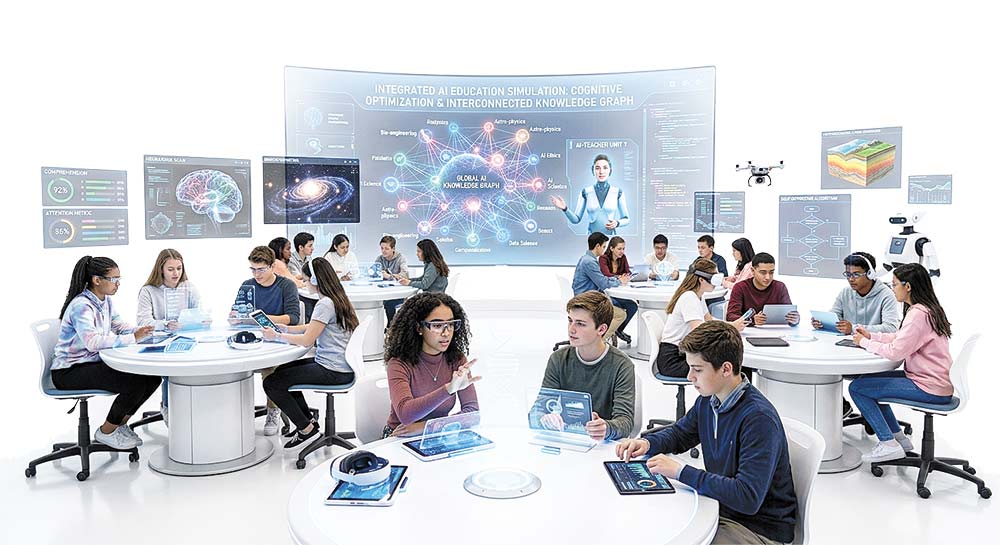 One of the greatest opportunities of AI in education is personalized learning. Students learn in different ways and at different speeds. In a traditional classroom, it can be difficult for teachers to meet every student’s individual needs and address their weaknesses Mohammad Mosharraf Hossain It is widely recognized that Artificial Intelligence (AI) is no longer a concept of the future. Today, it has become an essential part of daily life. AI significantly influences how people work, communicate, and learn. Its impact can be seen in healthcare, business, transportation, and entertainment as well. Recently, education and research have been among the fields undergoing significant changes. At present, AI is bringing changes to the way students learn, teachers teach, and researchers conduct their work. While AI offers many benefits, it also raises concerns. These concerns include creativity, critical thinking, and academic integrity. Therefore, AI should support human intelligence rather than replace it.
One of the greatest opportunities of AI in education is personalized learning. Students learn in different ways and at different speeds. In a traditional classroom, it can be difficult for teachers to meet every student’s individual needs and address their weaknesses. In this situation, AI can help solve the problem if it is used effectively and appropriately. It can easily analyze learning patterns and provide customized support. Students can receive instant feedback and learn at their own pace. This makes learning more effective and user-friendly.
Educational institutions should promote AI literacy so that students can understand both the benefits and limitations of these technologies. In today’s world, simply using AI tools is not enough; students should also understand how these systems work and how they influence learning and decision-making.
AI literacy can help students become more aware of the opportunities and challenges associated with artificial intelligence. It can help them understand that AI systems are not always perfect and may sometimes provide inaccurate or biased information. Therefore, learners should develop the ability to question, analyze, and evaluate AI-generated content instead of accepting it blindly.
In addition, understanding AI can encourage the responsible and ethical use of technology while improving critical thinking and problem-solving skills. Schools and universities should create opportunities for students to learn about AI through discussions, workshops, and practical experiences. This will not only help students use AI more effectively but also prepare them to become responsible and informed individuals in an increasingly technology-driven world.
Artificial Intelligence has brought significant innovation to the field of research. Researchers spend a lot of time collecting information and analyzing data. AI can enormously reduce this workload through optimizing functions. It can process large amounts of data quickly. It can also summarize research papers and identify useful patterns. This allows researchers to focus more on innovation and problem-solving.
According to a study, AI use in research is rapidly increasing. Many researchers use AI for writing support, data analysis, and idea generation. AI helps save time as well as enhances the productivity of its users. Moreover, some researchers express their concern that extreme dependence on AI may reduce the originality and creativity of articulating thoughts.
This concern is by no means unfounded given the overall circumstances. The purpose of education goes beyond finding correct answers. It aims to develop critical thinking, curiosity, and the ability to challenge ideas. If students become overly dependent on AI, they may lose essential thinking skills and become passive consumers rather than active problem-solvers.
Outlining Academic integrity is another important issue. AI-generated work may create risks of plagiarism. Some students and researchers may submit work with little personal effort. This can minimize the value of genuine learning. AI systems can also make mistakes. They may provide false information or biased results. So, human judgment is still necessary.
Creativity may also be affected by overdependence on AI. Human creativity comes from emotions, experiences, and curiosity. AI can generate ideas, but it does not have real-life experiences. Too much dependence on AI may pose a threat to our originality and limit independent thinking.
The burning issue is not whether AI should be used or not. Rather, the real phenomenon is how it should be used responsibly. Schools and universities should employ clear guidelines concerning the appropriate usage of AI. Students ought to realize that AI is nothing more than a helper, and it should be viewed as an assistant tool that lacks human emotions and consciousness. Researchers should engage in discussions pertaining to the positive and negative aspects of AI, and how to make the best use of it with honesty and morality .
Obviously, AI in the future may bring further innovative features and ideas, equipped with advanced algorithmic systems and operating methods. There will be a vast revolution in teaching and learning methodologies, as well as the accuracy of research. To keep pace with the development of AI, we must extend the horizon of our thoughts by discovering our dormant power of productivity. It should be remembered that we created AI utilizing our own intelligence, relentless efforts, original cognition, and the ultimate development of our creativity.
The writer is a student, University of Chittagong

Loading...
Loading...
Also read



Editor : Iqbal Sobhan Chowdhury
Published by the Editor on behalf of the Observer Ltd. from Globe Printers, 24/A, New Eskaton Road, Ramna, Dhaka.
Editorial, News and Commercial Offices : Aziz Bhaban (2nd floor), 93, Motijheel C/A, Dhaka-1000.
Phone: PABX- 41053001-06; Advertisement: 41053012; 01793317829, 01550707291, E-mail: [email protected], [email protected] Online: email: [email protected] 41053014; 01550707297 Advertisement: 01550707296
Published by the Editor on behalf of the Observer Ltd. from Globe Printers, 24/A, New Eskaton Road, Ramna, Dhaka.
Editorial, News and Commercial Offices : Aziz Bhaban (2nd floor), 93, Motijheel C/A, Dhaka-1000.
Phone: PABX- 41053001-06; Advertisement: 41053012; 01793317829, 01550707291, E-mail: [email protected], [email protected] Online: email: [email protected] 41053014; 01550707297 Advertisement: 01550707296


