



| HEADLINE |

|
Bangladesh may lose $1b in revenue from tariff cuts ahead of LDC graduation
Published : Wednesday, 9 September, 2026 at 12:00 AM
Business Correspondent


 Bangladesh could face a revenue loss of nearly $1 billion if it reduces tariffs as part of preparations for its graduation from the least developed country (LDC) category. However, tariff reforms could enhance the competitiveness of domestic industries and make it easier for the country to negotiate free trade agreements (FTAs) with different countries.
Economists and analysts said the short-term loss in government revenue could be offset by long-term economic gains. They said improved competitiveness and greater access to FTAs could create opportunities for an additional $4 billion in value addition to the economy.
However, some analysts cautioned that the issue was not as straightforward as it might appear.
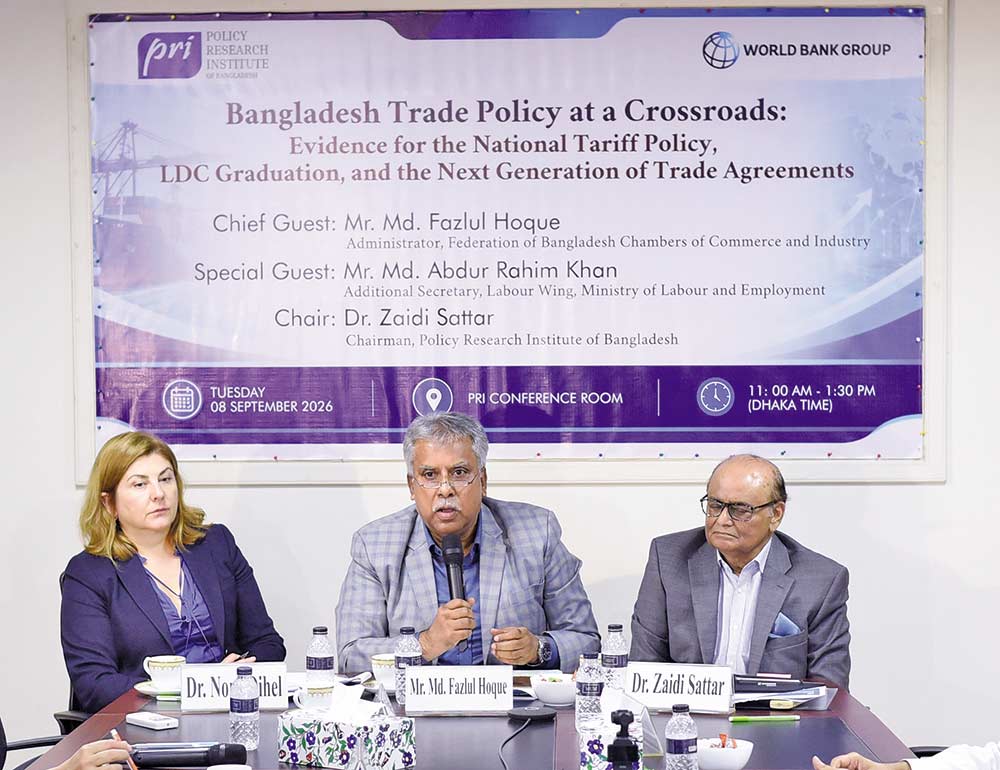
The observations came at a seminar jointly organised by the Policy Research Institute of Bangladesh (PRI) and the World Bank in Banani, Dhaka, on Tuesday.
The seminar, titled “Bangladesh at the Crossroads of Trade Policy: National Tariff Policy, LDC Graduation and the Next Generation of Trade Agreements,” was held at the PRI office.
World Bank economist Nora Diehl presented the keynote paper at the seminar. According to the paper, Bangladesh’s average nominal tariff rate is around 15 percent. However, the overall tariff burden rises to more than 22 percent when supplementary duties and regulatory duties are taken into account.
The paper noted that reducing these tariffs could lead to a decline in government revenue in the short term, although the country could reap benefits over the longer term.
Speaking at the discussion, CPD Distinguished Fellow Fahmida Khatun said the projection of an additional $4 billion in value addition from free trade was ambitious.
“Bangladesh will have to make the necessary preparations and build adequate capacity to achieve such a target,” she said.
SANEM Executive Director Selim Raihan said protectionist trade policies were gaining momentum globally amid geopolitical tensions.
“There is no need to rush into tariff reductions under the current circumstances. Reforms should be carried out gradually, taking the changing global situation into account,” he said.
Business leaders also expressed concern that tariff reductions could hurt small and medium-sized enterprises (SMEs) and domestic industries.
Metropolitan Chamber of Commerce and Industry (MCCI) President Kamran T Rahman said many small and medium-sized factories could be forced to shut down if tariffs were reduced abruptly.
“This could lead to lower employment and rising unemployment,” he warned.
PRI Chairman Zaidi Sattar said a country like Bangladesh should ideally have an average tariff rate of around 7 percent. However, the effective rate remains much higher because of various duties imposed on imports.
“Unless tariffs are reduced, the competitiveness of domestic industries will not improve,” he said.
As the chief guest, FBCCI Administrator Md Fazlul Hoque said small businesses were concerned about Bangladesh’s LDC graduation and the prospect of entering into FTAs.
He stressed the need to consult small businesses before negotiating and signing new trade agreements.
The speakers at the seminar said tariff reforms could help improve the competitiveness of domestic industries, while abrupt tariff reductions could expose some local businesses to serious challenges.
They called for a gradual and well-planned reform of the tariff structure, taking into account the interests of domestic industries, employment, government revenue and Bangladesh’s post-LDC trade prospects.
Loading...
Loading...
Also read



Editor : Iqbal Sobhan Chowdhury
Published by the Editor on behalf of the Observer Ltd. from Globe Printers, 24/A, New Eskaton Road, Ramna, Dhaka.
Editorial, News and Commercial Offices : Aziz Bhaban (2nd floor), 93, Motijheel C/A, Dhaka-1000.
Phone: PABX- 41053001-06; Advertisement: 41053012; 01793317829, 01550707291, E-mail: [email protected], [email protected] Online: email: [email protected] 41053014; 01550707297 Advertisement: 01550707296
Published by the Editor on behalf of the Observer Ltd. from Globe Printers, 24/A, New Eskaton Road, Ramna, Dhaka.
Editorial, News and Commercial Offices : Aziz Bhaban (2nd floor), 93, Motijheel C/A, Dhaka-1000.
Phone: PABX- 41053001-06; Advertisement: 41053012; 01793317829, 01550707291, E-mail: [email protected], [email protected] Online: email: [email protected] 41053014; 01550707297 Advertisement: 01550707296


