



| HEADLINE |

|
High import, low export deepen trade hole
Published : Wednesday, 9 September, 2026 at 12:00 AM
Shamsul Huda


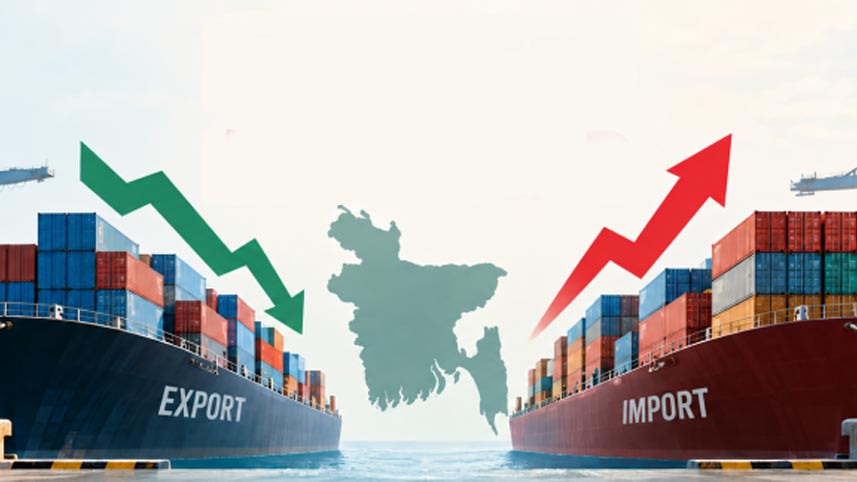 The new financial year started with a warning sign for country’s external sector: imports are rising while exports are falling. As a result, the trade deficit widened sharply in July, raising questions about whether the economic recovery is strong enough to generate higher export earnings.
According to Bangladesh Bank (BB) data, the merchandise trade deficit rose 38.4 per cent year-on-year to $2.09 billion in July, from $1.51 billion a year earlier.
The main reason was a clear mismatch between imports and exports. Imports rose 8.6 per cent to $6.44 billion, while exports fell 1.6 per cent to $4.35 billion.
In simple terms, Bangladesh bought more from abroad but earned less by selling goods overseas. The difference between the two sides increased by nearly $580 million in just one month compared with July last year.
The July figures are worrying because they follow a difficult FY26. During the last financial year, the trade deficit increased to $27.29 billion, from $20.40 billion in FY25. Imports rose 10.5 per cent to $71.14 billion, while exports slipped 0.2 per cent to $43.86 billion.
So, the July figures do not look completely isolated. They suggest that the imbalance seen in FY26 has continued into the new fiscal year.
The export side remains the bigger concern. Bangladesh's main export industry, readymade garments, earned $3.89 billion in July, down 1.9 per cent from a year earlier. RMG alone accounted for almost 90 per cent of merchandise exports during the month.
This heavy dependence makes Bangladesh vulnerable to weaker demand in major markets and changes in global sourcing.
The rise in imports, however, is not necessarily bad news. If businesses are importing capital machinery, industrial raw materials, fuel and other productive goods, higher imports can be a sign that economic activity is picking up.
Bangladesh Bank data from FY26 showed capital machinery imports increased 13.8 per cent to $3.21 billion. If this trend continues and businesses invest more, today's higher imports could eventually support production and exports.
But the immediate concern is that exports have not yet responded. A senior Bangladesh Bank official said rising imports should not automatically be seen as negative because much of the increase is linked to essential and productive goods. At the same time, the official acknowledged that the widening gap between imports and exports remains a challenge for the external sector.
There is one strong support for the economy: remittances. Bangladesh received $2.86 billion in remittances in July, up 15.4 per cent from $2.48 billion a year earlier. Remittances also reached a record $35.5 billion in FY26, rising 17.3 per cent from FY25.
The financial account also remains important, as stronger foreign-currency inflows are needed to offset pressure from the trade deficit.
Overall, the balance of payments remains under pressure, with the wider trade gap keeping the external position negative despite strong remittances and other inflows.
This strong flow of foreign currency is helping cushion the widening trade deficit, another senior BB official said.
Loading...
Loading...
Also read



Editor : Iqbal Sobhan Chowdhury
Published by the Editor on behalf of the Observer Ltd. from Globe Printers, 24/A, New Eskaton Road, Ramna, Dhaka.
Editorial, News and Commercial Offices : Aziz Bhaban (2nd floor), 93, Motijheel C/A, Dhaka-1000.
Phone: PABX- 41053001-06; Advertisement: 41053012; 01793317829, 01550707291, E-mail: [email protected], [email protected] Online: email: [email protected] 41053014; 01550707297 Advertisement: 01550707296
Published by the Editor on behalf of the Observer Ltd. from Globe Printers, 24/A, New Eskaton Road, Ramna, Dhaka.
Editorial, News and Commercial Offices : Aziz Bhaban (2nd floor), 93, Motijheel C/A, Dhaka-1000.
Phone: PABX- 41053001-06; Advertisement: 41053012; 01793317829, 01550707291, E-mail: [email protected], [email protected] Online: email: [email protected] 41053014; 01550707297 Advertisement: 01550707296


