



| HEADLINE |

|

The ‘Bangla Tesla’ Paradox: A Class Story on Dhaka’s Roads
Published : Sunday, 13 September, 2026 at 12:00 AM
Sayma Sultana


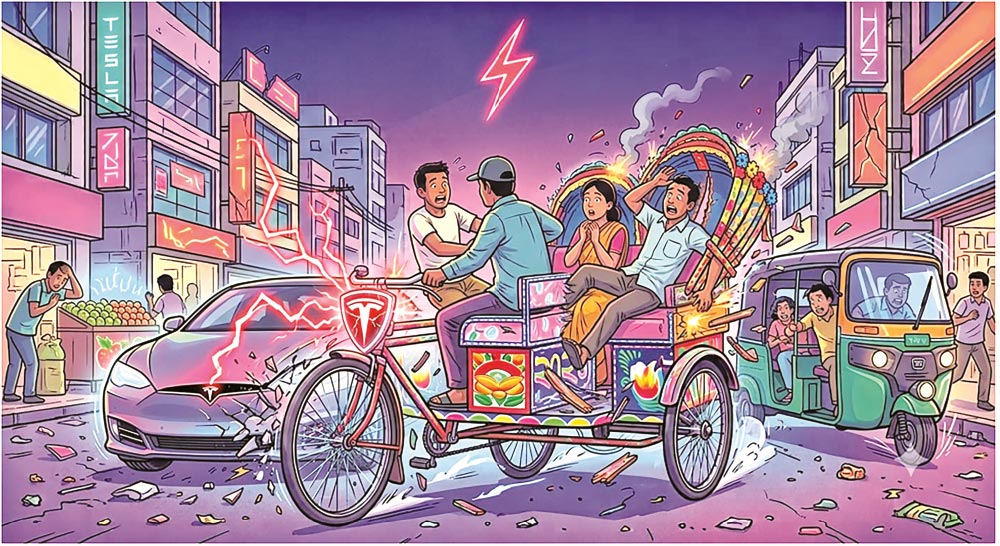
 Dhaka has found its newest villain, and it comes with three wheels, a battery and a nickname: the “Bangla Tesla”. It cuts through traffic, slips between buses and cars, appears where it is not supposed to be and turns every journey into a negotiation with chaos. For the city’s commuters and motorists, it has become a symbol of disorder. But perhaps the more revealing question is not why the Bangla Tesla is everywhere. It is why so many people have no better place to go.
That question matters because the vehicle is not merely a machine on the road. It is also part of Bangladesh’s informal economy, a source of livelihood and, for many workers, one of the few accessible forms of employment available to them.
A January 2026 study of Dhaka’s rickshaw sector found that 97.4 per cent of battery-powered rickshaws were operating outside formal registration systems. Around 75 per cent of battery-rickshaw drivers were newcomers who had never previously driven pedal rickshaws. This suggests something important: we are not simply witnessing the technological transformation of the rickshaw. We are also witnessing a transformation of the labour force, as people enter this occupation because it offers an accessible way to earn an income.
The criticism of battery-powered rickshaws is legitimate. They raise genuine concerns about road safety, regulation, electricity management and urban planning. A 2026 study reported that around 30 per cent of passengers using battery-powered rickshaws had experienced accidents. Drivers may lack adequate training, vehicles often remain unregistered and charging facilities frequently operate outside a regulated system. But statistics can describe the size of a problem without explaining its birth.
For that, we have to look away from the road and towards the labour market. Between January 2024 and March 2025, 113 garment factories reportedly closed, affecting more than 96,000 workers. Although new factories created jobs during the same period, the number of jobs lost still exceeded those created. Thousands more workers reportedly lost employment through layoffs and retrenchment in 2025.
 These figures do not prove that unemployed garment workers simply became battery-rickshaw drivers. They reveal something broader: a formal economy struggling to absorb everyone who needs work. When the formal economy cannot absorb labour, labour does not disappear. It finds another form. People drive rickshaws, deliver parcels, sell food, carry goods and work by the day. The battery rickshaw fits naturally into this world because its barriers to entry are relatively low. For someone with limited education, savings or professional connections, it offers something the formal economy often cannot: the possibility of earning immediately. This is where the old vocabulary of Marx acquires an unexpected presence on the streets of contemporary Dhaka.
Marx broadly distinguished between those who control capital and the means of production and those who possess little beyond their labour to sell. Bangladesh cannot simply be reduced to nineteenth-century European class categories. Our economy is more complex and our labour market more fragmented. Yet one fundamental question remains: what happens to those who possess their labour but little else to sell? Perhaps the battery-rickshaw driver is one of the modern faces of that question. The person sitting inside a private car experiences the Bangla Tesla as an obstruction. The person driving it experiences the same vehicle as rent, food, school fees and survival. One sees a disruption of movement; the other sees movement towards livelihood.
The same road contains two different realities. This is where Antonio Gramsci’s idea of cultural hegemony becomes useful. The worldview of dominant groups can become so deeply embedded in everyday life that it begins to appear as ordinary “common sense”. Consider the language of the debate. Battery rickshaws cause congestion. They are dangerous. They are illegal. They should be removed from major roads. These statements may contain truth. But they define the problem largely from the perspective of the person who has the power to demand a different road. What remains outside that definition is the question of why so many workers entered this occupation in the first place.
Perhaps that is the class blindness of the conversation: we see the inconvenience produced by poverty more readily than we see the poverty producing the inconvenience. This does not mean that every private-car owner is a villain or every battery-rickshaw driver is a victim. Poverty is not an exemption from traffic laws. Pedestrians and passengers deserve safety, motorists deserve predictable roads and drivers themselves deserve safer vehicles and working conditions. But class determines something morality alone cannot explain: whose problems become visible, whose voices carry weight and whose suffering is allowed to remain ordinary.
This is why the solution cannot be limited to removing vehicles from the roads. Registration, driver training, safety standards, route management and regulated charging are necessary. But these measures address the transport system. The larger question belongs to the labour market: what happens to the worker when his informal livelihood is taken away?
I do not claim to have a complete answer. That question belongs to economists, policymakers, urban planners, labour experts and political leaders. My purpose is more modest. I am simply asking that we look at the problem from the other side of the windshield. From inside a private car, the Bangla Tesla may look like an invasion of disorder. From behind its steering handle, it may look like the last available defence against unemployment. Perhaps both views are true. But only one is usually powerful enough to shape the conversation.
That is what makes the Bangla Tesla more than a transport controversy. It is a small, moving theatre of class relations. The driver sees a livelihood. The passenger sees a cheap ride. The car owner sees an obstruction. The policymaker sees an administrative problem. And beneath all these competing visions lies the economic system that made them collide on the same road.
The Bangla Tesla did not create that contradiction. It merely made it visible. Perhaps, before we ask how to remove the vehicle, we should ask why the working poor had to depend on it. And before those of us with the privilege to complain about the symptom raise our voices again, perhaps we should ask whether we are willing to use that same voice to question the system that produced it. Because sometimes the most revealing thing about a social problem is not the thing everyone is complaining about. It is the thing almost nobody with the power to change it is asking about.
The writer is a development communication professional

Loading...
Loading...
Also read



Editor : Iqbal Sobhan Chowdhury
Published by the Editor on behalf of the Observer Ltd. from Globe Printers, 24/A, New Eskaton Road, Ramna, Dhaka.
Editorial, News and Commercial Offices : Aziz Bhaban (2nd floor), 93, Motijheel C/A, Dhaka-1000.
Phone: PABX- 41053001-06; Advertisement: 41053012; 01793317829, 01550707291, E-mail: [email protected], [email protected] Online: email: [email protected] 41053014; 01550707297 Advertisement: 01550707296
Published by the Editor on behalf of the Observer Ltd. from Globe Printers, 24/A, New Eskaton Road, Ramna, Dhaka.
Editorial, News and Commercial Offices : Aziz Bhaban (2nd floor), 93, Motijheel C/A, Dhaka-1000.
Phone: PABX- 41053001-06; Advertisement: 41053012; 01793317829, 01550707291, E-mail: [email protected], [email protected] Online: email: [email protected] 41053014; 01550707297 Advertisement: 01550707296


