



| HEADLINE |

|
Battery-run rickshaws roam roads despite major drives
Published : Sunday, 13 September, 2026 at 12:00 AM
Tanvir Raihan


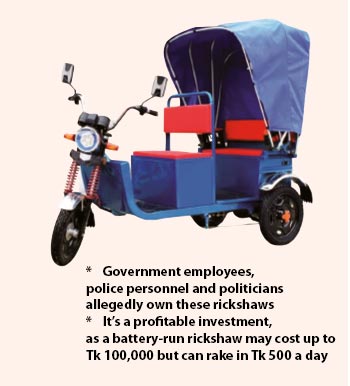 Despite regular drives against battery-run auto-rickshaws in Dhaka, the illegal three-wheelers continue to proliferate across the capital, raising questions about whether enforcement focused mainly on drivers can actually address the problem.
Drivers are being detained, fined and, in some cases, their vehicles seized. But those who finance the vehicles, operate garages and supply them to drivers often remain beyond the immediate enforcement net, according to field-level findings.
As a result, arresting or fining one driver does little to reduce the supply of vehicles. When one driver is removed, another can take his place, while new auto-rickshaws continue to emerge from garages across the city.
A recent field investigation in Jatrabari, Mugda, Manda, Maniknagar, Khilgaon, Sabujbagh, Banasree and Rampura found a large network of garages storing and operating battery-run auto-rickshaws.
Local sources estimated that nearly 4,000 garages operate in these areas, with more than 240,000 auto-rickshaws under their control. However, there is no consolidated government data available to independently verify these figures.
The investigation also found that the business is no longer limited to garage owners. Garage operators and drivers said house owners, businessmen and people from various professional backgrounds are investing in auto-rickshaws.
Some alleged that government employees, police personnel and politicians are also involved as investors, although these claims could not be independently verified.
The financial incentive is significant. Garage operators said a battery-run auto-rickshaw can cost between Tk70,000 and Tk100,000 to build. It can then be rented to a driver for around Tk500 a day.
At that rate, an owner can earn about Tk15,000 a month, or Tk180,000 a year, in rental income. The relatively low initial investment and steady rental return have made the business attractive to investors, according to people involved in the trade.
Mehedi, a garage owner in Maniknagar, said the nature of the business had changed in recent years.
“Previously, garage owners largely controlled the business. Now people from different professions are investing in auto-rickshaws because the returns are high,” he said.
Another garage owner, Abdullah, said the business had increasingly moved into the hands of relatively affluent people.
“Many house owners have one or two auto-rickshaws. Government employees and police personnel also own such vehicles,” he said.
Drivers, meanwhile, said most of them did not own the vehicles they operated. They took the auto-rickshaws from owners in exchange for paying a fixed daily rental. This arrangement, they said, means that drivers face enforcement action while the actual owners can remain unidentified.
Associate Professor Dr Touhidul Haque of the Institute of Social Welfare and Research at Dhaka University said the capital behind the rapid expansion of battery-run auto-rickshaws was not coming solely from marginal drivers.
“There is significant investment from affluent sections of society,” he said, adding that influential financiers give drivers the confidence to operate the vehicles in violation of traffic rules.
Loading...
Loading...
Also read



Editor : Iqbal Sobhan Chowdhury
Published by the Editor on behalf of the Observer Ltd. from Globe Printers, 24/A, New Eskaton Road, Ramna, Dhaka.
Editorial, News and Commercial Offices : Aziz Bhaban (2nd floor), 93, Motijheel C/A, Dhaka-1000.
Phone: PABX- 41053001-06; Advertisement: 41053012; 01793317829, 01550707291, E-mail: [email protected], [email protected] Online: email: [email protected] 41053014; 01550707297 Advertisement: 01550707296
Published by the Editor on behalf of the Observer Ltd. from Globe Printers, 24/A, New Eskaton Road, Ramna, Dhaka.
Editorial, News and Commercial Offices : Aziz Bhaban (2nd floor), 93, Motijheel C/A, Dhaka-1000.
Phone: PABX- 41053001-06; Advertisement: 41053012; 01793317829, 01550707291, E-mail: [email protected], [email protected] Online: email: [email protected] 41053014; 01550707297 Advertisement: 01550707296


