



| HEADLINE |

|
Growth Slows, Banks Bleed: Bangladesh’s Recovery Faces a New Test
Published : Monday, 14 September, 2026 at 12:00 AM
Faruk Ahmed


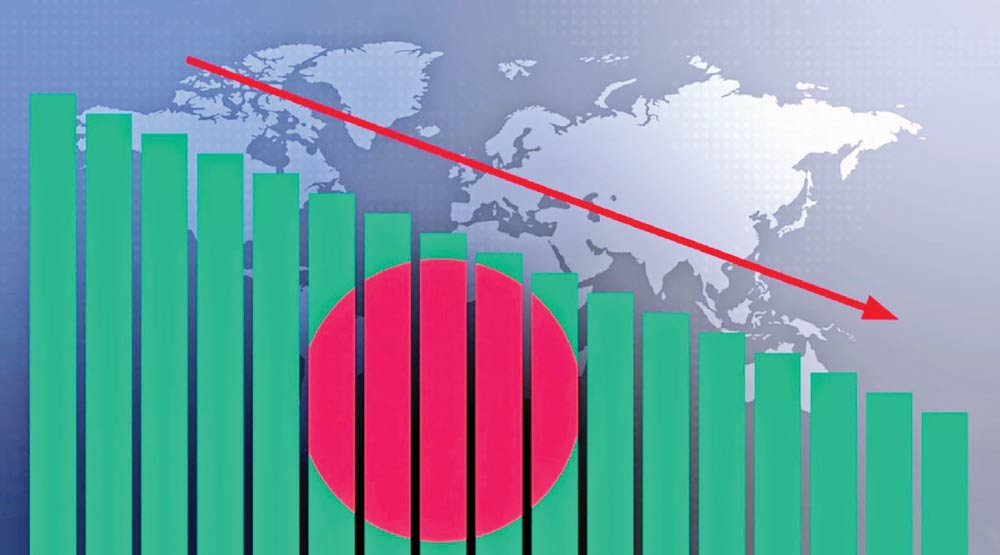 Bangladesh’s economy is showing flashes of resilience amid mounting structural strain, leaving the country at a critical economic crossroads.
 Stronger exports, rising remittances and a rapidly expanding startup ecosystem offer signs of vitality, but slowing growth, stubborn inflation, a severely weakened banking sector and fragile investment are clouding the recovery outlook.
Export earnings rose 13.29 per cent year-on-year to US$4.43 billion in August, driven largely by a 13.92 per cent increase in readymade garment exports to US$3.89 billion. Stronger demand in major markets, expanded production capacity and improved buyer confidence supported the gains, while several non-RMG sectors also recorded notable increases.
But the rebound remains uneven. August exports were 6.30 per cent below July’s US$4.72 billion, while exporters continue to face gas and power shortages, high interest rates and difficult global trading conditions.
The startup economy offers another bright spot. Bangladesh ranked fifth in the Asia-Pacific region in 2026, with its startup ecosystem expanding 56.5 per cent annually, according to StartupBlink’s Global Startup Ecosystem Index 2026. The pace was nearly twice the South Asian average of 27.5 per cent, underscoring the growing role of entrepreneurship, innovation and technology-driven businesses.
Yet this emerging dynamism is being overshadowed by the deepening crisis in the banking sector.
Bangladesh’s NPL ratio reached 32.78 per cent of total bank loans in June 2026, placing the country among those with the highest levels of bad loans globally. With almost one-third of bank credit classified as non-performing, the scale of distressed lending poses a major threat to banks’ ability to absorb losses and finance productive economic activity.
The official figure may also understate the problem. A substantial volume of loans was rescheduled during 2025-26 under special-consideration and policy-support arrangements. Such measures can defer the recognition of losses rather than resolve borrowers’ underlying repayment problems. If a significant portion of these loans returns to default, banks could face another surge in distressed assets and capital pressure.
Meanwhile, GDP growth slowed to 3.7 per cent in FY25, from 4.2 per cent in FY24 and 5.8 per cent in FY23. The IMF remains cautious, projecting growth of around 3.5 per cent in FY27 and warning that delayed reforms could weaken the medium-term outlook further. For an economy seeking to create jobs, raise incomes and absorb a growing workforce, such a slowdown is particularly concerning.
Inflation remains another major drag. The IMF projects average inflation of about 9.2 per cent in 2026, keeping pressure on household purchasing power. High prices are particularly damaging for lower-income families, while elevated borrowing costs are simultaneously weighing on businesses. Bringing inflation under control is therefore essential for restoring both consumer confidence and investment demand.
The government faces another constraint: limited fiscal capacity. Weak tax mobilisation restricts its ability to expand infrastructure, social protection and other development spending without adding to debt or intensifying economic pressures. Strengthening revenue collection and improving public-spending efficiency will consequently be crucial to sustaining future growth.
Economists say investment needs a revival to keep economic growth pace. Bangladesh also needs to unlock a stronger investment cycle. High financing costs, policy uncertainty and governance concerns have weakened business confidence, while inadequate diversification leaves the economy heavily exposed to conditions in a relatively narrow range of export markets.
A sustained increase in private and foreign investment will be vital for raising productivity, creating higher-value jobs and moving the economy beyond its traditional low-cost growth model.
External risks still remain. Global trade uncertainty, geopolitical tensions and volatile energy and commodity prices could add another layer of pressure. A sharp rise in import costs could quickly push up inflation and widen external financing requirements.
There are, however, important buffers. Bangladesh is not facing an imminent balance-of-payments collapse. Foreign-exchange reserves have begun rebuilding, while stronger remittance inflows and an improving current-account position are providing valuable external support.
But these gains should not obscure the scale of the structural challenge.
The economy now needs to convert stabilisation into genuine recovery. That means cleaning up the banking system, bringing inflation under control, strengthening revenue mobilisation, rebuilding investor confidence and diversifying the sources of growth.
Bangladesh still has considerable economic potential. But the latest figures suggest that the next phase of recovery will depend less on short-term rebounds and more on whether long-delayed structural reforms are finally delivered.
The immediate crisis may have been contained. The real test now is whether Bangladesh can turn fragile stability into durable growth before its underlying vulnerabilities deepen further.
Loading...
Loading...
Also read



Editor : Iqbal Sobhan Chowdhury
Published by the Editor on behalf of the Observer Ltd. from Globe Printers, 24/A, New Eskaton Road, Ramna, Dhaka.
Editorial, News and Commercial Offices : Aziz Bhaban (2nd floor), 93, Motijheel C/A, Dhaka-1000.
Phone: PABX- 41053001-06; Advertisement: 41053012; 01793317829, 01550707291, E-mail: [email protected], [email protected] Online: email: [email protected] 41053014; 01550707297 Advertisement: 01550707296
Published by the Editor on behalf of the Observer Ltd. from Globe Printers, 24/A, New Eskaton Road, Ramna, Dhaka.
Editorial, News and Commercial Offices : Aziz Bhaban (2nd floor), 93, Motijheel C/A, Dhaka-1000.
Phone: PABX- 41053001-06; Advertisement: 41053012; 01793317829, 01550707291, E-mail: [email protected], [email protected] Online: email: [email protected] 41053014; 01550707297 Advertisement: 01550707296


