



| HEADLINE |

|

BNP balances council, local polls
Published : Tuesday, 15 September, 2026 at 12:00 AM
Walid Khan


 The BNP faces a critical political balancing act: rebuilding its organisation from the grassroots while managing growing competition among its leaders ahead of the local government elections. The long-awaited national council has therefore assumed added importance as the party seeks to renew its leadership, reinforce its organisation and rein in internal rivalries.
One test will assess the party’s leadership and organisational strength, while the other will show how effectively the reorganised party can turn its grassroots strength into votes.
Party sources said preparations are underway to hold the BNP’s national council in next winter season, and a decision on the schedule may be taken very soon.
Experts observed that the council could be arranged at a convenient time during the multi-phase of Local Government election process, depending on the party’s organisational and strategic priorities to avoid any division within grassroots activists.
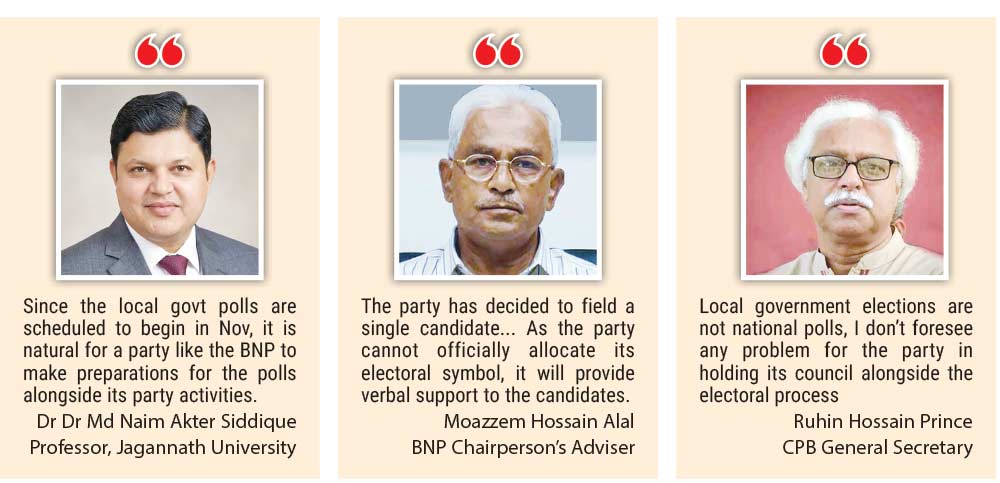
Dr Md Naim Akter Siddique, a professor in the Department of Political Science at Jagannath University, told the Daily Observer that the BNP is a democratic political party and its national council should be held in a democratic manner and that should not have any negative impact on the upcoming local government elections.
“Since the local government elections are scheduled to begin in November, it is natural for a party like the BNP to make preparations for the polls alongside its organisational activities,” Dr Naim added.
The party’s highest policy-making body, the National Standing Committee, meeting Presided over by BNP Chairman Tarique Rahman, was discussed the current political situation, including the upcoming local government elections.
Speaking to The Daily Observer on condition of anonymity, a Standing Committee member said the seventh national council would likely be held early next year to strengthen grassroots leadership.
The BNP last held its sixth national council on March 19, 2016. Although the party constitution provides for a council every three years, more than a decade has passed since the last council.
The upcoming council is therefore being seen as an opportunity not only to reorganise the central leadership but also to restructure the party from the district and upazila levels down to the union level.
The party’s organisational weaknesses have already become visible ahead of the local government elections. In many areas, several BNP leaders are preparing to contest the same post. In some places, five, seven or even more leaders are seeking the same position.
Competition among prospective candidates and their supporters has become intense in some areas, leading to clashes. Recent reports have also highlighted casualties in internal conflicts involving BNP supporters.
The problem is particularly serious in Union Parishad elections. Although the BNP wants to field a single candidate, a leader who does not receive party support may still contest as an independent, as the party symbol will not be used.
BNP Chairperson’s adviser Moazzem Hossain Alal told The Daily Observer that the party has decided to field a single candidate in every constituency this time. As the party cannot officially allocate its electoral symbol, it will provide verbal support to the candidates.
To ensure coordination among grassroots activists, divisional and district-level leaders will be given responsibility, he said.
“A meeting of the party’s high command regarding this matter will be held very soon,” Alal said.
As a result, ensuring that grassroots leaders follow decisions taken by the central leadership has become a major challenge for the party.
Grassroots activists said several BNP leaders are already campaigning for the same posts in areas ranging from Dhaka North and South City Corporations to Rajshahi, Munshiganj and other districts.
The council will therefore need to focus on genuine organisational restructuring, including developing new leadership at the district and upazila levels, reconstituting expired committees and recognising leaders who have remained active in the field for years.
Another major challenge for the BNP is maintaining a balance between the party organisation and leaders holding government positions.
Many BNP leaders became ministers and Members of Parliament after the national election. Balancing government responsibilities with party organisational work has therefore become difficult for many of them.
The council is consequently expected to focus on developing new leaders outside the group of ministers and MPs and bringing forward leaders who are actively involved in organisational activities.
On the timing of the council, Alal said the BNP had often faced the challenge of holding its council while participating in local government elections over the past 48 years.
He said the council is a gathering of party leaders and activists, while local government elections are aimed at strengthening the country and the government.
The Election Commission has announced a seven-phase schedule for the local government elections, with the first phase tentatively scheduled for November 12 and the seventh and final phase for May 27. Alal said the BNP council could be held at any convenient time during this period.
He added that major political parties usually hold their national councils during the winter season.
Meanwhile, a senior BNP leader involved in policy-making told The Daily Observer that a decision on the timing of the national council would be made only after two or three phases of the local government elections are completed.
The local government elections will provide the first major test of the BNP’s new leadership. If the central leadership can select a single candidate and bring other grassroots aspirants behind that candidate, the benefits of organisational restructuring will become visible in the field.
But if nomination disputes continue and rejected candidates remain in the race, the elections could expose the limits of the new leadership’s control over the grassroots organisation.
Jamaat-e-Islami could benefit from such divisions. If two or more BNP candidates contest in the same area, the party’s votes could be divided among them.
On the other hand, if Jamaat can keep its votes united behind a single candidate, it may be able to win with fewer total votes than the BNP. However, the individual popularity of its candidate and the strength of its local organisation will also be important.
The position of Awami League-supporting voters will also be important in this equation. Reports suggest that BNP leaders at the local level have already increased their contacts with ordinary voters who support the Awami League.
The concern is that if a large number of these voters stay away from polling stations, it could affect the prospects of BNP-backed candidates in some areas.
Therefore, the key question regarding Awami League-supporting voters may not only be whom they will vote for, but also whether they will participate in the election.
Some may support a locally acceptable BNP candidate, while others may choose a Jamaat candidate. Some may also decide not to vote. The interaction between national political positions and local relationships could determine the margin of victory in many areas.
CPB General Secretary Ruhin Hossain Prince told The Daily Observer that as the elections are not national polls, he does not foresee any problem for the party in holding its council alongside the electoral process.
He said every political party holds its national council according to its own strategic considerations.
The national council and the local government elections will therefore be two stages of the same organisational test for the BNP.
The council will test the party’s ability to renew its leadership and rebuild its grassroots organisation. The local elections will then show whether those organisational changes can be translated into electoral strength.
For the BNP, the challenge is therefore not simply deciding who will take leadership positions. The bigger political test will be whether the new leadership can unite the grassroots, maintain party discipline and prevent internal divisions from weakening the party’s electoral strength.

Loading...
Loading...
Also read



Editor : Iqbal Sobhan Chowdhury
Published by the Editor on behalf of the Observer Ltd. from Globe Printers, 24/A, New Eskaton Road, Ramna, Dhaka.
Editorial, News and Commercial Offices : Aziz Bhaban (2nd floor), 93, Motijheel C/A, Dhaka-1000.
Phone: PABX- 41053001-06; Advertisement: 41053012; 01793317829, 01550707291, E-mail: [email protected], [email protected] Online: email: [email protected] 41053014; 01550707297 Advertisement: 01550707296
Published by the Editor on behalf of the Observer Ltd. from Globe Printers, 24/A, New Eskaton Road, Ramna, Dhaka.
Editorial, News and Commercial Offices : Aziz Bhaban (2nd floor), 93, Motijheel C/A, Dhaka-1000.
Phone: PABX- 41053001-06; Advertisement: 41053012; 01793317829, 01550707291, E-mail: [email protected], [email protected] Online: email: [email protected] 41053014; 01550707297 Advertisement: 01550707296


