



| HEADLINE |

|

ICT Verdict on crimes against humanity
Death sentence for Quader, six others
Other recipients of death sentence include: Former state minister for information Mohammad Ali Arafat, AL joint GS AFM Bahauddin Nasim, Jubo League chairman Sheikh Fazle Shams Parash and GS Mainul Hossain Khan Nikhil, BCL leaders -- Saddam Hossain and Sheikh Wali Asif Inan.
Published : Wednesday, 16 September, 2026 at 12:00 AM
Staff Correspondent


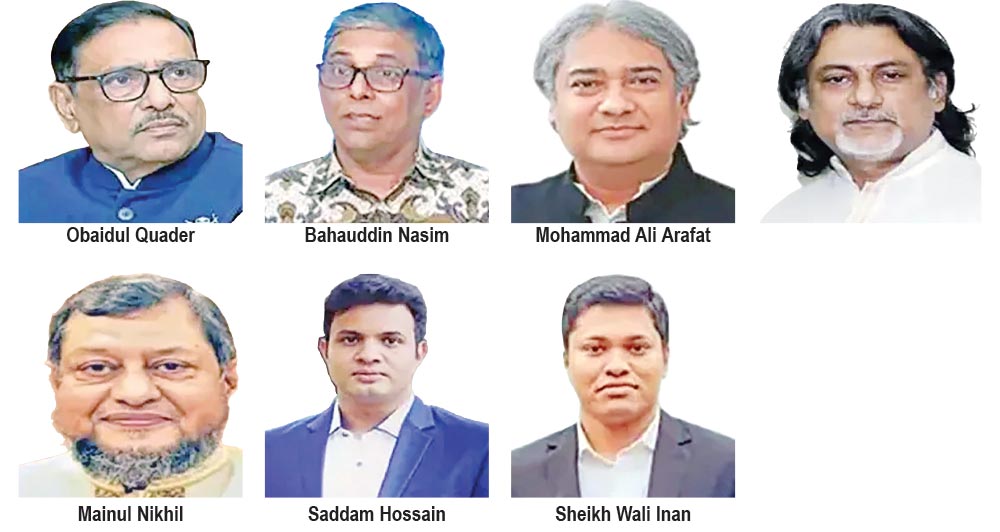 The International Crimes Tribunal-2 on Tuesday sentenced Awami League General Secretary Obaidul Quader and six others to death for crimes against humanity committed during the July Uprising in 2024.
The other recipients of death sentence are: former state minister for information Mohammad Ali Arafat, Awami League joint general secretary AFM Bahauddin Nasim, Juba League chairman Sheikh Fazle Shams Parash, its general secretary Mainul Hossain Khan Nikhil, and Chhatra League leaders Saddam Hossain and Sheikh Wali Asif Inan.
The three-member tribunal, headed by Justice Md Nozrul Islam Chowdhury, delivered the verdict in the case against the seven absconding leaders over their alleged superior roles as senior leaders in atrocities committed during the July Uprising which saw hundreds killed.
All seven accused were tried in absentia as they remain in hiding.
The tribunal also ordered the confiscation of half of the assets of Quader, Nasim, Arafat, Parash and Nikhil.
It also ordered that the confiscated assets be sold and the proceeds handed over as compensation to the families of those killed in the July Uprising and those injured. The tribunal said the compensation would be provided through the July Foundation or another statutory institution.
After the verdict, ICT Chief Prosecutor Md Aminul Islam said the seven fugitives sentenced to death would be arrested and brought back to Bangladesh if their whereabouts are identified.
"We will take steps to bring them back to the country and implement the tribunal's verdicts," he added.
The chief prosecutor said each accused faced four charges, most of which had been proved beyond reasonable doubt.
"We are grateful for this verdict. We are satisfied with it," he said, adding that the evidence established both the accused's superior command responsibility and individual liability.
He said the decision to impose a curfew and use lethal weapons was taken at a 14-party alliance meeting on 19 July 2024. The subsequent indiscriminate shooting and killing of protesters followed Quader's "shoot-at-sight" order, he added.
Responding to a query, he said although the trial was going on against them, they did not face it. It is clear that the accused are fugitives intentionally. They are absconding because they committed crimes. Any statement they make has no legal validity.
On the confiscation of assets, the chief prosecutor said the accused would have 30 days to appeal after the verdict is published.
The tribunal ordered 50% of the movable and immovable assets of Quader, Nasim, Arafat, Parash and Nikhil to be confiscated.
"There may be no scope to confiscate or hand over any property for management during these 30 days. But after 30 days, there is no legal obstacle for the Bangladesh government to implement this verdict," Aminul said.
He added that the tribunal's rules and statutes allow up to 75% of an accused person's assets to be confiscated.
"This is the first time our tribunal has confiscated 50% of their movable and immovable assets," he said.
Defence lawyers representing the seven accused expressed dissatisfaction with the verdict.
Israt Jahan, who represented Saddam, Enan, Nikhil and Parash, said she had made every effort to secure acquittal for her clients based on the evidence and documents presented before the tribunal.
"I argued and cross-examined witnesses in accordance with the law and to the fullest extent possible. But the honourable tribunal has sentenced my four clients to death and life imprisonment on various charges," she said.
"As lawyers, we are bound to accept the tribunal's verdict. We do not have the audacity to speak against the tribunal's verdict. We accept and respect the verdict. But I am not satisfied with this verdict," she added.
Hasan Imam, who represented Quader, Nasim and Arafat, said the defence had also made its best efforts during the trial.
Hasan, a former judge, said the defence should appeal against the verdict if there was an opportunity to do so.
"Perhaps we may get a better result on appeal," he added.
According to the charges, Quader, acting with law enforcement agencies and leaders and activists of the Awami League, Juba League and Chhatra League, ordered, instigated, aided and facilitated widespread and systematic attacks on unarmed student protesters between July 1, 2024 and August 5, 2024.
The prosecution alleged that after a 14-party alliance meeting at Ganabhaban on July 19, Quader told journalists that a curfew had been imposed with a 'shoot at sight' order.
It further alleged that on July 17, Sheikh Hasina spoke with Chhatra League general secretary Sheikh Walid Asif Enan, who later instigated and supervised attacks on protesters at Dhaka University and other educational institutions.
According to the charges, coordinated attacks by law enforcement agencies and party activists on July 18 left at least 23 people dead and about 2,500 injured.
The prosecution also cited a July 13 phone conversation in which Quader allegedly urged Saddam to crack down on protesters.
The violence continued across the country until the Awami League regime was ousted from power on August 5, 2024.
The prosecution submitted the formal charge in the case in December 2025.
The tribunal framed charges against the seven on January 23.
The prosecution produced 27 witnesses to prove its case.

Loading...
Loading...
Also read



Editor : Iqbal Sobhan Chowdhury
Published by the Editor on behalf of the Observer Ltd. from Globe Printers, 24/A, New Eskaton Road, Ramna, Dhaka.
Editorial, News and Commercial Offices : Aziz Bhaban (2nd floor), 93, Motijheel C/A, Dhaka-1000.
Phone: PABX- 41053001-06; Advertisement: 41053012; 01793317829, 01550707291, E-mail: [email protected], [email protected] Online: email: [email protected] 41053014; 01550707297 Advertisement: 01550707296
Published by the Editor on behalf of the Observer Ltd. from Globe Printers, 24/A, New Eskaton Road, Ramna, Dhaka.
Editorial, News and Commercial Offices : Aziz Bhaban (2nd floor), 93, Motijheel C/A, Dhaka-1000.
Phone: PABX- 41053001-06; Advertisement: 41053012; 01793317829, 01550707291, E-mail: [email protected], [email protected] Online: email: [email protected] 41053014; 01550707297 Advertisement: 01550707296


