



| HEADLINE |

|

Global military industries emerge as major polluters
World's richest countries spend roughly 30 times more on their armed forces than what they contribute in climate finance to developing countries
Published : Thursday, 17 September, 2026 at 12:00 AM
Shahnaj Behum


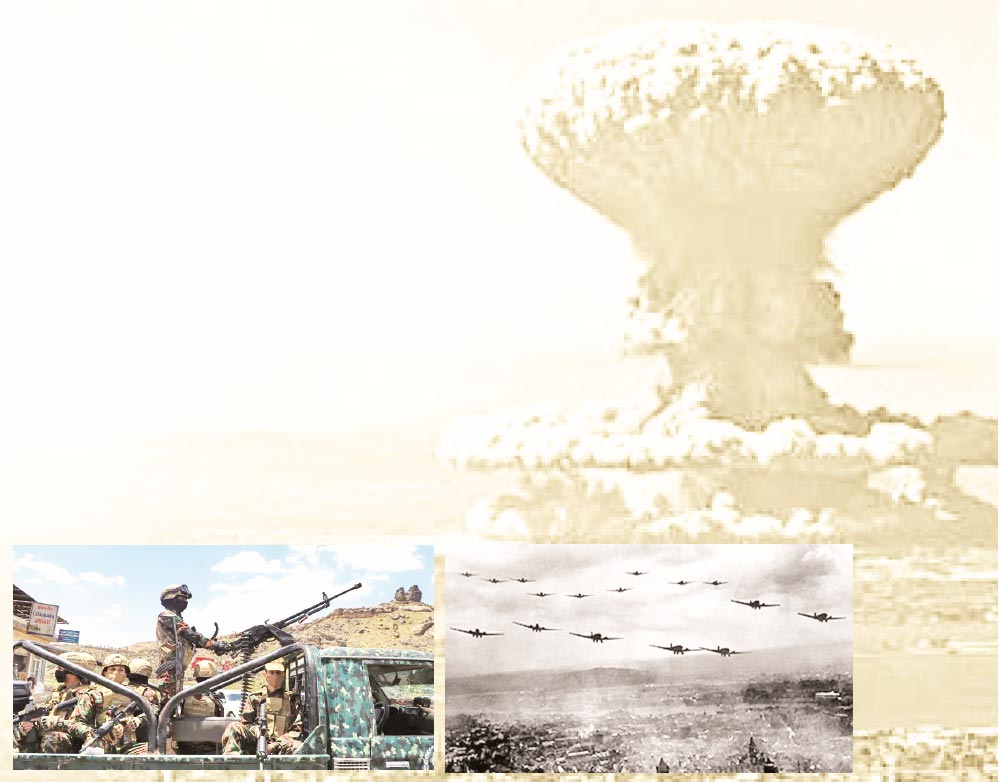 Researchers have identified that the military sector accounts for approximately 5.5 per cent of global greenhouse gas emissions�"enough to rank as the world's fourth-largest emitter if counted as a country. This figure covers peacetime operations alone. As conflicts proliferate, the world is committing to an ever-larger unaccounted carbon liability.
 The climate finance gap is likely to worsen as countries cut international development aid to redirect funds toward higher military spending. But none of this appears in any country's emissions reports to the United Nations Framework Convention on Climate Change (UNFCCC). Under the UNFCCC, countries have been exempting from fully reporting military emissions since the Kyoto Protocol negotiations in the 1990s.
The United States successfully lobbied for exclusion on national security grounds. The 2015 Paris Agreement introduced voluntary reporting, but a 2025 briefing from the Conflict and Environment Observatory and Griffith University described the resulting system as "patchy, incomplete or missing altogether."
U.S. China, and Russia, the world's top three military spenders�"�"either submit no data or incomplete, non-disaggregated figures, creating what researchers call a "structural blind spot" that excludes one of the most carbon-intensive sectors from meaningful accountability.
Data said the world's richest countries spend roughly 30 times more on their armed forces than they contribute in climate finance to developing countries. Global military spending has reached a record $2.7 trillion�"more than the total $2.2 trillion invested globally in clean energy in 2025.
Research said Russia's invasion of Ukraine has generated an estimated 311 million tonnes of CO₂ equivalent�"comparable to the combined annual emissions of Belgium, New Zealand, Austria, and Portugal.
The first 15 months of Israel's war in Gaza produced more than 33 million tonnes of CO₂ equivalent. The recent U.S.-Israel war against Iran has unleashed over five million tonnes more.
Researchers have identified what they call the "military emissions gap"�"the difference between what governments report and what their armed forces actually emit. The problem begins with the rules themselves.
The True Cost of War: A comprehensive study on Gaza reveals that direct combat emissions�"jets, rockets, artillery, military vehicles�"account for just 1.3 million of the 33.2 million tonnes of CO₂ equivalent generated. The vast majority, over 31 million tonnes, is projected to come from reconstruction: nearly 450,000 destroyed apartments, more than 3,000 kilometres of roads, schools, hospitals, and water systems.
In Ukraine, a report by the Initiative on GHG Accounting of War found that direct combat emissions constitute 37% of total emissions between February 2022 and 2026. The war has ignited thousands of fires in forests and wetlands, accounting for 23% of its carbon footprint. Russia's attacks on electrical infrastructure have released sulphur hexafluoride�"a greenhouse gas 24,000 times more potent than CO₂�"from high-voltage switching gear. The rerouting of civilian aircraft around Ukrainian and Russian airspace has added an estimated 20 million extra tonnes of CO₂ equivalent.
Environmental Damage That Outlasts Conflict: The environmental toll extends beyond carbon. Environmental toxicants like heavy metals linger for decades, and in dry areas can be transported across vast distances. Genotoxic effects�"as seen with Agent Orange�"can affect multiple generations.
A Legal and Moral Reckoning: In July 2025, the International Court of Justice delivered an advisory opinion establishing that states have binding obligations to assess, report, and mitigate harms to the climate system. ICJ judge Sarah Cleveland stated in a separate declaration that these obligations extend to harms resulting from armed conflicts and military activities.
"When Russia invaded Ukraine, it generated a climate debt on behalf of the entire planet," researchers argue. "The same can be said of other aggressors."
The Path Forward: The Intergovernmental Panel on Climate Change is currently in its seventh assessment cycle, with reports expected in late 2029. They also urge the UNFCCC to make reporting military emissions mandatory and develop a framework for attributing conflict emissions under its Enhanced Transparency Framework.
Civil society and academia have already demonstrated that accurate accounting is possible. Organizations like the Conflict and Environment Observatory have built methodologies from scratch using open-source data. "The science exists," researchers note. "What's lacking is the political will to enshrine it in global climate governance."
Civil society and academia have already done the hard work of showing it can be done. Organizations like the Conflict and Environment Observatory have built methodologies from scratch, using open-source data. The science exists. What’s lacking is the political will to enshrine it in global climate governance. As researchers warn, "Every degree of warming we are trying to avoid is undermined by wars."
"Every degree of warming we are trying to avoid is undermined by wars," researchers warn. "Accounting for conflict emissions is a vital way to make climate science whole.

Loading...
Loading...
Also read



Editor : Iqbal Sobhan Chowdhury
Published by the Editor on behalf of the Observer Ltd. from Globe Printers, 24/A, New Eskaton Road, Ramna, Dhaka.
Editorial, News and Commercial Offices : Aziz Bhaban (2nd floor), 93, Motijheel C/A, Dhaka-1000.
Phone: PABX- 41053001-06; Advertisement: 41053012; 01793317829, 01550707291, E-mail: [email protected], [email protected] Online: email: [email protected] 41053014; 01550707297 Advertisement: 01550707296
Published by the Editor on behalf of the Observer Ltd. from Globe Printers, 24/A, New Eskaton Road, Ramna, Dhaka.
Editorial, News and Commercial Offices : Aziz Bhaban (2nd floor), 93, Motijheel C/A, Dhaka-1000.
Phone: PABX- 41053001-06; Advertisement: 41053012; 01793317829, 01550707291, E-mail: [email protected], [email protected] Online: email: [email protected] 41053014; 01550707297 Advertisement: 01550707296


