



| HEADLINE |

|

Cash Crisis Deepens as Worn-Out Notes Flood Bangladesh
Published : Tuesday, 22 September, 2026 at 12:00 AM
Jibon Islam


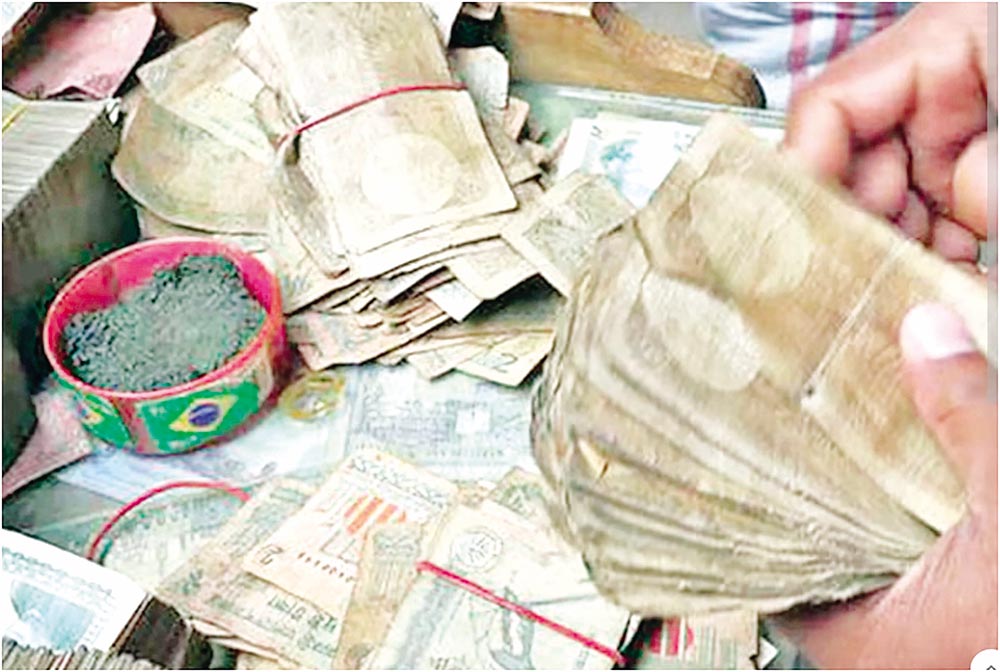 Bangladesh’s cash economy is under growing strain as consumers, businesses and banks grapple with a worsening shortage of fresh banknotes and a flood of torn, worn-out and damaged currency that is increasingly being rejected in everyday transactions.
From roadside shops to bank counters and automated machines, people are struggling to spend or deposit notes that have deteriorated beyond acceptable standards. Shopkeepers frequently refuse heavily damaged notes, while metro rail ticketing machines and banks’ Cash Recycling Machines (CRMs) often reject worn-out currency, leaving consumers with few alternatives.
Consumers and bankers blame Bangladesh Bank for failing to withdraw sufficient quantities of unfit notes and replace them with fresh currency quickly enough, creating a persistent mismatch between the demand for usable cash and its supply.
The problem is particularly acute for lower-denomination notes, which circulate rapidly and deteriorate faster. The shortage is also causing difficulties for people who rely heavily on cash for daily purchases and have no immediate access to alternative payment methods.
Bangladesh Bank Executive Director and spokesperson Arif Hossain Khan said the central bank is currently printing new Tk10 and Tk500 notes. Once printed, the notes will be handed over by Security Printing Corporation (Bangladesh) Limited (SPCBL), the state-owned security printer, to Bangladesh Bank for distribution through commercial banks.
He said new-design Tk10 notes were not printed during the 2024-25 fiscal year but were printed in 2025-26 and are now being released gradually into circulation. Printing of Tk20 and Tk50 notes, however, has yet to begin because the required raw materials did not arrive in Bangladesh on schedule, Khan said.
The disruption comes at a time when banks are increasingly pushing customers towards automated cash services. Many banks have made CRMs mandatory for cash deposits below Tk50,000 or Tk100,000. But when machines reject damaged notes, customers can be left stranded if the cash in their possession consists largely of worn-out currency.
Small Notes, Big Problem
Bangladesh Bank has also stopped printing Tk2 and Tk5 paper notes, while coins of the same denominations remain in the vaults of the central bank and commercial banks.
Yet the shift from paper to coins has encountered resistance. Customers are reluctant to accept coins from banks, while banks themselves have little enthusiasm for handling and distributing them.
The result is a growing circulation problem involving precisely the denominations most frequently used in everyday transactions.
According to sources at Bangladesh Bank, the disruption in the supply of new notes was also linked to the transition to new-design currency following the political change after the July uprising. The issuance of banknotes carrying the portrait of Bangabandhu Sheikh Mujibur Rahman was halted, while the design, approval, printing and subsequent release of replacement notes took considerable time.
That transition created a gap in the supply of fresh currency that has not yet been fully eliminated.
Tk4.76 Trillion Cash Base
Bangladesh Bank data show that reserve money stood at slightly above Tk476,000 crore in June, of which around Tk336,000 crore was held by the public, with the remainder held by banks.
Despite the huge volume of currency in circulation, the availability of clean and usable notes remains a serious issue because notes constantly move through the economy and require regular replacement.
The problem is compounded by rising currency-printing costs and limited domestic printing capacity.
For high-value banknotes, Bangladesh Bank currently has enlisted suppliers of raw materials from France, the United Kingdom, Germany, Switzerland, the Netherlands, Spain, Italy and Indonesia, according to sources.
Even after the necessary raw materials arrive, it takes about three months to print banknotes, partly because the capacity of SPCBL remains limited. Bangladesh Bank is now seeking to increase the use of coins as an alternative to Tk2 and Tk5 paper notes, sources said.
Digital Payments as the Exit Route
The central bank is also pushing consumers and businesses towards digital payments, particularly Bangla QR, in an effort to reduce dependence on physical cash.
Bangladesh Bank believes wider adoption of digital transactions could reduce demand for small-denomination notes while also helping improve transaction transparency and curb irregularities and corruption.
But for millions of Bangladeshis who still depend on cash for everyday transactions, the immediate challenge remains unchanged: there must be enough clean, usable currency in circulation to keep the cash economy moving.
The continuing shortage of fresh notes, combined with the slow withdrawal of damaged currency, has therefore become more than a nuisance for consumers�"it is exposing a structural weakness in the management of Bangladesh’s physical cash supply.

Loading...
Loading...
Also read



Editor : Iqbal Sobhan Chowdhury
Published by the Editor on behalf of the Observer Ltd. from Globe Printers, 24/A, New Eskaton Road, Ramna, Dhaka.
Editorial, News and Commercial Offices : Aziz Bhaban (2nd floor), 93, Motijheel C/A, Dhaka-1000.
Phone: PABX- 41053001-06; Advertisement: 41053012; 01793317829, 01550707291, E-mail: [email protected], [email protected] Online: email: [email protected] 41053014; 01550707297 Advertisement: 01550707296
Published by the Editor on behalf of the Observer Ltd. from Globe Printers, 24/A, New Eskaton Road, Ramna, Dhaka.
Editorial, News and Commercial Offices : Aziz Bhaban (2nd floor), 93, Motijheel C/A, Dhaka-1000.
Phone: PABX- 41053001-06; Advertisement: 41053012; 01793317829, 01550707291, E-mail: [email protected], [email protected] Online: email: [email protected] 41053014; 01550707297 Advertisement: 01550707296


