



| HEADLINE |

|

Govt can keep fuel prices as before thru tax cuts



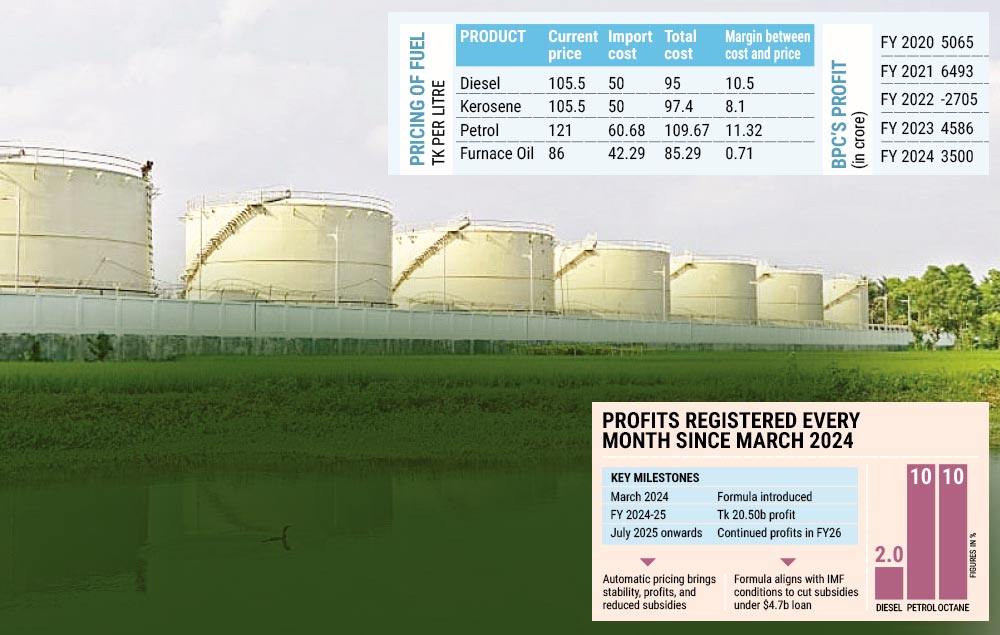 On the excuse of an operational loss of Tk 8,014.51 crore in fuel oil sales incurred in the last six months, the Energy and Mineral Resources Division recently increased fuel oil prices by 19 per cent the highest in 20 years.
According to data available, the government can keep fuel prices at their previous levels through tax and tariff cuts, without raising fuel prices, as the state-owned Bangladesh Petroleum Corporation (BPC) have continued fuel supplies for around 21 months with its profits even if its daily loss continues this way.
If the new taxes on fuel are withdrawn, per litre diesel price would fall by Tk 36.
In the last eight years, the BPC made profits cashing in on low fuel prices in the international market. However, the government always tends to go for upward adjustments of fuel prices in keeping with the global market volatility, but it barely reduces prices where there is a global fall.
The BPC is the only profit making government agency that has made a profit to the tune of Tk 48,000 crore over the last eight years by selling fuel to consumers at prices higher than in the global market. BPC data say since FY18, the corporation has paid around Tk 56,309 crore to the national exchequer in the form of tax, duties and dividends.
BPC is not incurring any losses from selling petrol or octane. They claim losses on diesel, but consumers have no way to verify this. A review of BPC’s financial statements at the end of the fiscal year reveals that they are not losing money on fuel sales. The energy division has implemented a pricing formula for fuel, and the market follows this. For the sake of transparency, BERC could discuss BPC’s pricing formula in a public hearing. This would allow consumers to understand the actual costs of the products they purchase.
Finance Division data says after meeting its regular operational costs and paying all taxes, the BPC has fixed deposits amounting to around Tk32,000 crore in different banks, while its three distribution companies - Padma Oil Company Ltd, Meghna Petroleum Ltd and Jamuna Oil Company - have bank deposits of more than Tk13,000 crore, according to Bangladesh Bank.
How much money people pay as taxes for fuel
Sources at NBR said the revenue collector takes around 34 per cent in taxes, including customs duty, on imports of furnace oil, jet fuel, diesel and octane, meaning that the government is now realising Tk36 in taxes out of Tk135 now fixed as a price of one litre diesel.
Out of the amount, customs duty is 10 per cent, VAT 15per cent, advance tax 2 per cent and advance income tax 2 per cent.
BPC employs a pricing formula for fuel that includes ten different cost factors. From the refinery to the consumer level, BPC adds costs for its development fund, marketing margins, transportation funds, and dealer agent commissions. Additionally, BPC incorporates a substantial profit margin. Despite the government’s imposition of VAT, taxes, and other ancillary costs on consumers, energy experts have questioned the fairness and ethicality of such a high-profit margin.
New tax policy
BPC will have to pay an additional Tk 8,000 crore in the current fiscal year following a policy shift in the fuel import duty structure.
As an immediate step, BPC recently paid Tk 700 crore to the NBR, with the remaining amount to be adjusted in phases, officials confirmed.
Until recently, BPC paid import duties based on a fixed “tariff value,” irrespective of fluctuating international oil prices. This meant that when global prices increased, BPC’s duty payments remained unchanged. While the NBR calculated duties based on the actual invoice value, BPC had continued to use the tariff value system.
BPC official acknowledged that the shift to invoice-based valuation will increase BPC’s costs. To mitigate the impact, the government has reduced fuel import duties in the national budget for FY2025-26.
NBR has proposed a duty rate of 40 US cents per litre of crude oil imports.
CAG report on BPC
In 2014, the Parliamentary Standing Committee on Public Undertakings has, according to a report expressed “shock” at the extent of financial irregularities at BPC.
The Comptroller and Auditor General (CAG) pored over the company’s books from fiscal 2012-13 to 2019-20 and made field visits.
All this shows how unaccountable these institutions have become in the absence of effective interventions from the higher authorities. A continuation of this situation would further erode public trust in these vital institutions.
Later the IMF set condition that the BPC should be audited by an internal firm.
Automatic pricing mechanism: The Bangladesh Energy Regulatory Commission (BERC) sets the prices of gas, electricity, LPG, furnace oil and jet fuel, but has yet to gain authority over diesel, petrol, octane and kerosene pricing.
In January 2023, however, the then Awami League government passed the BERC (Amendment) Bill to give itself direct authority to set prices by executive order through gazette notifications. The government has adjusted prices of the four fuels monthly since March 2024, in line with movements in Brent crude on international markets.
Under the law, BERC has the primary authority to set electricity and fuel prices through public hearings. In January 2023, however, the then Awami League government passed the BERC (Amendment) Bill to give itself direct authority to set prices by executive order through gazette notifications. The government has adjusted prices of the four fuels monthly since March 2024, in line with movements in Brent crude on international markets.
Consumers have no direct access to information on how the government’s pricing mechanism accounts for international market price increases, smuggling risks or the cost of each product. Price notifications are issued using figures supplied by the Bangladesh Petroleum Corporation and the Energy Division, an approach unchanged across the former Awami League government, the subsequent interim administration and the current government.

Loading...
Loading...
Also read



Editor : Iqbal Sobhan Chowdhury
Published by the Editor on behalf of the Observer Ltd. from Globe Printers, 24/A, New Eskaton Road, Ramna, Dhaka.
Editorial, News and Commercial Offices : Aziz Bhaban (2nd floor), 93, Motijheel C/A, Dhaka-1000.
Phone: PABX- 41053001-06; Advertisement: 41053012; 01793317829, 01550707291, E-mail: [email protected], [email protected] Online: email: [email protected] 41053014; 01550707297 Advertisement: 01550707296
Published by the Editor on behalf of the Observer Ltd. from Globe Printers, 24/A, New Eskaton Road, Ramna, Dhaka.
Editorial, News and Commercial Offices : Aziz Bhaban (2nd floor), 93, Motijheel C/A, Dhaka-1000.
Phone: PABX- 41053001-06; Advertisement: 41053012; 01793317829, 01550707291, E-mail: [email protected], [email protected] Online: email: [email protected] 41053014; 01550707297 Advertisement: 01550707296


