



| HEADLINE |

|

Open-pit Coal Mining: Bangladesh Perspective
This article was published on 14 September 2007. However, its appeal is same-equal and relative as the government is currently considering embarking on coal-powered electricity generation. As the write-up is relevant and a scientific one, we are sharing it with our readers.
Published : Sunday, 20 September, 2026 at 12:00 AM
Dr Aftab Alam Khan


 An open pit coal mine may contribute four, five, even ten times more than an underground coal mine do in energy production. This is an example sighted from Germany. However, the controversy lies with different scenario which is often overlooked while advocating for open pit mining in Bangladesh. The first line of comparison between the two should be drawn based on the principal condition with the same level and standard.
 If the level and standard between the two are different then the comparisons made are not likely to sustain. Bangladesh and Germany are two countries with marked differences from cultural, socioeconomic, physiographic, geomorphic, hydrogeologic, and overall geologic points of view. The North Rhine Westfalia (NRW) coal mine areas in Germany do not possess any catchment area like Tista fan in Bangladesh. Neither, it possesses such thick groundwater bearing formation like Dupitila in Bangladesh directly overlying the coal beds. Sand, clay and gravel layer overlying the coal bearing formation in NWR converges towards a valley not even 10 km wide and eventually is directed along the valley gradient towards Netherlands occupying very negligible land in NWR, Germany.
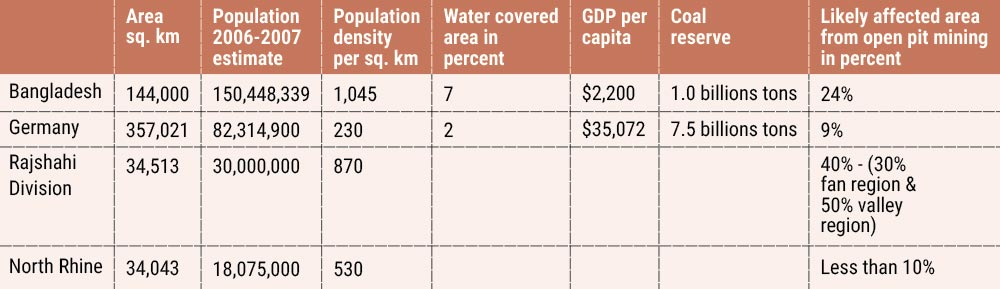 The NE-SW geological cross section of NWR coal mine area clearly exhibits its subsurface geological condition which is markedly different from Bangladesh coal field region. The coal field regions in Bangladesh are characterised by more porous and permeable thick groundwater bearing layer directly overlying coal bearing formation and diverge radially along multiple river valley systems occupying around 50 percent of the valley covered region. In addition, around 30 percent and more area of the Tista fan will be affected by massive groundwater depletion. Both surface and subsurface gradients in the North Rhine Westfalia (NRW) coal zone are directed to only narrow linear zone along Rhine river valley; while, both the surface and subsurface gradients of Bangladesh coal field areas are directed radially along Sib-Barnai, Atrai and Little Jamuna river valley systems. It is reported that the NRW mining area is pumping out 550 million cubic meters of groundwater annually where open pit mining is likely to start and very interestingly this mining area is not characterised by or linked to any such region like Tista fan and thick Dupitila formation.
 Hence, it is apprehended that if an open pit mine is started in Bangladesh that would require dewatering many folds higher than that of NWR open pit mine area. Boropukuria underground coal mine is pumping out around 15 million cubic meter of water annually from a water bearing formation at around 300m depth which is markedly sealed at the top by an impermeable shale/clay layer separating overlying highly porous and permeable Tista fan sediments and Dupitila formation. Thus, the present dewatering at Boropukuria underground mine is being managed for the water discharged only from the coal bearing formation.
An obvious question arises that how much water shall be required to pump out when an open pit mine face alongwith the entire Tista fan and Dupitila coal field areas will be opened? An article/company brochure published by RWE Power AG (www.mining-technology.com) states, "Rheinbraun has developed sophisticated dewatering programmes that can handle up to 1,200Mmm³/y of groundwater without affecting neighbouring communities' water supplies". However, it did not mention actually how much of water is being managed by dewatering and from flooding in actual field development. A comparison on other components is listed on the table. With such differences, how could an example of benefit out of an open pit mining be brought to justify the same for Bangladesh? It is undoubtedly true that Bangladesh is heading towards a major energy crisis in the days to come. But the reserve of coal supposed to be recovered even by open pit mining will contribute only a pond if not a drop in an ocean.
The writer is Professor, Department of Geology, Dhaka University

Loading...
Loading...
Also read



Editor : Iqbal Sobhan Chowdhury
Published by the Editor on behalf of the Observer Ltd. from Globe Printers, 24/A, New Eskaton Road, Ramna, Dhaka.
Editorial, News and Commercial Offices : Aziz Bhaban (2nd floor), 93, Motijheel C/A, Dhaka-1000.
Phone: PABX- 41053001-06; Advertisement: 41053012; 01793317829, 01550707291, E-mail: [email protected], [email protected] Online: email: [email protected] 41053014; 01550707297 Advertisement: 01550707296
Published by the Editor on behalf of the Observer Ltd. from Globe Printers, 24/A, New Eskaton Road, Ramna, Dhaka.
Editorial, News and Commercial Offices : Aziz Bhaban (2nd floor), 93, Motijheel C/A, Dhaka-1000.
Phone: PABX- 41053001-06; Advertisement: 41053012; 01793317829, 01550707291, E-mail: [email protected], [email protected] Online: email: [email protected] 41053014; 01550707297 Advertisement: 01550707296


