



| HEADLINE |

|

Hundreds of French schools remain closed
Published : Saturday, 3 October, 2026 at 9:35 AM
Observer Online Desk


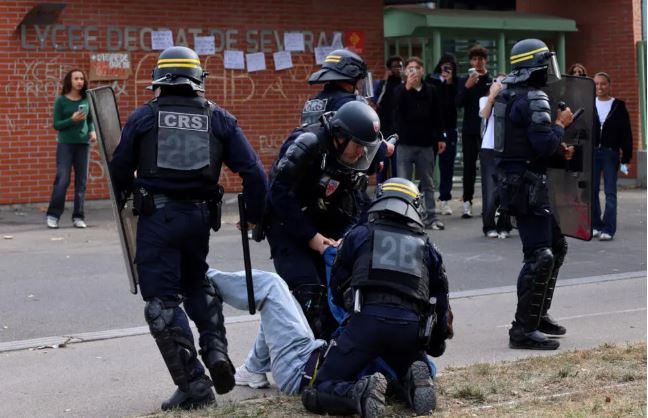
Riot police clashed with high school students across France on Friday and unions called for teachers to strike as President Emmanuel Macron's government battled to contain increasingly violent protests over classroom conditions and education funding.
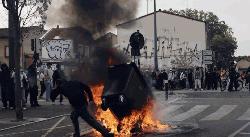
Tear gas choked the streets in the eastern city of Strasbourg, fireworks were aimed at police lines in Marseille in the south and rubbish bins set ablaze in Rennes in the west.
Rights groups have accused the police of using heavy-handed tactics against minors, including the use of batons, tear gas and non-lethal flash-ball guns. French authorities have opened four investigations to examine accusations of police violence.

One such probe will examine the case of a 16-year-old, who suffered an eye injury after police fired rubber bullets into a crowd of protesters, according to his friends.
In Rennes, the tension was already palpable outside the Jean-Mace high school with students dressed in black, wearing balaclavas and standing not far from a heavy police presence.
“As far as we’re concerned, we’ve won – our school is closed this morning,” said Lola, 16, who declined to give her last name.
She condemned what she said was police violence.
“It makes us even angrier – the police have no right to hit us or use tear gas on us.”
James, a high school student in the northern city of Lille, also denounced what he called "extremely violent police repression, which inevitably fuels students' anger."
"When we see fellow students being beaten, choked, blinded in one eye, and tear-gassed from all sides while we're simply trying to have a dialogue with the government, of course it makes people angry," he said.
'Outsiders'
Some 170 students have been wounded since the start of the movement, Education Minister Édouard Geffray said, while more than 100 high schools have suffered “severe damage”.
Speaking Friday evening, he said that some 735 high schools out of the country's 3,700 had been affected "in one way or another" – though he stressed that this was 30 percent fewer than Thursday.
At least 65 staff members – including 40 high school principals – have also been injured as the protests have at times turned violent. Geffray said that three staff members had been injured on Friday, compared with 31 the day before.
In La Ciotat, near Marseille, a young person sprayed petrol at a teacher, said a spokesperson for that region's educational authority. In a social media clip broadcast by BFM TV, a man is seen wiping his face after a hooded person wearing a face-mask sprays a liquid from a bottle at him. Reuters was not able to verify the circumstances.
'Apocalyptic scenes' as France school protests escalate
Protesters in Pantin, on the outskirts of Paris, set items including fences on fire and threw firecrackers at riot police, before running away.
Interior Minister Laurent Nunez said images from the eastern city of Belfort showing a group of youths encircle a lone policeman and kick him to the ground were of a "rare violence and intolerable".
He said police had arrested 1,747 on Friday, adding there had been "projectiles thrown, attacks on law enforcement, teachers, journalists, passersby".
After a government crisis meeting on Thursday, a source close to the prime minister said the demonstrations had morphed from a protest movement to urban violence, and Justice Minister Gérald Darmanin has said it had been hijacked by "outsiders".
Several students in the Paris region whom Reuters spoke to earlier in the week said they were staying away from the protests on Friday due to escalating violence.
'A real state of anxiety'
Six months before next year's presidential election, opinion polls consistently show the deep unpopularity of Macron and his centre-right government. Planned budget cuts, which exacerbate the funding crisis in education, have fuelled the discontent.
Trade unions meanwhile called a teachers’ strike for Tuesday, a week after public-sector workers walked out.
"(The violence) is regrettable, but ... when demands go unheard for years, and given the political and geopolitical context, there are several conditions that put ... students in a real state of anxiety," teacher Sandra Champain-Seller said.
The protests erupted in the Paris region last week but have turned increasingly violent as they spread nationwide.
Four hundred high schools – roughly one in 10 – were closed on Friday due to the unrest, while Geffray urged parents to keep their children from protesting.
Some parents supported the protests.
Vincent Martin joined his daughter outside Hélène Boucher high school, in Paris, saying students were "fundamentally right to demand ... better learning conditions".
Budget cuts
The students blockading the high schools have voiced anger over overcrowding in classrooms, regular shortages of teachers and rundown buildings, blaming years of under-investment.
"We are 35 per class, we don’t have enough chairs in classrooms, the one-hour lunch break (is too short) for everyone to get food," 15-year-old Kesia told Reuters in the Paris suburb of Pantin before running off as the police used tear gas.
Under the draft 2027 budget presented by the government on Thursday, the education budget is set to increase by a below-inflation 1.7 percent to €65.53 billion ($73.77 billion), excluding teacher pensions.
Education is traditionally the largest budget item, but that changes next year with debt servicing costs expected to reach €74.5 billion, according to the draft bill.
According to the OECD global policy forum, French spending on education is in the middle of the range among member countries and increased between 2015 and 2022, but its share of the budget has slightly decreased.
Intelligence agencies reportedly told the crisis meeting that the protest movement had been initiated by politicians from the left-wing France Unbowed party (LFI).
Senior LFI lawmakers dismissed the allegations, accusing the government of politicising the protests ahead of the election.
Loading...
Loading...
Also read





Editor : Iqbal Sobhan Chowdhury
Published by the Editor on behalf of the Observer Ltd. from Globe Printers, 24/A, New Eskaton Road, Ramna, Dhaka.
Editorial, News and Commercial Offices : Aziz Bhaban (2nd floor), 93, Motijheel C/A, Dhaka-1000.
Phone: PABX- 41053001-06; Advertisement: 41053012; 01793317829, 01550707291, E-mail: [email protected], [email protected] Online: email: [email protected] 41053014; 01550707297 Advertisement: 01550707296
Published by the Editor on behalf of the Observer Ltd. from Globe Printers, 24/A, New Eskaton Road, Ramna, Dhaka.
Editorial, News and Commercial Offices : Aziz Bhaban (2nd floor), 93, Motijheel C/A, Dhaka-1000.
Phone: PABX- 41053001-06; Advertisement: 41053012; 01793317829, 01550707291, E-mail: [email protected], [email protected] Online: email: [email protected] 41053014; 01550707297 Advertisement: 01550707296


