



| HEADLINE |

|

World's First Radio signal detected from exoplanet
Published : Wednesday, 7 October, 2026 at 12:00 AM
Observer Desk


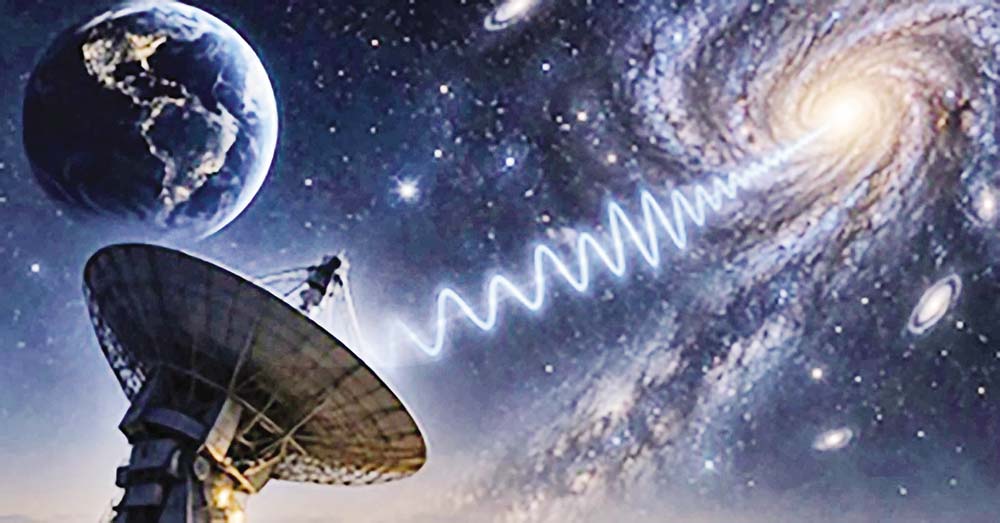 For the first time, astronomers say they have detected radio waves from a planet outside our solar system. The planet, about 63 light-years away, is producing a radio signal that’s linked to an enormous magnetic field, according to CNN.
Scientists say the signal is not evidence of intelligent life.
Researchers believe that the field is at least 200 times stronger than Jupiter’s.
More observations are planned as scientists try to understand why the magnetic field is so powerful.
The team concluded that the radio bursts originated from Beta Pictoris b rather than its host star by examining their position and radio characteristics. The researchers were able to isolate the planetary signal partly because Beta Pictoris, the host star, is relatively magnetically quiet. Distant quasars were also used as reference points to help map the source of the emissions.
The team of scientists believe the detected radio bursts are natural auroral emissions. Similar radio emissions occur when high-energy particles interact with gases around the magnetic poles of planets such as Jupiter and Earth.
The observations also allowed researchers to estimate the strength of Beta Pictoris b's magnetic field. The study inferred a magnetic field of approximately 1,250 gauss in the radio-emitting region. For comparison, Jupiter's equatorial magnetic field is around 4.3 gauss, while Earth's is approximately 0.5 gauss. The measurements, however, refer to different regions of the respective planetary magnetic fields.
As the latest discovery does not indicate the presence of extraterrestrial life or an artificial communication signal. Instead, the radio emissions provide astronomers with a new way to study the magnetic environments of exoplanets, as per NYPost.
All Planetary magnetic fields are considered important in understanding how worlds interact with stellar winds and cosmic radiation. Measuring these fields could therefore provide valuable information about the evolution and atmospheric conditions of distant planets.

Loading...
Loading...
Also read



Editor : Iqbal Sobhan Chowdhury
Published by the Editor on behalf of the Observer Ltd. from Globe Printers, 24/A, New Eskaton Road, Ramna, Dhaka.
Editorial, News and Commercial Offices : Aziz Bhaban (2nd floor), 93, Motijheel C/A, Dhaka-1000.
Phone: PABX- 41053001-06; Advertisement: 41053012; 01793317829, 01550707291, E-mail: [email protected], [email protected] Online: email: [email protected] 41053014; 01550707297 Advertisement: 01550707296
Published by the Editor on behalf of the Observer Ltd. from Globe Printers, 24/A, New Eskaton Road, Ramna, Dhaka.
Editorial, News and Commercial Offices : Aziz Bhaban (2nd floor), 93, Motijheel C/A, Dhaka-1000.
Phone: PABX- 41053001-06; Advertisement: 41053012; 01793317829, 01550707291, E-mail: [email protected], [email protected] Online: email: [email protected] 41053014; 01550707297 Advertisement: 01550707296


