



| HEADLINE |

|

KUET researchers develop diesel-rich bio-crude from human waste
Published : Saturday, 10 October, 2026 at 12:00 AM
Our Correspondent


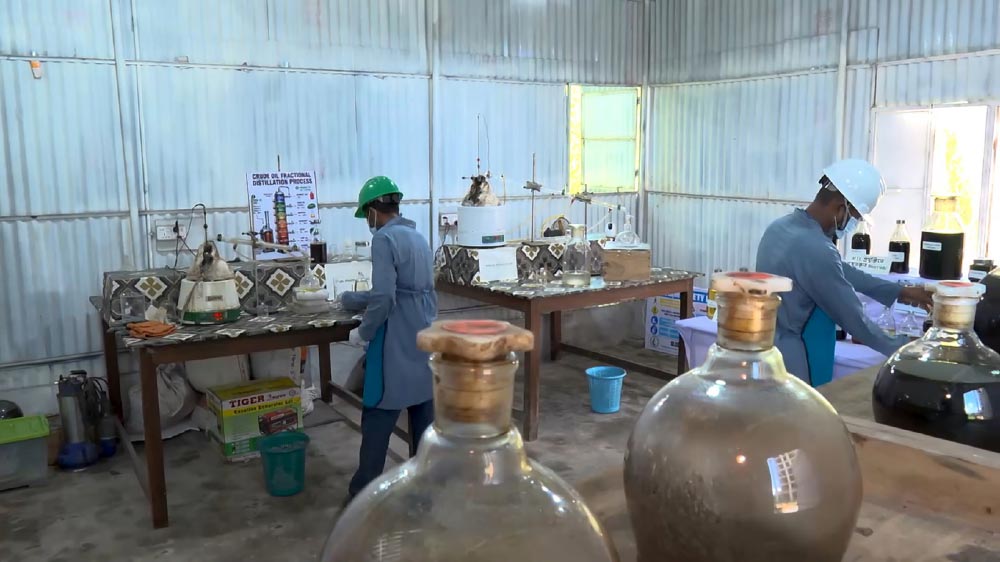 KHULNA, Oct 9: Researchers at Khulna University of Engineering and Technology (KUET) have made progress in producing diesel-rich bio-crude from human waste, sewage sludge and agricultural residues, potentially reducing Bangladesh’s dependence on imported fuel.
The research, led by Professor Md Khalekuzzaman of KUET’s Department of Civil Engineering, began in 2016 and involves 13 researchers.
Initially, the team focused on producing petrol- and octane-range fuel from human waste and sewage treatment plant sludge. Laboratory experiments produced bio-crude yields of 50 per cent to 55 per cent.
The researchers later shifted their focus to diesel-rich bio-crude because of Bangladesh’s heavy reliance on imported diesel. Diesel accounts for an estimated 70 per cent to 75 per cent of the country’s liquid fuel imports, costing billions of dollars in foreign exchange annually, according to the researchers.
By combining waste with rice husk and sawdust, the team has produced bio-crude containing more than 50 per cent diesel-range components, indicating the potential to replace a portion of imported diesel with locally produced fuel.
The research has produced more than 15 papers in international scientific journals, including several Q1-ranked journals, the researchers said.
The project received initial support from the government’s Power and Energy Research Council about a year ago, helping accelerate experimental work.
The researchers use hydrothermal liquefaction, or HTL, technology, which converts wet organic waste into bio-crude under high temperature and pressure without requiring the waste to be dried first. The resulting bio-crude can then be further refined into usable fuels.
The researchers estimate the technology could eventually meet about 30 per cent of Bangladesh’s diesel demand through domestic production, subject to successful commercial-scale implementation.
They estimate that a commercial plant capable of processing three tonnes of waste would require an investment of about Tk 80 crore to 120 crore. Commercial production could begin within a year of investment, they said.
“The technology has already gained scientific acceptance, with more than 15 research papers published in Q1 journals,” Professor Md Khalekuzzaman told The Daily Observer. “It has the potential to meet around 30 per cent of our import-dependent fuel demand.”
He said processing 25 per cent to 50 per cent of the country’s human waste, sewage sludge and wet organic waste could replace about 10 per cent to 15 per cent of imported crude oil and potentially save foreign exchange equivalent to Tk 6,500 crore to Tk 13,000 crore annually.
He cautioned that replacing up to 30 per cent of imported crude oil would require sustained research, improved technology, reliable feedstock collection and phased commercial expansion.
The researchers said commercialisation could help address waste management and energy security while reducing pollution, creating jobs and encouraging domestic production of process equipment.
They have proposed establishing a continuous HTL pilot plant capable of processing one to three tons per day, followed by technology validation, certification and development of a regulatory framework. Larger plants could then be developed through public-private partnerships and private investment, they said.
The technology could also produce petrol, octane and kerosene, according to the researchers.
KUET Vice-Chancellor Professor Dr Muhammad Masud said many promising research projects in Bangladesh remain confined to laboratories because of limited financial and logistical support.
“If the government provides financial assistance to take this technology to the production stage, it will benefit the country,” he said.
Sheikh Ashrafuzzaman, president of the Greater Khulna Development Sangram (Action) Committee, said implementing the research through commercial plants with government assistance would be a major achievement for Bangladesh.

Loading...
Loading...
Also read



Editor : Iqbal Sobhan Chowdhury
Published by the Editor on behalf of the Observer Ltd. from Globe Printers, 24/A, New Eskaton Road, Ramna, Dhaka.
Editorial, News and Commercial Offices : Aziz Bhaban (2nd floor), 93, Motijheel C/A, Dhaka-1000.
Phone: PABX- 41053001-06; Advertisement: 41053012; 01793317829, 01550707291, E-mail: [email protected], [email protected] Online: email: [email protected] 41053014; 01550707297 Advertisement: 01550707296
Published by the Editor on behalf of the Observer Ltd. from Globe Printers, 24/A, New Eskaton Road, Ramna, Dhaka.
Editorial, News and Commercial Offices : Aziz Bhaban (2nd floor), 93, Motijheel C/A, Dhaka-1000.
Phone: PABX- 41053001-06; Advertisement: 41053012; 01793317829, 01550707291, E-mail: [email protected], [email protected] Online: email: [email protected] 41053014; 01550707297 Advertisement: 01550707296


