



| HEADLINE |

|

Why do we pay the most for LP gas?


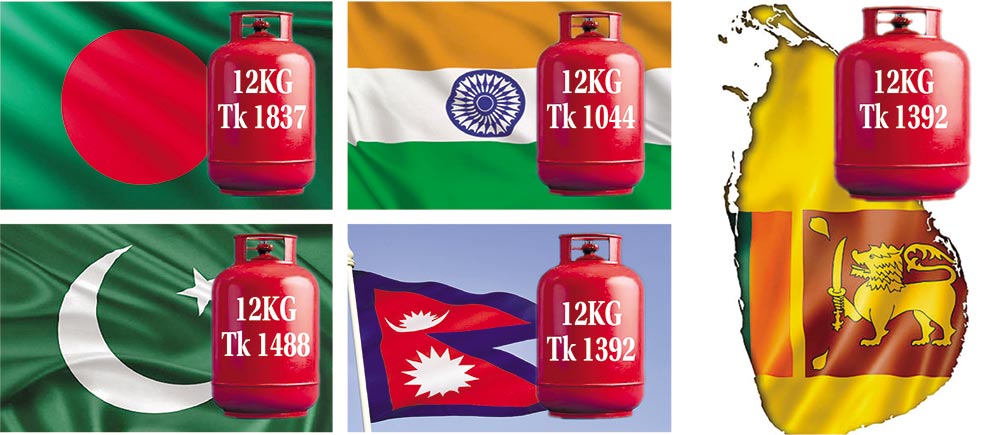
LPG is not a luxury; it’s a necessity now. But the Bangladesh Energy Regulatory Commission's October price announcement did not echo it. When the BERC had raised the official price of a 12-kilogramme LPG cylinder by Tk 252 to Tk 1,837, consumers were being asked to pay Tk 863 extra, as no retailer was willing to supply LP gas as regulated rate.
This is not new, this additional expense, month after month, was crushing people’s budget, consumers received irregular piped gas-sometimes nothing for days. So they have no option. But have to bow down under the axe of BERC, as the watch dog can only pushes the burden of the traders towards consumers shoulders. But failed to take any step against the aligners keeping their hording evident in their hand, provided by the state intelligence agency.
BERC has been setting LPG prices since 2021, yet overcharging and periodic supply crises persist. Announcing a rate without ensuring compliance creates only the appearance of regulation without public hearing.
Consumers of Bangladesh are paying extra due to the failures of regulation, enforcement and market oversight. If official prices are to mean anything, authorities must make them real in the marketplace. This cycle of passing regulatory failure onto households must end.
Raising prices cannot be the default response whenever the market tightens. International LPG prices and shipping costs may rise, but regulators must first establish how much in hike is justified and whether shortages are genuine. Otherwise, price adjustments reward market manipulators……
LPG-Intelegencereport
An intelligence report has found that several major liquefied petroleum gas (LPG) importers sharply reduced supplies despite adequate imports, creating an artificial shortage and pushing up prices in the domestic market.
According to the report, five companies almost stopped selling LPG from September 22 after international prices rose by around $64 per tonne, allegedly withholding thousands of tonnes in anticipation of a higher price set by the Bangladesh Energy Regulatory Commission (BERC).
Major importers allegedly cut supplies despite adequate imports, pushing up retail prices
The report said Bangladesh imported around 158,000 tonnes of LPG in August and 156,000 tonnes in September, indicating that there was no shortage at the import level.
A Market Out of Control
Following the announcement of BERC, across Dhaka and in districts like Narayanganj and Gazipur, consumers reported being charged between Tk 2,200 and Tk 2,700 for a 12 kg cylinder that the government had declared should sell for Tk 1,837. The gap-ranging from Tk 363 to Tk 863-represented a failure of oversight that consumers said was becoming a pattern.
"The supply is low and the rate is high now," Alim Mian of Khilkhet said, quoting Tk 2,700 for a refill without the cylinder.
In Narayanganj, Jahid offered an I-Gas cylinder for Tk 2,200. "This is the only gas available," he said. "You can take it if you want."
The Consumers Who Wait and Lose
Shamim Swolaiman, a consumer from Mirpur, had done exactly what the government encouraged-waited for the official price announcement before buying. When he went to purchase on Monday, the seller demanded Tk 800 more than the regulated price.
"We were waiting to buy the cylinder after the new price was fixed," he said. "But when I went to buy it today, the seller asked for Tk 800 more. Who will take responsibility for this?"
He alleged that authorities conducted only nominal drives against overpricing without taking effective action. For families like his, the monthly price adjustments had become meaningless-a bureaucratic exercise that failed to reach the retail market.
The Watchdog's Frustration
AHM Shafiquzzaman, president of the Consumers Association of Bangladesh (CAB), did not mince words.
"Consumers are being burdened repeatedly," he said. "What is the government doing when retailers are charging more than the official price? No visible action is being taken."
Importers Deny Shortage
Mohammad Amirul Haque, president of the Bangladesh LPG Operators Association, rejected claims of supply shortage.
"LPG imports have not decreased," he said. "Retailers may be creating this problem."
LOAB, the traders’ organisation, stated that in August, 158,000 metric tonnes of LPG was imported. The import quantity in September was 156,000 tonnes. This indicates that import levels are normal. Therefore, the organisation has warned everyone not to sell LPG at excessively high prices.
It was anticipated that the market price would stabilise following BERC’s price adjustments. According to business sources, after BERC increased the prices, the supply is now increasing. However, there is a long queue of waiting trucks, so it may take more than a week for supply to normalise.
He promised action against any operator selling above the regulated price, warning that licences would be cancelled if proof emerged.
Yet industry insiders said restoring discipline required more than price-fixing. BERC and other agencies needed to strengthen monitoring across the supply chain-at importer, dealer, and retail levels. Without that, the regulated price would remain largely ineffective.
Former president of the LPG Operators Association of Bangladesh (LOAB) Azam J Chowdhury told that due to infrastructural limitations and ship rental costs, Bangladesh is lagging behind in the competition. If a terminal were constructed in the deep sea and storage capacity increased, the price would also decrease in the country. He said that if the price goes up, demand goes down, so traders don’t want higher prices.
A Year of Volatility
The official price of a 12kg LPG cylinder had fluctuated sharply throughout the year. It began at Tk 1,306 in January-the lowest of the year-then rose to Tk 1,356 in February, dipped to Tk 1,341 in March, and surged by Tk 387 to Tk 1,728 in April. In May, it reached its peak of Tk 1,940.
Two consecutive declines followed: Tk 1,885 in June and Tk 1,528 in July. August saw a modest increase to Tk 1,598, then a slight drop to Tk 1,585 in September. October's increase of Tk 252-about 15.9 per cent-pushed the price to Tk 1,837.
Compared with January, the October price was Tk 531 higher-an increase of about 40.6 per cent. While BERC fixed the October price at Tk 1,837, consumers in some markets were paying up to Tk 2,700-nearly Tk 900 more than the regulated rate.
BERC Seeks Answers
Amid the complaints, BERC sought information on LPG imports and sales from 12 importers for September. Letters were issued on Saturday, requiring submission by Sunday. The commission referenced import data from the National Board of Revenue and confirmed that several companies had already complied.
Attempts to contact the power and energy minister, state minister, and BERC officials for comment went unanswered.

Loading...
Loading...
Also read



Editor : Iqbal Sobhan Chowdhury
Published by the Editor on behalf of the Observer Ltd. from Globe Printers, 24/A, New Eskaton Road, Ramna, Dhaka.
Editorial, News and Commercial Offices : Aziz Bhaban (2nd floor), 93, Motijheel C/A, Dhaka-1000.
Phone: PABX- 41053001-06; Advertisement: 41053012; 01793317829, 01550707291, E-mail: [email protected], [email protected] Online: email: [email protected] 41053014; 01550707297 Advertisement: 01550707296
Published by the Editor on behalf of the Observer Ltd. from Globe Printers, 24/A, New Eskaton Road, Ramna, Dhaka.
Editorial, News and Commercial Offices : Aziz Bhaban (2nd floor), 93, Motijheel C/A, Dhaka-1000.
Phone: PABX- 41053001-06; Advertisement: 41053012; 01793317829, 01550707291, E-mail: [email protected], [email protected] Online: email: [email protected] 41053014; 01550707297 Advertisement: 01550707296


