



| HEADLINE |

|

111 DO letters across 38 districts
Fisheries Minister issues strict law enforcement to protect mother hilsa
Published : Sunday, 18 October, 2026 at 5:37 PM
Observer Special Correspondent


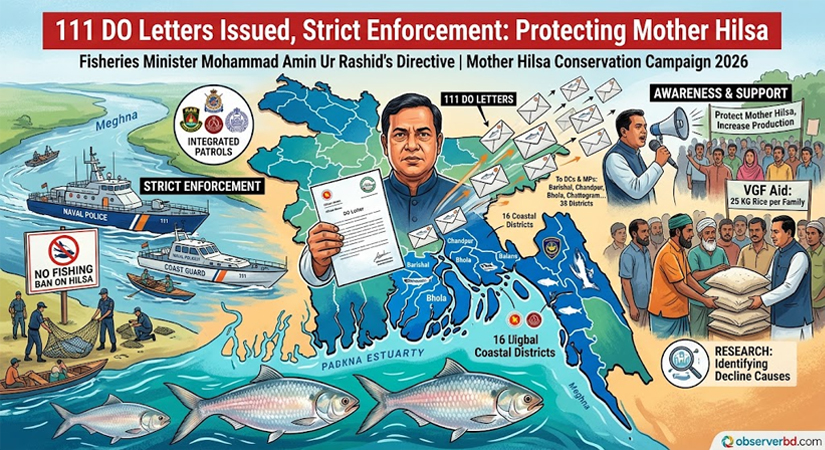
AI Illustration
The government is actively strengthening its ongoing nationwide campaign to ensure the safe breeding of hilsa during the current ban on catching the prized fish.
As part of this effort, Fisheries and Livestock, as well as Agriculture Minister Mohammad Amin Ur Rashid, has issued 111 DO (Demiofficial) letters across 38 districts, including 16 coastal districts.
The decision was taken yesterday during a meeting of the National Task Force Committee on Hilsa Resource Development held at the ministry to set the timeframe for prohibiting hilsa harvesting and to execute the "Mother Hilsa Conservation Campaign 2026."
According to official sources, letters have been sent to ministers, members of parliament, and deputy commissioners in 38 districts. The communication emphasizes raising public awareness by involving local communities alongside relevant authorities to protect hilsa.
Local law enforcement agencies have also been urged to maintain vigilance regarding individuals entering the rivers during the embargo. Furthermore, the minister and the state minister instructed officials to strictly monitor the distribution process so that genuine fishermen receive their allocated government food support.
In line with the meeting's decisions, a nationwide ban on the transport, storage, marketing, buying, selling, and exchange of hilsa will remain in effect throughout the prohibited period. The Mother Hilsa Conservation Campaign will be rigorously enforced during this time. To support fishermen abstaining from netting hilsa, the government is providing relief assistance under the VGF (Vulnerable Group Feeding) program.
Presiding over the meeting, Fisheries, Livestock, and Agriculture Minister Mohammad Amin Ur Rashid stated that no leniency would be shown regarding the protection of mother hilsa to ensure its sustainable production. Surveillance and drive operations must be further intensified in major breeding zones, particularly in Barishal, Chandpur, and Bhola.
He emphasized that the district administration, Naval Police, Coast Guard, and the Department of Fisheries must work in a coordinated manner to strictly enforce the fishing ban during the spawning season. Additional vessels and logistical support will be provided in identified hotspots if required.
The minister added that monitoring must be extended to ice factories, wholesale markets (aarats), and retail markets to prevent the commercialization of illegally caught fish. Strict drives must be conducted to remove illegal nets from hilsa sanctuaries, including the Chandpur estuary. Under no circumstances will catching or marketing fish be allowed during the ban. He expressed optimism that if all relevant agencies maintain coordinated efforts, hilsa production will rise further in the coming season.
State Minister for Fisheries and Livestock Sultan Salauddin Tuku MP highlighted the need to conduct research to identify the root causes behind the gradual decline in hilsa production. He affirmed that necessary measures would be implemented after pinpointing operational weaknesses or shortcomings.
Emphasizing the eradication of illegal nets, he stated that effective measures must be taken to stop the manufacture and sale of prohibited nets. Alongside government action, fishermen’s representatives must play a role in raising awareness among fishermen against purchasing such nets. He further mentioned that the government is providing incentives to keep fishermen away from fishing during the ban, and supervision will be increased to ensure this aid reaches genuine fishermen properly.
The state minister noted that this decline in production is a matter of concern. Identifying why such a situation has arisen, integrated actions must be taken by involving all stakeholders. Comprehensive action plans will be adopted in the days ahead to increase production and preserve hilsa as a national asset and GI (Geographical Indication) product.
The meeting was attended by Fisheries and Livestock Secretary Md. Delwar Hossain, Bangladesh Fisheries Development Corporation Chairman Md. Meer Hossain, Director General of the Department of Fisheries Dr. Md. Khaled Kanak, and Director General of the Bangladesh Fisheries Research Institute Dr. Md. Latiful Islam. Representatives from the Cabinet Division, Ministry of Shipping, Ministry of Commerce, Deputy Commissioners, RAB, Coast Guard, Air Force, Naval Police, and BGB also participated in the session. Senior officials from the ministry and department, representatives from Dhaka University, and members of the National Fishermen's Association were also present.
Sources from the Department of Fisheries disclosed that to support the livelihoods of fishermen during the ban running until October 29, the government has allocated food grain at a rate of 25 kg of rice per family for a total of 6,46,290 fishermen households across 168 upazilas in 38 districts under its humanitarian assistance program. The allocation includes 65,717 beneficiaries in Dhaka Division, 3,58,516 in Barishal Division, 1,59,595 in Chattogram Division, 8,163 in Mymensingh Division, 18,762 in Khulna Division, 19,411 in Rajshahi Division, and 16,126 in Rangpur Division.
According to Coast Guard sources, mother hilsa conservation activities have been intensified across 54 upazilas in 16 districts under their jurisdiction. To this end, intelligence surveillance has been expanded, regular and special patrols have been increased, and searches are being conducted on suspicious vessels and fishing boats. Operational drives are being carried out with special emphasis on high-density areas such as Chandpur, Shariatpur, Madaripur, Munshiganj, Barishal, Patuakhali, Bhola, Pirojpur, Jhalakathi, Sharankhola and Bagi in Bagerhat, the outer anchorage area of Chattogram, as well as Raipur and Kamalnagar in Lakshmipur.
Beyond enforcement drives, the government is placing significant emphasis on creating awareness among fishermen regarding mother hilsa protection. Loudspeaker announcements (myking), distribution of leaflets, and discussion sessions are being organized across various regions for this purpose.
According to concerned experts, prohibiting hilsa harvesting during its peak breeding season and keeping spawning grounds safe are crucial for enhancing the production and availability of the fish. Therefore, alongside adhering to official guidelines during the ban, citizens should report any illegal fishing activities to the authorities.
The success of the ongoing campaign relies not only on legal enforcement but also on the cooperation of fishermen, fish traders, and all stakeholders. Halting hilsa capture during the spawning period will smooth the path for higher production and better availability of the fish in the future.
Speaking on the issue, Salim Bepari, a fisherman from Char Fasson in Bhola, stated that the government's 22-day ban aimed at enhancing hilsa production and breeding would ensure undisturbed spawning and propagation. In the long run, fishermen themselves will benefit the most from this measure. He added that to alleviate hardship during this period, the government is providing food assistance, calling it a commendable and public-welfare-oriented initiative.
Prof. Mohammad Mamun Chowdhury, Chairman of the Department of Fisheries at Dhaka University, remarked that the 22-day ban imposed by the government to ensure the safe spawning of mother hilsa is a highly effective initiative. However, to make hilsa breeding protection even more effective, the duration of the ban needs to be extended from 22 days to one month, especially at a time when hilsa production is dropping and fish has to be imported from abroad.
-TIS/SA

Loading...
Loading...
Also read







Editor : Iqbal Sobhan Chowdhury
Published by the Editor on behalf of the Observer Ltd. from Globe Printers, 24/A, New Eskaton Road, Ramna, Dhaka.
Editorial, News and Commercial Offices : Aziz Bhaban (2nd floor), 93, Motijheel C/A, Dhaka-1000.
Phone: PABX- 41053001-06; Advertisement: 41053012; 01793317829, 01550707291, E-mail: [email protected], [email protected] Online: email: [email protected] 41053014; 01550707297 Advertisement: 01550707296
Published by the Editor on behalf of the Observer Ltd. from Globe Printers, 24/A, New Eskaton Road, Ramna, Dhaka.
Editorial, News and Commercial Offices : Aziz Bhaban (2nd floor), 93, Motijheel C/A, Dhaka-1000.
Phone: PABX- 41053001-06; Advertisement: 41053012; 01793317829, 01550707291, E-mail: [email protected], [email protected] Online: email: [email protected] 41053014; 01550707297 Advertisement: 01550707296


