



| HEADLINE |

|

Major school curriculum overhaul planned for 2028
Published : Wednesday, 21 October, 2026 at 12:00 AM
Staff Correspondent


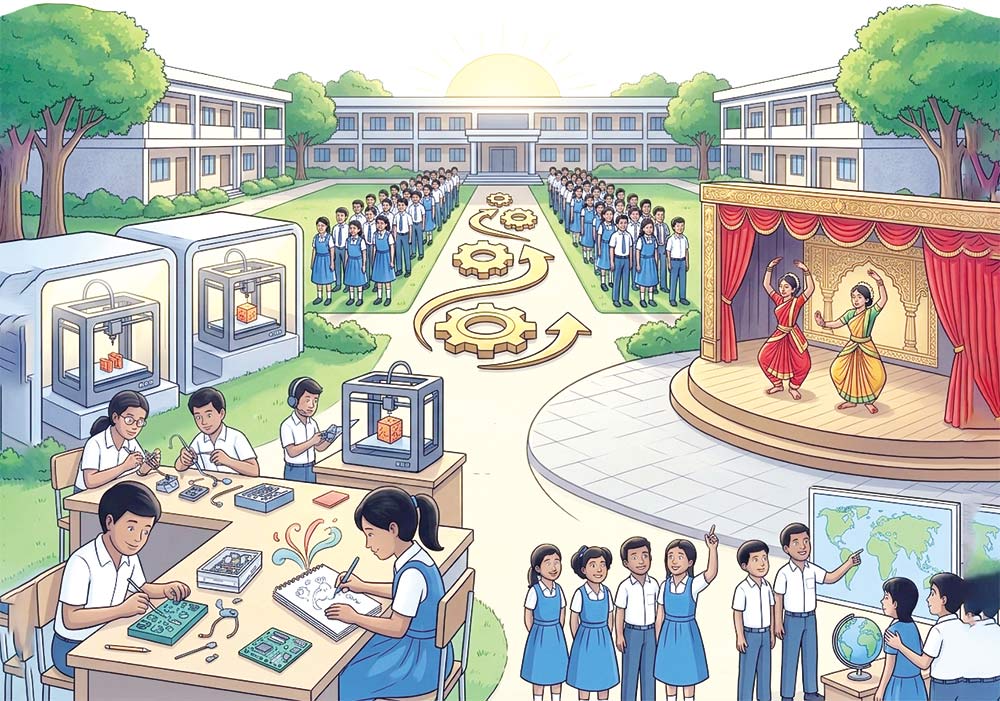 Bangladesh is preparing to revise its school curriculum, with four new textbooks scheduled for introduction in the 2027 academic year and a broader curriculum overhaul planned for 2028. The government says the changes will place greater emphasis on practical skills, student-friendly learning and the development of responsible citizens.
The four proposed textbooks will cover Sports and Culture for Class IV students, and Technical and Vocational Education and Learning with Happiness for Class VI students. The government has described the initiative as an initial step towards wider reforms in primary and secondary education.
Prime Minister’s Education Adviser Mahdi Amin has clarified that the immediate initiative is not intended to replace the entire existing curriculum at once. Instead, authorities are revising existing materials, making additions and removing content where necessary, while preparing for more comprehensive changes in 2028.
Speaking at a workshop on finalising the framework for the four new textbooks in Dhaka on July 12, Mahdi Amin said the proposed books reflected the government’s longer-term vision for education. Education Minister ANM Ehsanul Hoque Milon also emphasised the need to improve textbook quality and address shortcomings in previous editions.
The Sports and Culture textbook is intended to give students greater opportunities to engage with physical activities, cultural practices and related learning experiences. The vocational education book is expected to introduce students to technical knowledge and practical skills that can be applied in everyday life.
Experts have cautioned against allowing historical accounts to change according to the preferences of successive governments. Ensuring that students receive balanced, evidence-based accounts will therefore bean important test of the revision process
Learning with Happiness is intended to go beyond conventional textbook-based instruction. Mahdi Amin has called for the book to use illustrations, diagrams, tables and other visual elements to make learning more engaging. He has also emphasised the importance of explaining the subject’s educational objectives and its role in developing students’ values and character.
Officials have also discussed providing supporting materials, including teacher guides, workbooks and video lessons, to help students learn both inside and outside the classroom.
The four new textbooks are part of a phased approach rather than the complete curriculum overhaul itself. Education Minister Milon has said the broader changes will become visible from the 2028 academic year, allowing more time to prepare a realistic and implementable framework.
The distinction is important because curriculum reform involves more than introducing new subjects or changing textbooks. It requires revisions to learning objectives, teaching methods, assessment systems, teacher training and the resources available to schools.
The government will therefore need to clarify how the proposed changes will affect different grades, whether implementation will take place in stages and how schools will be prepared before the revised curriculum takes effect.
Historical content is another area receiving attention. In October, reports indicated that the National Curriculum and Textbook Board (NCTB) was preparing additions and revisions to history-related content for the 2027 academic year.
The proposed changes cover the Liberation War, post-independence political developments, the 1990 mass uprising and the July 2024 uprising. The revisions are expected to affect several textbooks used by students in Classes III to X.
The changes have also renewed discussion about the importance of presenting history accurately and impartially. Textbooks should distinguish established historical facts from political interpretations, use reliable evidence and reflect differing perspectives where appropriate.
Experts have cautioned against allowing historical accounts to change according to the preferences of successive governments. Ensuring that students receive balanced, evidence-based accounts will therefore be an important test of the revision process.
Training programmes and practical teaching guidelines should be prepared alongside the books. Assessment methods must also be explained clearly so that teachers, students and parents understand how learning progress will be measured.
The reforms could help address longstanding concerns about rote learning and excessive dependence on examination results if they encourage critical thinking, problem-solving and the practical application of knowledge.
However, additional subjects must not create unnecessary academic pressure. The government will need to ensure that the new materials complement existing lessons and that students have sufficient time to learn without an excessive workload.
Education Minister Milon has pledged to improve textbook quality, address errors and ensure better printing standards. The preparation process has involved education experts and reviews of the proposed manuscripts.
Timely distribution will be equally important. Delays in preparing manuscripts, printing books and delivering them to schools have affected the textbook distribution process in previous years. Authorities will need to complete quality checks and printing arrangements early enough to ensure that students receive the revised books on schedule.
Differences between urban and rural schools also require attention. Institutions with shortages of teachers, classrooms and learning materials may struggle to implement new teaching approaches without additional support.
The proposed curriculum changes offer an opportunity to make education more practical, inclusive and relevant to students’ future needs. Their success, however, will depend on transparent planning, reliable textbooks, adequate teacher training and fair implementation across the country.
As the government moves towards the 2027 academic year and the wider reform planned for 2028, the key measure of success will be whether students learn more effectively and gain skills that prepare them for higher education, employment and responsible participation in society.

Loading...
Loading...
Also read



Editor : Iqbal Sobhan Chowdhury
Published by the Editor on behalf of the Observer Ltd. from Globe Printers, 24/A, New Eskaton Road, Ramna, Dhaka.
Editorial, News and Commercial Offices : Aziz Bhaban (2nd floor), 93, Motijheel C/A, Dhaka-1000.
Phone: PABX- 41053001-06; Advertisement: 41053012; 01793317829, 01550707291, E-mail: [email protected], [email protected] Online: email: [email protected] 41053014; 01550707297 Advertisement: 01550707296


