



| HEADLINE |

|

THE BIGGER PICTURE
Can Bangladesh Stitch Its Way into the Semiconductor Revolution?
Published : Saturday, 24 October, 2026 at 12:00 AM
Professor Muhammad Mustafa Hussain


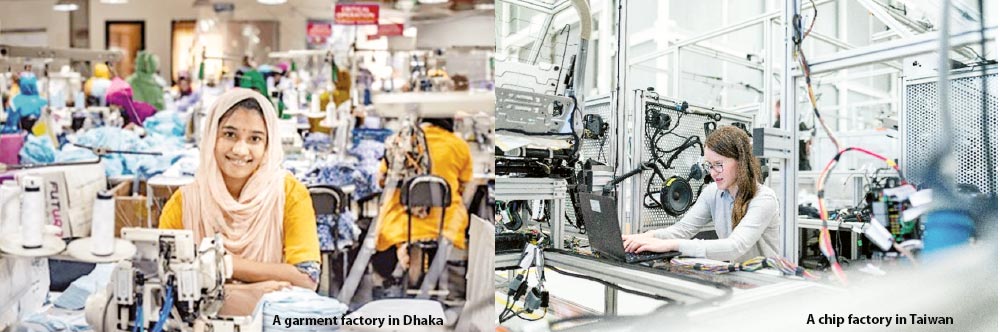
 Inside the Analysis
Dreams are free. Global competitiveness is earned.
Bangladesh has built an export powerhouse with needles, threads and millions of pairs of working hands. Now it faces a far more formidable challenge: entering an industry where scientific expertise, intellectual property and technological precision "not cheap labour "determine success.
Behind every smartphone, advanced computer, modern vehicle and artificial intelligence system lies the semiconductor, the tiny chip powering the digital economy. These chips have become instruments of economic strength, national security and geopolitical influence. Yet their production remains concentrated in economies that have invested for decades in research, specialised skills and sophisticated industrial ecosystems.
Can Bangladesh, a country that transformed itself through garment manufacturing, carve out a place in this trillion-dollar industry? Or will its silicon dream become another casualty of grand ambitions, weak execution and inadequate preparation?
The debate has gained momentum following an ambitious vision articulated by Professor Muhammad Mustafa Hussain, chief architect of the Silicon River Initiative and professor at Saudi Arabia’s King Abdullah University of Science and Technology (KAUST).
A Purdue University-trained expert and former programme manager of SEMATECH’s Emerging Technology Programme in Austin, he presented his vision in a keynote paper at a recent Dhaka conference attended by Prime Minister Tarique Rahman as chief guest.
His proposition is bold: Bangladesh should seek to replicate its garment success in semiconductors, with the industry targeting $1 billion in annual exports by 2030.
The opportunity deserves serious consideration. But optimism alone cannot build an industry. Bangladesh must confront a fundamental question: does it possess "or have a credible plan to develop "the skills, investment, infrastructure and institutions needed to compete?
A garment miracle, a different technological battle
Bangladesh’s garment revolution began not with thousands of factories or billions of dollars in exports, but with entrepreneurial vision and technology transfer.
In 1977, M. Noorul Quader established Desh Garments Ltd. The following year, 130 trainees, including 18 women, travelled to South Korea to acquire the skills needed to develop a modern garment industry. That pioneering initiative helped lay the foundations for one of the country’s most remarkable industrial transformations.
Today, Bangladesh has approximately 5,000 garment factories employing more than four million workers, predominantly women. According to the Bangladesh Garment Manufacturers and Exporters Association (BGMEA), garment exports reached approximately $39.35 billion in FY2024 "25, accounting for more than four-fifths of merchandise export earnings.
Workers mostly poor women are working in a Gazipur garments factory
The achievement demonstrates Bangladesh’s ability to mobilise workers, attract entrepreneurs, develop supply chains and serve demanding international markets. But the garment model cannot simply be transferred to semiconductors.
Advanced chip fabrication demands enormous capital, exceptionally clean environments, precision equipment and reliable utilities. Even chip design, which generally requires less capital than fabrication, involves complex engineering and rigorous verification.
The distinction is fundamental: success in labour-intensive manufacturing does not automatically translate into technological leadership.
Bangladesh must learn from the garment revolution without assuming that the silicon revolution can follow the same script.
From ambition to commercial reality
The global semiconductor industry offers Bangladesh an opportunity to diversify exports and move into higher-value activities. Chips underpin artificial intelligence, cloud computing, telecommunications, robotics, electric vehicles and countless other technologies reshaping the world economy.
Bangladesh has made an encouraging start in chip design. Invest Bangladesh has reported a pool of more than 700 chip designers, while the industry has set its sights on $1 billion in annual semiconductor exports by 2030.
But a pool of designers is not the same as a globally competitive industry. The critical questions are whether engineers have industry-ready skills, whether domestic firms can win international contracts, whether research can produce commercially viable intellectual property and whether exports can grow sustainably.
The country must also distinguish between the different segments of the semiconductor value chain. Chip design, verification, electronic design automation services, intellectual-property development, testing, packaging and assembly each present different technical and financial requirements. Advanced wafer fabrication is a far more capital-intensive undertaking.
Bangladesh need not begin by attempting to manufacture the world's most advanced chips. A more credible strategy would identify viable entry points, build specialised expertise and establish commercial partnerships with experienced international firms. Success in these areas could create the foundation for gradual expansion into more sophisticated activities.
The immediate priority should be to develop capabilities that customers will pay for "not to pursue the most glamorous segment of the industry.
The warning from failed technology ambitions
Bangladesh has seen how grand technological promises can falter when implementation fails to match ambition.
A November 2024 investigation by a leading daily reportedly highlighted concerns surrounding 15 ICT-related projects worth approximately Tk8,500 crore. Bangabandhu Hi-Tech City in Kaliakoir, Gazipur, illustrated the challenge of converting ambitious plans and substantial infrastructure spending into investment and employment on the scale originally envisaged.
The lesson is clear: a technology park is not a technology ecosystem. Buildings do not generate innovation simply because they are labelled high-tech. Laboratories do not guarantee commercially successful research, and investment announcements do not automatically produce exports.
A productive ecosystem requires reliable infrastructure, capable institutions, modern research facilities, skilled engineers, private-sector participation and access to international markets.
For semiconductors, the margin for error is particularly narrow. Unreliable power, weak intellectual-property protection, regulatory uncertainty and shortages of specialised talent can undermine competitiveness before a company secures its first major contract.
Bangladesh must therefore resist turning semiconductors into another prestige project measured by ribbon-cutting ceremonies, memoranda and projected export figures. Public spending and incentives should be tied to transparent milestones, credible business plans and measurable outcomes.
Bangalore's lesson: build capabilities before claiming success
Bangalore, widely recognised as India’s Silicon Valley, offers a useful lesson in how technological ecosystems evolve.
The expansion of electronics and engineering industries, the emergence of companies such as Infosys and Wipro, and the arrival of international technology firms strengthened the ecosystem. Texas Instruments established a presence in Bangalore in the 1980s, while India's economic liberalisation in the 1990s created further opportunities for technology businesses.
Bangalore did not become a technology hub through a single project or political announcement. Its growth rested on decades of accumulated scientific knowledge, engineering talent, industrial experience, entrepreneurship and international connections.
Bangladesh cannot simply reproduce that history. Its circumstances differ, and its semiconductor strategy must reflect its own capabilities. But the underlying lesson is universal: technological leadership grows from sustained investment in people, research and productive enterprise"not from infrastructure alone.
Build the bridge, not another industrial mirage
Bangladesh should not treat semiconductors as a substitute for garments. Its apparel industry remains a vital source of employment, foreign exchange and industrial experience. Instead, the country should use that manufacturing base as a platform for technological upgrading.
Automation, robotics, artificial intelligence, industrial sensors and digital supply-chain systems can improve productivity in garment factories while strengthening demand for engineering and electronics expertise. Closer collaboration among universities, manufacturers and technology companies could help connect traditional exports with emerging industries.
Realising this opportunity will require internationally competitive engineering education, specialised laboratories, reliable electricity, access to capital, predictable regulations and effective intellectual-property protection. Bangladesh must also retain skilled professionals and mobilise its diaspora to support research, entrepreneurship and international partnerships.
The government should establish a realistic, publicly accountable roadmap for the semiconductor industry, with measurable targets for skills development, private investment, research collaboration, international contracts and export earnings. Progress must be judged by commercial results, not conference speeches or the number of facilities inaugurated.
Above all, the country must be prepared for a long journey. Semiconductor competitiveness cannot be bought overnight or manufactured through declarations of intent.
Bangladesh has already demonstrated that it can transform a modest industrial beginning into a global export success. Its next challenge is to convert that manufacturing experience into technological capability.
The garment revolution taught Bangladesh how to dress the world. The semiconductor challenge is whether it can help power it. The answer will be determined not by the grandeur of the silicon dream, but by the quality of the engineers, the strength of the institutions and the discipline of execution behind it.

Loading...
Loading...
Also read





Editor : Iqbal Sobhan Chowdhury
Published by the Editor on behalf of the Observer Ltd. from Globe Printers, 24/A, New Eskaton Road, Ramna, Dhaka.
Editorial, News and Commercial Offices : Aziz Bhaban (2nd floor), 93, Motijheel C/A, Dhaka-1000.
Phone: PABX- 41053001-06; Advertisement: 41053012; 01793317829, 01550707291, E-mail: [email protected], [email protected] Online: email: [email protected] 41053014; 01550707297 Advertisement: 01550707296


