



| HEADLINE |

|

Crab, Kuchia exports syndicated, allege peers
Published : Saturday, 24 October, 2026 at 12:00 AM
Staff Correspondent


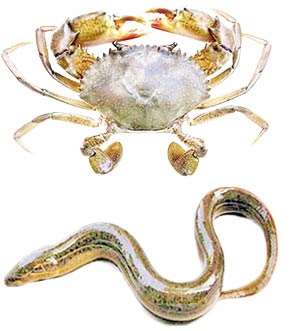 Bangladesh’s promising crab and kuchia (swamp eel) export trade is allegedly dominated by a handful of influential traders, leaving hundreds of businesses struggling to survive despite holding licences, investing capital and building overseas markets.
Small and mid-sized exporters allege that a group of just 15 to 16 traders controls the trade, while others are denied access to the sample testing and certification required for exports. Some have virtually abandoned the business, while others survive by shipping small quantities under other firms’ licences.
The alleged exclusion threatens not only exporters but also collectors, transport workers, labourers and others dependent on the supply chain. Traders warn that unequal access could cost Bangladesh valuable foreign currency while allowing a potentially lucrative sector to remain concentrated in a few hands.
Several traders allege that influential businesses enjoy preferential access with the help of some Department of Fisheries officials. The allegations could not be independently verified.
Probir, proprietor of B.C. Food, said he had exported crab and kuchia under another company’s licence until three or four months ago, when the arrangement ended.
“The entire sector is now in the hands of a syndicate,” he alleged. “A group is doing business by showing its power, while everyone else is deprived.”
Probir said the Fisheries Department was no longer accepting samples from the licensed firm through which he had shipped his products.
“If you are outside the syndicate, the department does not take samples,” he alleged.
Even traders holding their own export licences say they cannot resume shipments because their samples are not being collected or processed.
Gopal, proprietor of Biswas Trading, said he had exported crab and kuchia two to three months ago but had since been unable to secure the required certification.
“When we go to the Department of Fisheries, they say samples cannot be taken for now,” he said. “They tell us to contact the minister if we have any complaint. We return from the Fisheries Building empty-handed. Some of us have even gone to the minister and got no solution.”
Gopal questioned why licensed traders should be denied export opportunities, arguing that the sector’s potential was being squandered.
“There is huge potential in this sector, but because of one group, we cannot do business,” he said.
A former leader of the Bangladesh Live and Chill Food Exporters Association, who requested anonymity, said many traders had been unable to export for six to seven months.
The association has more than 300 members, around 85 of whom hold approval to export crab and kuchia to China. Yet, according to the former leader, only 15 to 16 are currently exporting.
“Everyone outside this syndicate is in bad shape,” he alleged. “Various people are labelled as associates of the previous regime and kept away from this business. Everyone who holds an export licence has the right to send crab and kuchia abroad, but in reality that is not happening.”
He said the concentration of trade had created an atmosphere of fear, discouraging disadvantaged traders from speaking out.
According to traders, exports require samples to be examined and coded by a Fisheries Department inspector before the necessary approvals and health certificates can be obtained.
Uttam, proprietor of Riju International, said each sample required a pay order of Tk 50,000. Exporters who prepare goods and invest in the process risk financial losses when their samples are not accepted.
“I have my own licence, yet I cannot send goods according to demand,” he said. “People linked to the big players are sending their goods. We cannot. We are somehow surviving on others’ licences, but for how long?”
Shaheen, proprietor of SNR Enterprise, said he was among the small traders forced to depend on other firms to keep his business afloat.
“Many cannot send at all,” he said. “Samples are not being taken from everyone, so they are suffering losses.”
Some traders alleged that political identities were being used to pressure businesses and that certain individuals had locked up premises to extort money. They said minority traders faced particular pressure.
The allegations could not be independently verified. The political organisations and individuals accused could not be reached for comment.
If substantiated, such practices would compound the difficulties of businesses already struggling with alleged barriers to regulatory approval. The claims require an impartial investigation.
Traders said crab is mainly sourced from Khulna, Satkhira and Chakaria in Chattogram, while kuchia comes from Rajbari, Netrokona, Sylhet and Chandpur, among other areas.
They estimate that around 99 per cent of exports go to China, with smaller markets in Thailand, Taiwan and Singapore. They believe broader market access and diversification could increase export earnings, provided businesses receive fair access to regulatory services.
A separate allegation concerns the collection of kuchia samples on September 27.
Some licensed exporters said they had submitted applications and documents and waited around two months without having their samples collected. Yet, they alleged, around 90 kuchia samples were collected from a particular packing firm on that date.
They have demanded an investigation into the sampling process and the role of officials at the Fisheries Building. Allegations have also been raised against an official and two female inspectors.
No independently verified documents were available to establish the claims, and the officials concerned had not responded by the time of reporting.
The traders have demanded an investigation into the legitimacy and procedures surrounding the 90 samples collected on September 27, cancellation of related certificates if irregularities are established, and the collection and testing of samples from all eligible applicants under the rules.
Exports of fish and fish products to China require inspection, sampling, testing and health certification. The central question raised by the traders is whether these procedures are being applied consistently.
Sultan Salauddin Tuku, State Minister for Fisheries and Livestock, told the New Nation that the ministry would examine complaints and take action where necessary.
“If there are any such complaints, we will examine them and take action,” he said. “Exporters facing such obstacles should meet me directly. Whoever’s samples are not being taken or who are not being given certificates, I will look into those complaints and take necessary action.”

Loading...
Loading...
Also read



Editor : Iqbal Sobhan Chowdhury
Published by the Editor on behalf of the Observer Ltd. from Globe Printers, 24/A, New Eskaton Road, Ramna, Dhaka.
Editorial, News and Commercial Offices : Aziz Bhaban (2nd floor), 93, Motijheel C/A, Dhaka-1000.
Phone: PABX- 41053001-06; Advertisement: 41053012; 01793317829, 01550707291, E-mail: [email protected], [email protected] Online: email: [email protected] 41053014; 01550707297 Advertisement: 01550707296


