



| HEADLINE |

|

Bangladesh’s Renewable Energy Strategy Turning Ambition into Action
Published : Sunday, 25 October, 2026 at 12:00 AM
Shahriar Ahmed Chowdhury


 After years of aspiration and a prolonged wait for a clear national roadmap, Bangladesh’s National Renewable Energy Development Strategy (2026-2030) arrives as a timely and potentially transformative policy framework. It offers an opportunity to accelerate renewable energy development, strengthen energy security, reduce exposure to volatile fossil fuel markets, and unlock investment and employment. However, its success will depend not on targets alone, but on translating this long-awaited ambition into bankable projects, affordable financing, modern power infrastructure, and accountable implementation.
From ambition to energy security
Bangladesh’s renewable energy transition is no longer simply a climate imperative; it is an economic and energy-security necessity. Dependence on imported fossil fuels exposes the country to international price volatility and puts pressure on foreign exchange reserves. Domestically generated renewable electricity can diversify the energy mix, reduce fuel import requirements, and improve long-term energy security.
The strategy targets 20 per cent of electricity generation from renewables by 2030, alongside at least 15 per cent electricity savings through energy efficiency and demand management. Its proposed interventions include rooftop and utility-scale solar, floating solar, agrivoltaics, wind, waste-to-energy, solar irrigation, battery storage, and green financing.
The strategy envisages 5,500 MW of rooftop solar, 4,500 MW of ground-mounted solar, and approximately 450-500 MW from other renewable technologies. With projected annual electricity demand of 135,000 gigawatt-hours (GWh), a 20 per cent renewable share would require approximately 27,000 GWh annually. Depending on the technology mix and capacity factors, the strategy estimates a requirement of around 12,000-14,000 MW of installed capacity, compared with approximately 2,000 MW of existing RE capacity, including on-grid and off-grid installations.Achieving this ambition requires coordinated planning, timely investment, and a credible implementation pathway.
Unlocking solar potential and investment
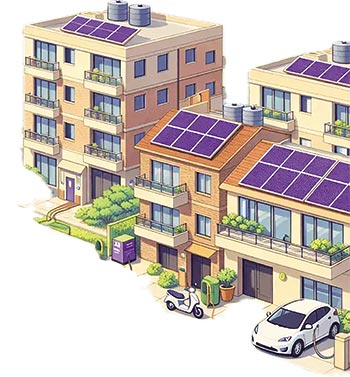
Rooftop solar offers substantial opportunities across industrial, commercial, institutional, and residential buildings without directly competing for agricultural land. Simpler net-metering procedures, predictable connection timelines, transparent export compensation, and accessible grievance redress mechanisms would encourage wider adoption. Third-party investment models could reduce upfront costs for businesses and households.
Floating solar and agrivoltaics also deserve attention, provided environmental safeguards and agricultural viability are carefully assessed. Utility-scale projects should avoid ecologically sensitive areas and ensure meaningful community consultation and fair compensation. Kaptai hydropower reservoir can be an ideal place for floating solar PV project development.
Financing remains another critical constraint. The proposed Renewable Energy Development Fund, concessional lending, credit guarantees, and incentives for domestic manufacturing could improve project viability. Bangladesh should mobilize international climate finance through institutions such as the Green Climate Fund and development partners, supported by bankable proposals and credible safeguards. Predictable power purchase agreements, payment security, competitive procurement, and timely approvals are equally essential to investor confidence.
Grid readiness must become a national priority
Renewable energy expansion will falter if transmission and distribution networks cannot accommodate additional generation. Coordinated renewable energy planning must therefore integrate generation, transmission, distribution, storage, and conventional power plant operations. The strategy’s proposed technical assessment of renewable energy integration during 2026-2030 should urgently establish grid hosting capacity, identify infrastructure requirements, and develop a time-bound grid integration roadmap.
Accurate forecasting is fundamental to this process. All solar power plants should submit hourly or 30-minute generation forecasts and corresponding schedules, supported by effective arrangements to ensure compliance. Similar requirements should be introduced for wind power plants.A Centralized Renewable Energy Management (CREM) system should be developed at NLDC to integrate weather information, plant forecasts, actual generation, and real-time grid conditions. This would improve dispatch planning, reserve management, and renewable energy utilization while reducing avoidable curtailment.
Flexible generation, storage, and ancillary services
Conventional power plants must become more responsive to variable renewable generation. Their minimum stable generation, ramp rates, primary frequency response, Automatic Generation Control (AGC) response, and start-up and shutdown flexibility should be assessed systematically. Necessary technical modifications and retrofitting should follow. Effective implementation of Free Governor Mode of Operation (FGMO) and AGC in applicable conventional plants is essential for national grid frequency stability and system security. Equipment installation must be supported by reliable communication, operating procedures, and performance testing.
Battery Energy Storage Systems (BESS) should be considered from the project development stage. For every proposed large scale solar and wind power project, the technically and economically justified storage power rating and energy capacity should be determined before projects are finalized. Storage requirements must reflect generation profiles, grid constraints, allowable ramp rates, demand patterns, and balancing needs.
Bangladesh should also progressively introduce an ancillary services framework to procure and compensate frequency control, operating reserves, reactive power support, balancing, and storage services. Appropriate technical standards and transparent compensation mechanisms would encourage investment in flexibility and improve system reliability.
Strengthening grid stability and distribution networks
All relevant inverter-based renewable energy resources should have adequate reactive power capability in accordance with applicable grid codes and connection requirements. Where network studies demonstrate a need, Flexible AC Transmission Systems (FACTS), including Static Synchronous Compensators (STATCOMs) and Static VAR Compensators (SVCs), should be installed to strengthen voltage stability and reactive power management.
At the distribution level, all utilities should progressively implement Supervisory Control and Data Acquisition (SCADA), Advanced Distribution Management Systems (ADMS), and Distributed Energy Resource Management Systems (DERMS). These systems would improve network visibility, support effective Demand Side Management (DSM), facilitate distributed generation, and strengthen voltage and outage management.Distribution utilities must also reduce unnecessary feeder tripping and unjustified manual feeder outages. Preventive maintenance, improved lightning protection and earthing, proper protection coordination, and stronger operational coordination can reduce avoidable interruptions and create greater capacity for rooftop solar integration.
Accountability must deliver results
The strategy’s proposed coordination mechanisms and monitoring dashboard offer a useful foundation, but every major target needs annual milestones, an accountable institution, an allocated budget, and measurable performance indicators. Public reporting should cover project awards, financial closure, commissioning, actual electricity generation, curtailment, and investment mobilized. The proposed 2028 midterm review should identify delays and enable evidence-based adjustments. Workforce development, accredited training, and opportunities for women and young professionals must also receive practical attention.
Turning strategy into action
Bangladesh’s National Renewable Energy Development Strategy (2026-2030) presents a long-awaited opportunity to reshape the country’s energy future. Yet renewable energy must be treated as a comprehensive power system transformation, not merely a collection of generation projects.Coordinated planning, accurate forecasting, flexible conventional plants, appropriately sized storage, modern grid controls, and reliable distribution networks must advance alongside investment and policy reform. The implementation window is short. By 2030, success must be measured by renewable electricity actually generated and reliably delivered-not simply by installed capacity or announced commitments.
The ambition is clear; now Bangladesh needs decisive implementation to turn its long-awaited strategy into energy security, economic resilience, and a cleaner future.
Director, Centre for Energy Research, United International University, Email: [email protected]

Loading...
Loading...
Also read



Editor : Iqbal Sobhan Chowdhury
Published by the Editor on behalf of the Observer Ltd. from Globe Printers, 24/A, New Eskaton Road, Ramna, Dhaka.
Editorial, News and Commercial Offices : Aziz Bhaban (2nd floor), 93, Motijheel C/A, Dhaka-1000.
Phone: PABX- 41053001-06; Advertisement: 41053012; 01793317829, 01550707291, E-mail: [email protected], [email protected] Online: email: [email protected] 41053014; 01550707297 Advertisement: 01550707296


