



| HEADLINE |

|

The way of lighting up a village
Published : Sunday, 15 November, 2026 at 12:00 AM
Md Aktarujjaman


 During the COVID-19 pandemic, my thoughts often returned to rural Bangladesh. After more than twenty years working in power systems and renewable energy abroad, I wondered whether what I had learned could improve the life of even one village family.
I did not begin with a government programme or a large grant. I began with a belief that lasting development should give people more than temporary assistance: it should give them skills, opportunities and a meaningful say in their future.
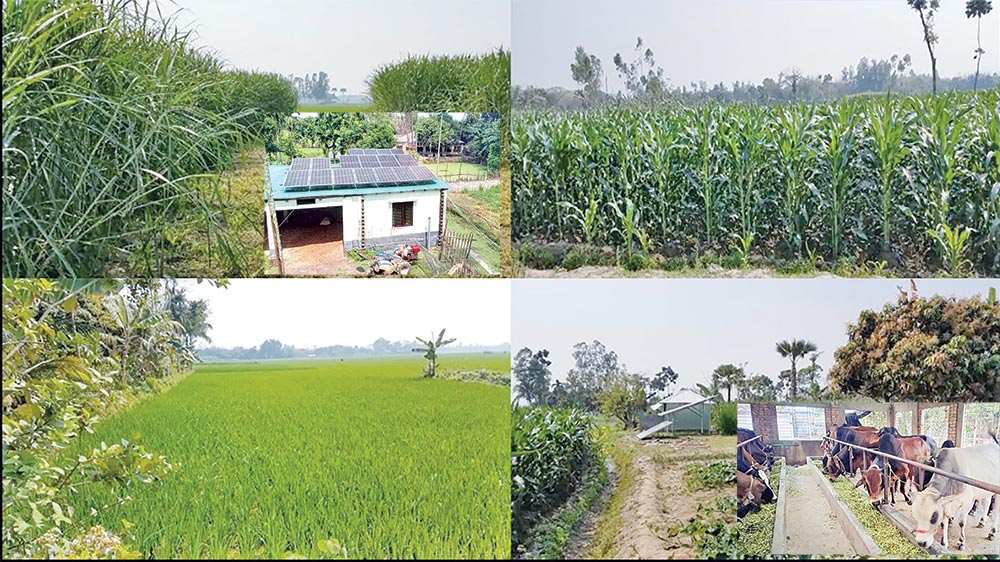
A solar-supported cattle farm at Mokamtola in Bogura is the start of a model I hope can spread: rural enterprise that leaves skills, assets and decisions in the village. At Mokamtola, a solar hybrid installation has shown that much of the farm’s diesel and electricity bills can be avoided.
At Mokamtola, the farm keeps 40-50 cattle. Since 2020, its 5 kW solar system (currently 20 kW with net-metering) has powered lighting, water pumping, fans and cooling, irrigated more than 50 bighas and saved over Tk 3 lakh a season in combined electricity and irrigation costs. It keeps power running during load-shedding and supports five permanent and five to ten temporary local jobs including jobs for women.
At Sonatala in Bogura, a standalone solar irrigation installation has shown that much of that cost need not be paid in diesel. Since 2021, the 5 kW system has irrigated more than 30 bighas and created one permanent job.
A farm that leaves something behind
My starting point was cattle farming. Many rural families have land and agricultural knowledge but lack the capital to establish a viable enterprise. Rather than purchase land, my approach is to work with landowning families through negotiated arrangements. I invest in facilities and operations; the family makes suitable land available. Under the model I envisage, agreements would last around ten years, with farm infrastructure ultimately remaining with the landowner, subject to agreed terms.
The point is not simply to raise cattle. It is to build an enterprise that leaves useful assets, experience and greater independence in the community. Clear agreements, proper maintenance and fair responsibilities are essential if the arrangement is to benefit everyone involved.
Work, dignity and opportunity
I want these farms to create meaningful work for people frequently overlooked: older residents, people from marginalised households and those without formal qualifications. With suitable roles and training, they can bring valuable local knowledge, commitment and judgement to the business. Employment, however, should be a beginning rather than an endpoint. Workers should have opportunities to learn accounting, livestock care and operations, and gradually take responsibility as supervisors, managers or even future entrepreneurs.
 Energy that works for farmers
Cattle farming also creates opportunities to use renewable energy in practical ways. At Mokamtola, a solar-supported farm has demonstrated how electricity can assist everyday operations. At Sonatala, a solar irrigation installation has reinforced the value of reducing dependence on diesel. These experiences have convinced me that solar power is most useful when it supports activities that directly improve farming and livelihoods.
There is potential to go further. Manure from cattle could be collected for biogas, subject to technical and financial assessment. Solar power can support water pumping, lighting, cooling and agricultural processing. When irrigation demand is low, other services may make use of available electricity. Integrating these activities could reduce waste, strengthen business viability and allow more value to remain within the village.
From one farm to an agro-renewable hub
The next phase is to expand carefully into integrated agro-renewable hubs. Depending on local needs, a hub could bring together solar irrigation, mini cold storage, hydroponics or greenhouse cultivation, a farmers’ shop and charging for electric rural transport. Batteries might help match solar generation with demand, while any grid exports would require utility approval. These services should be added only where there is a genuine market and a workable operating plan.
Pass the lamp on
Success should not mean owning countless farms myself. I would rather see village workers become managers, families gain stronger assets and local entrepreneurs adapt the model to their own circumstances. The first projects must prove themselves through fair wages, manageable costs, reliable services and lasting community benefit. Starting small gives us room to learn from mistakes and offers others something practical to assess before investing in a similar enterprise. None of this will work through technology alone; reliable operation, honest accounting and local trust must be built alongside the equipment. Only then should the idea spread. One lamp cannot light all of Bangladesh. But it can illuminate a path that another person chooses to follow. If this initiative leaves behind capable people who no longer need me to begin their own enterprises, that will be its most meaningful achievement.
He serves as General Manager, Power Systems at Akaysha Energy, based in Melbourne, Australia. His expertise covers a broad spectrum of renewable energy projects, from small-scale to utility-scale solar PV, wind power and battery energy storage systems (BESS), as well as build-own-operate developments, including a landmark 850 MW BESS project.

Loading...
Loading...
Also read






Editor : Iqbal Sobhan Chowdhury
Published by the Editor on behalf of the Observer Ltd. from Globe Printers, 24/A, New Eskaton Road, Ramna, Dhaka.
Editorial, News and Commercial Offices : Aziz Bhaban (2nd floor), 93, Motijheel C/A, Dhaka-1000.
Phone: PABX- 41053001-06; Advertisement: 41053012; 01793317829, 01550707291, 01550707296
E-mail: [email protected], [email protected]. [email protected], [email protected], [email protected], [email protected], Online-email: [email protected]


