



| HEADLINE |

|

Australia targets Bangladesh’s clean energy market with investment push
Published : Tuesday, 27 October, 2026 at 12:00 AM
Business Correspondent


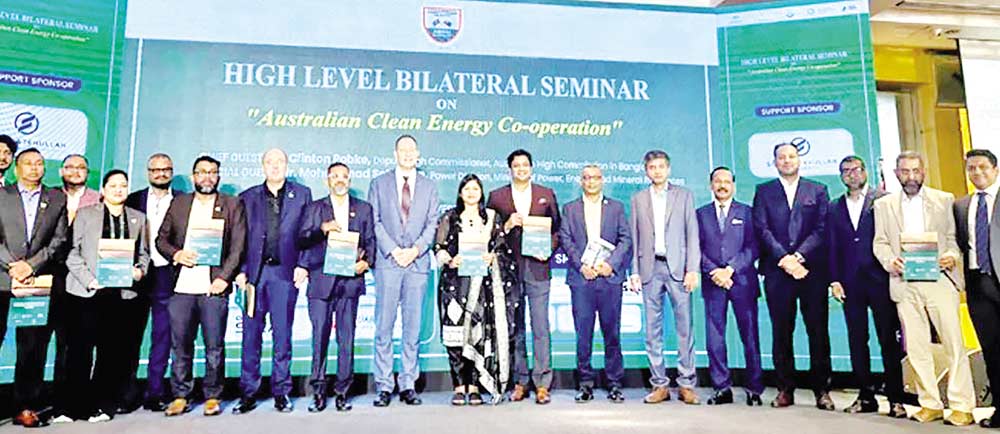 Australia is eyeing Bangladesh’s largely untapped clean energy market for investment, technology transfer and joint manufacturing, as the country struggles to diversify its power mix and meet rising energy demand sustainably.
Australian officials and industry representatives outlined opportunities for deeper commercial engagement at a high-level seminar, titled “Australian Clean Energy Co-operation”, held at the Westin in Dhaka on Monday, identifying renewable energy, battery storage, electric mobility and clean technology manufacturing as promising areas for bilateral partnerships.
The investment pitch comes as Bangladesh seeks to accelerate its energy transition under the Renewable Energy Policy 2025, which targets generating 20 per cent of electricity from renewable sources by 2030 and 40 per cent by 2041.
Renewable energy accounts for only around five per cent of the country’s total installed power generation capacity, leaving substantial room for investment and technological cooperation.
Australian Deputy High Commissioner Clinton Pobke said Bangladesh had made significant progress in expanding electricity access and building infrastructure, but ensuring secure, affordable and sustainable energy supplies amid growing demand remained a major challenge.
He welcomed the country’s renewable energy ambitions, saying Australian expertise could help Bangladesh overcome technical and operational challenges associated with the transition.
Promising areas for cooperation include rooftop solar, net metering, battery storage, grid-scale energy storage, electric vehicle charging infrastructure and floating solar projects. Pobke also highlighted the potential for installing solar panels on underused land within tea plantations to expand renewable power generation.
Australia’s experience in integrating renewable energy into electricity grids, maintaining system security, mobilising investment and developing a skilled workforce could support Bangladesh’s transition, he said.
“The real opportunity is to combine international experience and technology with Bangladesh’s local knowledge, its capabilities, and its priorities,” Pobke said.
Jody McKay, senior trade and investment commissioner at the Australian Trade and Investment Commission (Austrade), said the global energy transition was creating substantial commercial opportunities, particularly in solar power and biomass.
She said the Australian delegation had come not simply to showcase technologies but also to understand Bangladesh’s market, identify potential business partners and explore viable investment opportunities.
The participating Australian companies bring expertise in solar photovoltaic systems, battery technologies, engineering, electrical safety, energy modelling, skills development and renewable energy project development.
The proposed cooperation could extend beyond equipment exports to joint ventures, local manufacturing and assembly, engineering services and research collaboration �" arrangements that could help establish a stronger Australian commercial presence while developing Bangladesh’s domestic industrial capabilities.
M. Maksud, president of the Australia Bangladesh Chamber of Commerce and Industry (ABCCI), urged businesses from both countries to move beyond conventional buyer-seller relationships towards long-term investment partnerships.
He identified joint manufacturing and assembly of clean technologies, engineering and consultancy services, research and development, workforce training and innovative green financing as priority areas for cooperation.
Such partnerships could give Australian companies access to Bangladesh’s expanding clean energy market while creating skilled jobs and strengthening local manufacturing capacity, he said.
Battery energy storage systems, microgrids and intelligent energy management technologies also featured prominently in the discussions. These solutions could help improve grid stability as Bangladesh increases its reliance on intermittent renewable energy sources.
Electric mobility offers another potential avenue for collaboration, particularly in charging networks, battery management systems and local assembly capabilities.
John Grimes, chief executive of the Renewable Energy Council Asia Pacific (RECAP), encouraged Australian companies to adopt a collaborative approach to Bangladesh, working together to develop commercially viable opportunities across the clean energy sector.
The ABCCI reaffirmed its commitment to connecting businesses, financial institutions and regulators in both countries to facilitate investment and commercial partnerships.
For Bangladesh, the challenge will be to translate the growing interest into actual investment, technology transfer and locally grounded projects. For Australia, the opportunity lies in combining its clean energy expertise with Bangladesh’s market potential through partnerships that deliver commercial returns while supporting the country’s energy transition.

Loading...
Loading...
Also read



Editor : Iqbal Sobhan Chowdhury
Published by the Editor on behalf of the Observer Ltd. from Globe Printers, 24/A, New Eskaton Road, Ramna, Dhaka.
Editorial, News and Commercial Offices : Aziz Bhaban (2nd floor), 93, Motijheel C/A, Dhaka-1000.
Phone: PABX- 41053001-06; Advertisement: 41053012; 01793317829, 01550707291, E-mail: [email protected], [email protected] Online: email: [email protected] 41053014; 01550707297 Advertisement: 01550707296


