



| HEADLINE |

|

Century-old pillarless bridge remains a lifeline in S'ganj
Published : Wednesday, 28 October, 2026 at 12:00 AM
Our Correspondent


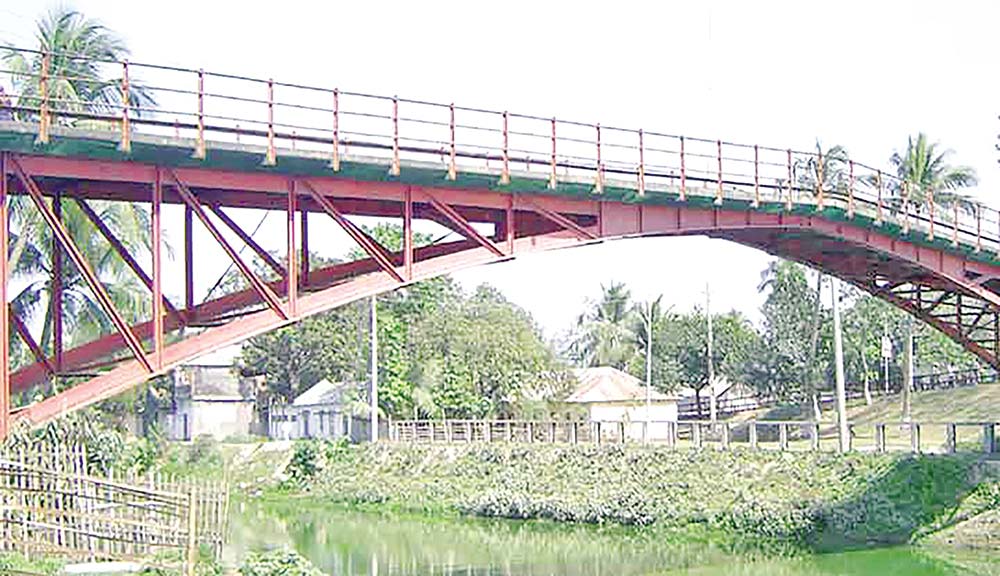 SIRAJGANJ, Oct 27: Thousands of people cross the historic Elliott Bridge in the Sirajganj town every day, making the more than a century-old structure an enduring part of the city's transport network.
Locally known as Baropul, the bridge spans the Katakhali Canal, a tributary connected to the Jamuna River that once divided Sirajganj town into two parts. Locals called the two sides Epar and Opar, and crossing between them was once difficult because of the strong current in the canal.
To address the problem, then sub-divisional officer Beatson Bell planned a bridge over the canal in 1892. He formed a committee with leading local businessmen and secured a donation of Tk 1,500 from the District Board. The businessmen also contributed financially to the project.
British engineer Stuart Hartland constructed the bridge at a cost of Tk 45,000. Charles Elliott, the then governor of Assam, inaugurated the foundation-laying work on August 6, 1892. The bridge was named after him and was completed in 1895.
The 180-foot-long and 16-foot-wide bridge stands around 30 feet above the canal. Its most distinctive feature is the absence of supporting pillars. Built with an arched steel structure and iron and cement, it was designed to allow large boats and ships to pass beneath it.
Today, the bridge is used by pedestrians and small vehicles. Its distinctive design and historical significance also attract visitors of different ages, making it a local attraction.
The bridge is repainted every year to maintain its appearance.
Syed Abdur Rouf Mukta, a former mayor of Sirajganj municipality, said the structure had suffered no significant structural damage since its construction.
Lawyers and freedom fighters Sukumar Chandra Das and Abu Mohammad Zulfikar said they had known the bridge since childhood and were amazed that it had retained its original character despite the many changes in the town over the decades.
The Elliott Bridge continues to stand as a witness to Sirajganj's history while serving generations of residents.

Loading...
Loading...
Also read



Editor : Iqbal Sobhan Chowdhury
Published by the Editor on behalf of the Observer Ltd. from Globe Printers, 24/A, New Eskaton Road, Ramna, Dhaka.
Editorial, News and Commercial Offices : Aziz Bhaban (2nd floor), 93, Motijheel C/A, Dhaka-1000.
Phone: PABX- 41053001-06; Advertisement: 41053012; 01793317829, 01550707291, 01550707296
E-mail: [email protected], [email protected]. [email protected], [email protected], [email protected], [email protected], Online-email: [email protected]


