



| HEADLINE |

|

BGMEA warns of factory closures if garment-sector unrest persists
Published : Sunday, 1 November, 2026 at 7:22 PM
Observer Online Report



Garment factory owners do not want to continue operations if labour unrest, disorder and vandalism persist in the apparel sector, Bangladesh Garment Manufacturers and Exporters Association (BGMEA) President Mahmud Hasan Khan Babu has said.
He said factories could not sustain production without a conducive operating environment while speaking to journalists at his office on Sunday evening (November 1).
“Every member wants to run their factory every day. We invested in these businesses to keep factories operational. But production is impossible without an environment suitable for running factories,” he said.
He noted that the government had already issued a gazette notification to form a minimum wage board and that workers had been informed of the move earlier. However, incidents of disorder and factory vandalism had continued in different areas, disrupting production.
The BGMEA president said factory owners were deeply concerned about the situation, although most workers wanted to work and employers wanted to keep their factories open. He alleged that a small group of people posing as workers were trying to create disorder.
He urged the Home Ministry and law enforcement agencies to take strict action against those involved in the unrest and bring them to justice. He also said the association had conveyed the message that factory owners would not want to continue operations if the disorder did not stop.
BGMEA will soon hold discussions with the government to decide on the next course of action, he added.
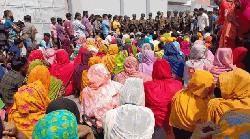
Meanwhile, garment workers staged demonstrations, work stoppages and road blockades in Mirpur, Gazipur and Savar on Sunday, demanding, among other things, a minimum monthly wage of Tk 30,000. The protests disrupted traffic in industrial areas, prompting authorities to declare holidays at several factories.
According to BGMEA data, 318 of the 2,134 garment factories across five industrial zones were closed, with 702,255 workers leaving their workplaces.
In the Dhaka Metropolitan Police area, 68 of 320 factories in Mirpur were closed, forcing 51,625 workers to leave. In the Gazipur and Mymensingh industrial zones, 225 of 836 factories were closed, with 525,360 workers walking out.
In the Savar-Ashulia and Zirabo industrial zones, 25 of 441 factories were closed, with 125,270 workers leaving their workplaces.
Workers said rising commodity prices had made it difficult to manage household expenses with their current wages. They also alleged that male workers faced discrimination because employers gave preference to female workers. They demanded a minimum monthly wage of Tk 30,000 to address these concerns.
Editorial flag: The factory-closure figures by area add up to 318, but the total number of factories in the three listed areas is 1,597, not 2,134. The source does not specify the other two industrial zones included in the overall BGMEA figure.
- MaT

Loading...
Loading...
Also read





Editor : Iqbal Sobhan Chowdhury
Published by the Editor on behalf of the Observer Ltd. from Globe Printers, 24/A, New Eskaton Road, Ramna, Dhaka.
Editorial, News and Commercial Offices : Aziz Bhaban (2nd floor), 93, Motijheel C/A, Dhaka-1000.
Phone: PABX- 41053001-06; Advertisement: 41053012; 01793317829, 01550707291, 01550707296
E-mail: [email protected], [email protected]. [email protected], [email protected], [email protected], [email protected], Online-email: [email protected]


