



| HEADLINE |

|

Govt plans two monorail routes in Dhaka by 2030
Published : Saturday, 7 November, 2026 at 1:57 PM
Observer Online Report


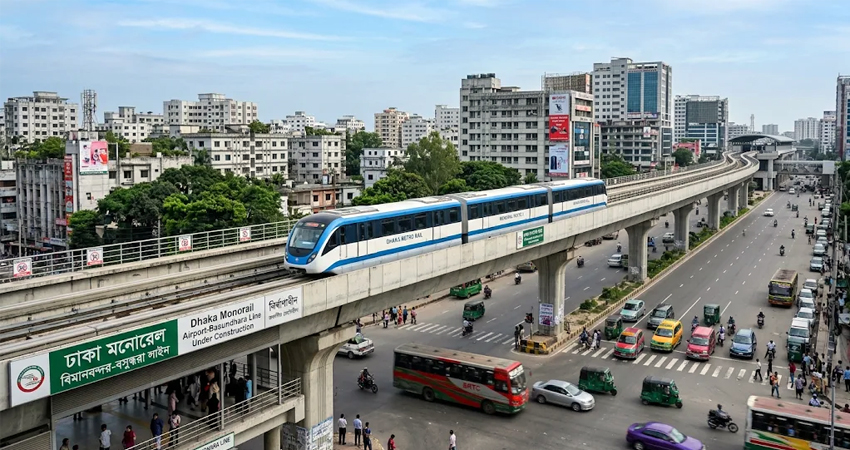
Collected Photo
The government is moving forward with plans to construct two monorail routes in the capital by 2030, with detailed design work currently underway following the completion of pre-feasibility studies.
According to Dr Md Mashiur Rahman, Additional Executive Director of the Dhaka Transport Coordination Authority (DTCA), the proposed monorail system aims to expand Dhaka's public transport network, offering an eco-friendly and sustainable transit solution to ease passenger movement in high-demand corridors.
Consultants from Bangladesh University of Engineering and Technology (BUET) completed the pre-feasibility study under a 7.57 crore BDT allocation from the government's revenue budget. The detailed designs are scheduled for submission within the next six months.
Under the updated Revised Strategic Transport Plan (RSTP), five potential monorail corridors spanning 79.4 kilometres were initially identified, particularly targeting dense urban pockets where feeder bus services are limited and conventional heavy-rail transit infrastructure is difficult to construct due to spatial constraints.
The five proposed corridors under consideration span a combined 79.4 kilometres, comprising the 25.2-kilometre Airport–Basundhara route via Purbachal and Jolsiri, the 14.6-kilometre Middle Badda–Bhulta route, the 10.3-kilometre Rampura–Demra route, the 11.7-kilometre Mohammadpur–Postogola route, and the 17.6-kilometre Airport–Savar route via Uttara Centre.
Additional route proposals under consideration include Monorail-8 (Dhaka University TSC to Kamrangirchar with nine stations), Monorail-10 (Alubdi to West Agargaon/Shyamoli with 10 stations), and Monorail-13 (Paltan to Sadarghat/Jhilmil with six to 11 stations).
One priority route will be selected within three months, followed by final route alignment based on technical feasibility, passenger demand, financial viability, and land availability for stations and depots.
A BUET consultant told state news agency BSS that the study evaluated population density, catchment areas, traffic congestion, land availability for maintenance depots, and future expansion possibilities. Local and expatriate Bangladeshi experts have been engaged in the technical, economic, and environmental assessment process.
-EM

Loading...
Loading...
Also read







Editor : Iqbal Sobhan Chowdhury
Published by the Editor on behalf of the Observer Ltd. from Globe Printers, 24/A, New Eskaton Road, Ramna, Dhaka.
Editorial, News and Commercial Offices : Aziz Bhaban (2nd floor), 93, Motijheel C/A, Dhaka-1000.
Phone: PABX- 41053001-06; Advertisement: 41053012; 01793317829, 01550707291, 01550707296
E-mail: [email protected], [email protected]. [email protected], [email protected], [email protected], [email protected], Online-email: [email protected]


