



| HEADLINE |

|

Textbook delays, exam failures, strikes hit education in 2025
Published : Saturday, 3 January, 2026 at 12:00 AM
Staff Correspondent


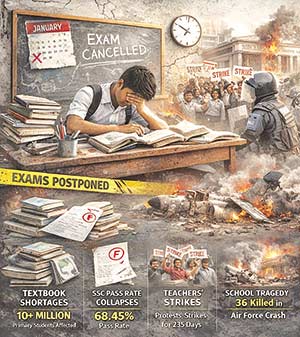 The year 2025 has laid bare the structural fragility, administrative inefficiency, and policy contradictions within Bangladesh's education sector. Students, teachers, and administrators faced unprecedented uncertainty, grappling with textbook shortages, exam disruptions, legal disputes, and campus political tensions.
Textbook Delays and Academic Disruption
The year began with severe disruption in primary and secondary education due to delays in textbook distribution. Millions of students waited until the third week of January to receive even one textbook, creating a significant learning deficit.
Official records indicate that over 10 million government primary school students attended classes for only 92 days in the year, with scheduled holidays, strikes, and closures due to floods, cyclones, and a cold wave further reducing instructional time.
Collapse of SSC and HSC Results
The crisis deepened as SSC and HSC results revealed a historic decline in student performance. The SSC pass rate dropped to 68.45 percent-14.59 percentage points lower than 2024, marking the lowest pass rate in 16 years. Among 1,928,181 examinees, only 1,303,426 passed, with failures concentrated in English and mathematics. Barisal recorded the lowest pass rate at 56.38 percent, while Rajshahi topped the boards at 77.63 percent. The number of GPA-5 achievers also fell sharply to 139,032, over 43,000 fewer than the previous year. Female students outperformed males, with pass rates of 70.67 percent and 65.11 percent, respectively.
HSC results mirrored this trend, with the average pass rate across 11 boards declining to 58.83 percent, the lowest in 21 years. Notably, 202 institutions reported 100 percent failure. Dhaka Board Chairman Professor Dr. Khandokar Ehsanul Kabir attributed the decline to long-standing qualitative weaknesses, lack of subject-based preparation, and systemic mismanagement.
Teachers' Agitation and Administrative Weakness
Teachers' movements dominated the public and political discourse throughout 2025, with protests, sit-ins, and marches occurring for 235 days. Government and non-government teachers demanded salary revisions, house rent allowances, festival benefits, job security, promotion, nationalization of Ebtedayi Madrasas, and MPO inclusion.
Government primary schools operated for only 92 days, while secondary teachers boycotted exams, and seven colleges faced week-long strikes due to legal ambiguities surrounding notifications from Dhaka Central University. Eminent educationist Rasheda K Chowdhury warned, "This cannot be the education system of any civilized country. We will pay the price for this."
Professors Dr. Manzoor Ahmed and Dr. Sadiq Hasan emphasized that effective education requires at least 160-180 teaching days annually, warning that learning deficits could produce an inefficient educated population.
Legal Complexities and Scholarship Examinations
Despite disruptions, the eighth-grade junior scholarship examination returned after 12 years, with 346,591 students participating across 611 centers from December 28 to 31. However, the primary-level scholarship exam remains stalled due to a High Court suspension, following a writ petition challenging the inclusion of private school students under the 2008 policy. Preparations remain uncertain until legal proceedings conclude.
Student Politics and Campus Dynamics
Student parliament elections resumed at major public universities, including Dhaka, Jahangirnagar, Rajshahi, Chittagong, Shahjalal University of Science and Technology, and Gana University. The elections highlighted the dominance of Islami Chhatra Shibir, intensifying political debates on campuses and reflecting broader challenges of youth political engagement.
Milestone Tragedy
The sector's vulnerability was tragically exposed on July 21, when an Air Force fighter jet crashed at Milestone School and College in Diyabari, Uttara, killing 36 people, including 28 students. The disaster underscored persistent gaps in institutional safety and regulatory oversight.
Policy, Legal, and Governance Imperatives
The events of 2025 demonstrate that delays, legal entanglements, administrative inertia, and political contestation are deeply intertwined, undermining learning outcomes and institutional credibility. With nearly 25 million students affected and unprecedented cumulative instructional loss, the consequences for national human capital, productivity, and social equity are profound.
Professor Dr. Khandokar Ehsanul Kabir emphasized that exam results and administrative lapses highlight systemic weaknesses that require comprehensive policy overhaul, managerial reforms, and strict enforcement of educational standards. The year 2025 will be remembered as a stark reminder of the urgent need for legal clarity, governance efficiency, and political will to stabilize Bangladesh's education sector.

Loading...
Loading...



Editor : Iqbal Sobhan Chowdhury
Published by the Editor on behalf of the Observer Ltd. from Globe Printers, 24/A, New Eskaton Road, Ramna, Dhaka.
Editorial, News and Commercial Offices : Aziz Bhaban (2nd floor), 93, Motijheel C/A, Dhaka-1000.
Phone: PABX- 41053001-06; Advertisement: 41053012; 01793317829, 01550707291, E-mail: [email protected], [email protected] Online: email: [email protected] 41053014; 01550707297 Advertisement: 01550707296
Published by the Editor on behalf of the Observer Ltd. from Globe Printers, 24/A, New Eskaton Road, Ramna, Dhaka.
Editorial, News and Commercial Offices : Aziz Bhaban (2nd floor), 93, Motijheel C/A, Dhaka-1000.
Phone: PABX- 41053001-06; Advertisement: 41053012; 01793317829, 01550707291, E-mail: [email protected], [email protected] Online: email: [email protected] 41053014; 01550707297 Advertisement: 01550707296


