



| HEADLINE |

|
Braille system for dignified life
Published : Sunday, 4 January, 2026 at 12:00 AM
Manik Esahak Biswas


 Every year on January 4th, the global community observes World Braille Day. It is a day dedicated to Louis Braille, the man who, in the 19th century, transformed a system of military "night writing" into a tactile language that unlocked the world of literacy for millions. In the context of Bangladesh - a nation striving to transition into a developed country, in Bangladesh, this day is not merely a commemorative event on the calendar; it is a profound call to action for human rights, governance, and social justice.
As we look toward upcoming national milestones and elections, the inclusion of the visually impaired into the mainstream of society is no longer a peripheral "charity" issue. It is a fundamental benchmark of our progress toward the Sustainable Development Goals (SDGs) and the realization of our Constitutional mandates.
Why Braille Matters in the Digital Age: There is a common misconception among policymakers and the general public that in the age of screen readers and Artificial Intelligence, Braille is becoming obsolete. This could not be further from the truth. For a sighted person, literacy is the ability to read and write, not just listen to an audiobook. For a visually impaired person, Braille is literacy.
Listening is not the same as learning grammar, spelling, or the structural nuances of language. In Bangladesh, where roughly 17 million people live with some form of disability - a significant portion being visually impaired - the lack of Braille materials in schools and public libraries remains a wall between a talented individual and their potential.
The COVID-19 pre and post pandemic revealed the lethality of this gap. When essential health guidelines were disseminated primarily through visual posters or digital graphics without alt-text or Braille versions, the visually impaired were left in a vacuum of information. World Braille Day reminds us that accessibility is a matter of life and death.
Bangladesh possesses a robust legal framework. Our Constitution, under Articles 11, 15, 17, and 29, guarantees human dignity, basic necessities, and equality of opportunity for all citizens. Furthermore, the Rights and Protection of Persons with Disabilities Act (2013) shifted the national paradigm from a "welfare-based" approach to a "rights-based" approach. However, a chasm exists between the law and its implementation. Consider the recent case of Bishwajit Boshak, a meritorious student who secured a GPA of 4.28 in his SSC exams. Despite being selected for Chittagong College by the Ministry of Education, the college administration hesitated to admit him simply because he was visually impaired.
This is not just a failure of a single institution; it is a symptom of a systemic lack of Good Governance. When a "qualified" candidate is denied entry based on a physical attribute, it violates Section 33 of the 2013 Act, which explicitly prohibits discrimination in educational institutions.
To observe World Braille Day meaningfully in Bangladesh, we must move beyond the "barren tree" of unenforced laws. We must ask: If the law exists, why are Bishwajit and Al-Amin still fighting for a seat in a classroom?
The Bangladesh government has frequently voiced its commitment to the 2030 Agenda for Sustainable Development. The observation of World Braille Day is directly linked to several key SDGs:
SDG 4 (Quality Education): Ensuring inclusive and equitable quality education. This is impossible without the mass production of Braille textbooks and the training of teachers in tactile pedagogy. SDG 8 (Decent Work and Economic Growth): Literacy through Braille is the gateway to employment. Without the ability to read and write independently, visually impaired citizens are often relegated to low-skill jobs, stunting national economic potential. SDG 10 (Reduced Inequalities): Empowering and promoting the social, economic, and political inclusion of all, irrespective of disability. SDG 16 (Peace, Justice, and Strong Institutions): This requires "Good Governance" - ensuring that the Rights and Protection of Persons with Disabilities Act is not just a document, but a lived reality enforced by the judiciary and the executive.
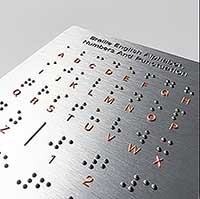
To make World Braille Day a remarkable turning point in Bangladesh, we propose a multi-sectoral shift. The Ministry of Social Welfare and the Ministry of Education must coordinate to ensure that "Inclusive Education" isn't just a buzzword. This requires- Mandatory Braille literacy training for all special education teachers. Enforcing Schedule 5 and 6 of the 2013 Act, which mandates ICT accessibility and the production of information in audible and tactile formats. Increasing the budgetary allocation for the Social Safety Net, specifically for assistive technologies.
For the Corporate Sector and Employers: Private entities must stop viewing "reasonable accommodation" as a burden. Hiring a visually impaired professional who is Braille-literate and tech-savvy brings unique perspectives to problem-solving and fulfills corporate social responsibilities in a meaningful way.
For Civil Society and the Judiciary: Organizations with human rights defenders must continue to challenge discriminatory practices in court. The judiciary must take a proactive role in ensuring that the "Non-discrimination" clauses of the Constitution are upheld in every college admission and job application.
Joining the Marrakesh Treaty: Bangladesh must prioritize joining the Marrakesh Treaty, which facilitates the creation and international transfer of Braille and other accessible-format books. This would end the "book famine" that currently starves the minds of our visually impaired youth.
From Perception to Participation: World Braille Day is a reminder that the disability is not in the person, but in an environment that fails to provide the right tools. When Louis Braille created his system, he didn't just create a code; he created a tool for autonomy, privacy, and dignity.
In Bangladesh, we have the laws, we have the talent, and we have the vision of a "Smart Bangladesh." What we lack is the consistent application of Good Governance to bridge the gap. We must stop seeing persons with visual impairments as "backward sections" to be helped, and start seeing them as valuable assets to be empowered.
As we celebrate this day, let it be a pledge from every citizen, policymaker, and educator: that no student like Bishwajit will ever be turned away from a gate of learning again. Let us build a Bangladesh where the "touch of a finger" is enough to open the doors of the future.
An inclusive, fair, and just society is not a gift - it is a right. And that right begins with a single dot of Braille.
The writer is a social development worker
Loading...
Loading...
Also read



Editor : Iqbal Sobhan Chowdhury
Published by the Editor on behalf of the Observer Ltd. from Globe Printers, 24/A, New Eskaton Road, Ramna, Dhaka.
Editorial, News and Commercial Offices : Aziz Bhaban (2nd floor), 93, Motijheel C/A, Dhaka-1000.
Phone: PABX- 41053001-06; Advertisement: 41053012; 01793317829, 01550707291, E-mail: [email protected], [email protected] Online: email: [email protected] 41053014; 01550707297 Advertisement: 01550707296
Published by the Editor on behalf of the Observer Ltd. from Globe Printers, 24/A, New Eskaton Road, Ramna, Dhaka.
Editorial, News and Commercial Offices : Aziz Bhaban (2nd floor), 93, Motijheel C/A, Dhaka-1000.
Phone: PABX- 41053001-06; Advertisement: 41053012; 01793317829, 01550707291, E-mail: [email protected], [email protected] Online: email: [email protected] 41053014; 01550707297 Advertisement: 01550707296


