



| HEADLINE |

|

HR crisis deepens as violence surge in 2025: Rights watchdogs



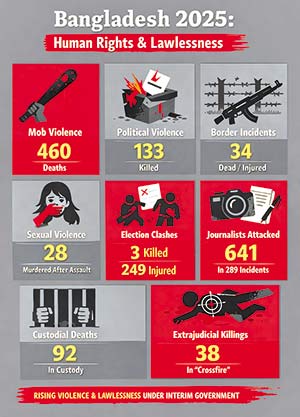 The year 2025, governed entirely by the interim administration, witnessed a dramatic deterioration in law and order and human rights, according to multiple human rights organizations, including Ain o Salish Kendra (ASK), the Manabadhikar Shongskriti Foundation (MSF), and the Human Rights Support Society (HRSS).
Instead of improvement, the political, social, democratic, and legal environment became increasingly precarious, with mob violence, targeted attacks, and custodial fatalities rising sharply across the country.
Mob Violence Escalates Alarmingly
Mob justice emerged as a dominant and deadly trend, claiming 460 lives-more than triple the 126 fatalities recorded in 2024. Human rights groups documented 292 incidents in which 168 people died and 248 were injured, involving accusations ranging from theft to religious insults.
"Society is witnessing unprecedented insecurity. The government has not taken any initiative to stop mob violence… they do not want it," said Saidur Rahman, CEO of MSF. Analysts argue that these patterns reflect both societal unrest and systemic governmental inaction.
Political Violence Intensifies Ahead of Elections
Political unrest surged in 2025, fueled by disputes over party dominance, committee formation, elections, and extortion. Reports documented 914 incidents leading to 133 deaths among party members and activists. Following the December 11 announcement of the election schedule, targeted attacks escalated, notably the December 18 murder of Shahid Sharif Osman Hadi.
Overall, 5,604 people were affected in 599 incidents, including 86 deaths and 5,518 injuries. Election-related confrontations accounted for 252 victims (3 dead, 249 injured), while attacks on political leaders claimed 47 lives and injured 187 others. Notable incidents included looting in Sylhet (May), six deaths during an NCP program attack in Gopalganj (July), the November shooting in Chittagong-8, and the February demolition of Bangabandhu Sheikh Mujibur Rahman's house.
Experts warn that political rivalries increasingly take violent, vindictive forms, undermining democratic dispute resolution.
Attacks on Media and Freedom of Expression
Journalists faced systematic targeting, with 641 reporters affected in 289 incidents, including assaults, threats, and legal harassment. Media outlets such as Prothom Alo and The Daily Star faced vandalism, arson, and operational blockages on December 18. High-profile arrests, including journalist Manjurul Alam Panna, former secretary Abu Alam Mohammad Shahid Khan, and Dhaka University law professor Hafizur Rahman Karzon, further raised concerns about freedom of expression.
Law and Order, Judicial Backlog, and Custodial Deaths
The law and order situation remained critical, marked by widespread extortion, corruption, politically motivated arrests, and custodial fatalities. Over 212,800 people were arrested nationwide, including under joint operations such as "Operation Devil Hunt." Reports indicate 244 cases filed against former Prime Minister Sheikh Hasina and party leaders, naming thousands of individuals as defendants.
Judicial inefficiency compounded insecurity, with 4.52 million cases pending, delaying access to justice. Custodial deaths rose to alarming levels: at least 92 people died in custody, including 20 in police detention. Extrajudicial killings-so-called "crossfires"-claimed at least 38 lives, while prison fatalities exceeded 100 due to illness, torture, or unclear circumstances.
Gendered and Child Violence Escalates
Violence against women and children reached unprecedented levels. Over 2,000 women and girls were tortured, 828 raped (nearly half minors), 28 murdered following sexual assault, and 168 forced to commit suicide. Children were disproportionately affected, with 1,023 subjected to torture and 410 killed due to abuse or neglect.
Domestic violence, dowry-related abuse, acid attacks, sexual harassment, and attacks on domestic workers persisted across the country, particularly in Dhaka, Narayanganj, Gazipur, and Mymensingh. Reports documented 749 rapes, including 180 gang rapes, and 193 women faced systemic sexual harassment.

Loading...
Loading...
Also read



Editor : Iqbal Sobhan Chowdhury
Published by the Editor on behalf of the Observer Ltd. from Globe Printers, 24/A, New Eskaton Road, Ramna, Dhaka.
Editorial, News and Commercial Offices : Aziz Bhaban (2nd floor), 93, Motijheel C/A, Dhaka-1000.
Phone: PABX- 41053001-06; Advertisement: 41053012; 01793317829, 01550707291, E-mail: [email protected], [email protected] Online: email: [email protected] 41053014; 01550707297 Advertisement: 01550707296
Published by the Editor on behalf of the Observer Ltd. from Globe Printers, 24/A, New Eskaton Road, Ramna, Dhaka.
Editorial, News and Commercial Offices : Aziz Bhaban (2nd floor), 93, Motijheel C/A, Dhaka-1000.
Phone: PABX- 41053001-06; Advertisement: 41053012; 01793317829, 01550707291, E-mail: [email protected], [email protected] Online: email: [email protected] 41053014; 01550707297 Advertisement: 01550707296


