



| HEADLINE |

|

Debt burden deepens as foreign loans surge
Published : Wednesday, 28 January, 2026 at 12:00 AM
Mizanur Rahman


 Bangladesh is facing growing concerns over a potential foreign debt trap, as the government's total debt-including both domestic and external borrowing-has exceeded US$113 billion, according to the latest debt bulletin released by the Finance Division.
Economists warn that weak revenue generation, ambitious development spending, and heavy reliance on foreign loans are intensifying pressure on the country's economy.
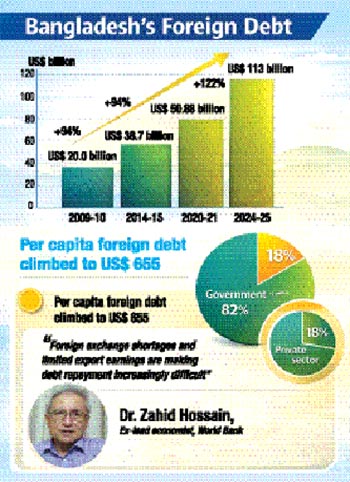
With rising debt levels, Bangladesh's per capita foreign debt has climbed to US$655, the highest since the COVID-19 pandemic. Analysts argue that a significant portion of the borrowing has been driven by indiscriminate project implementation, often without adequate assessment of repayment capacity or economic returns.
Economists note that while debt accumulation continues, the government must now allocate billions annually to service both principal and interest payments.
"Not only are we repaying loans taken by previous governments, but the current government has also borrowed externally for operational expenses, further adding to the burden," said one economist, emphasizing that many loans were taken in the name of development but yielded limited immediate returns.
Over the past decade, Bangladesh's foreign borrowing has increased steadily, particularly to finance large-scale infrastructure and energy projects. Projects such as the Padma Bridge, Dhaka Metro Rail, Rooppur Nuclear Power Plant, and Karnaphuli Tunnel, taken during the Awami League government's 15-year rule, are expected to contribute to long-term growth. However, experts caution that economic benefits will take several years to materialize, while debt repayment obligations have already begun to mount.
Data show that foreign debt stood at around US$20 billion in the 2009-10 fiscal year, rising sharply to approximately US$113 billion in 2024-25. In 2014-15, it was about US$38.7 billion, and in 2020-21, US$50.88 billion.
Of the current total, nearly US$81 billion has been accumulated over the past 15 and a half years, mainly through borrowing from international lenders including the IMF, World Bank, Asian Development Bank (ADB), JICA, and AIIB. About 82 per cent of foreign debt lies in the government sector, with the remaining 18 per cent in the private sector.
Debt servicing costs are rising rapidly. In the current fiscal year, Bangladesh is expected to spend around US$3.5 billion in foreign currency on debt repayments-more than double the amount paid five years ago. A substantial portion of newly acquired loans is reportedly being used to repay old debts and interest, raising concerns about sustainability.
Meanwhile, revenue collection remains weak amid sluggish business activity, driven by political uncertainty, economic instability, and deteriorating law and order. As trade and investment slow, government revenue has declined, forcing greater reliance on borrowing to meet state expenditures.
The pressure has been exacerbated by a persistent foreign exchange crisis. Despite import controls and various policy measures, foreign exchange reserves have continued to fall, currently standing at US$24 billion. Higher external payments than earnings have made it increasingly difficult to stabilize reserves.
Compounding the challenge, the IMF has imposed borrowing limits on Bangladesh. Under IMF conditions, the country will be allowed to borrow a maximum of US$8.44 billion in foreign loans in the 2025-26 fiscal year, with phased limits throughout the year.
The IMF's latest Debt Sustainability Analysis shows Bangladesh's debt-to-export ratio exceeding 162 per cent, far above the estimated safe threshold, while the debt-to-revenue ratio has also risen sharply.
Former World Bank lead economist in Dhaka, Dr Zahid Hossain, said that optimism surrounding Bangladesh's debt position has diminished. "Foreign exchange shortages and limited export earnings are making debt repayment increasingly difficult," he observed.
Echoing similar concerns, Prof Mostafizur Rahman, Distinguished Fellow at the Centre for Policy Dialogue (CPD), warned that debt repayment pressure will intensify as grace periods for large projects end.
"When both interest and principal repayments begin simultaneously, pressure on foreign exchange reserves will increase significantly," he said, stressing the need for caution in contracting new foreign loans and calling for improved debt projections.
"There are uncertainties in our repayment forecasts that must be addressed. Otherwise, policymakers will struggle to make timely and informed decisions," Prof Rahman added. He suggested that negotiating easier loan terms and seeking budgetary support could provide some short-term relief amid ongoing challenges.

Loading...
Loading...
Also read



Editor : Iqbal Sobhan Chowdhury
Published by the Editor on behalf of the Observer Ltd. from Globe Printers, 24/A, New Eskaton Road, Ramna, Dhaka.
Editorial, News and Commercial Offices : Aziz Bhaban (2nd floor), 93, Motijheel C/A, Dhaka-1000.
Phone: PABX- 41053001-06; Advertisement: 41053012; 01793317829, 01550707291, E-mail: [email protected], [email protected] Online: email: [email protected] 41053014; 01550707297 Advertisement: 01550707296
Published by the Editor on behalf of the Observer Ltd. from Globe Printers, 24/A, New Eskaton Road, Ramna, Dhaka.
Editorial, News and Commercial Offices : Aziz Bhaban (2nd floor), 93, Motijheel C/A, Dhaka-1000.
Phone: PABX- 41053001-06; Advertisement: 41053012; 01793317829, 01550707291, E-mail: [email protected], [email protected] Online: email: [email protected] 41053014; 01550707297 Advertisement: 01550707296


