



| HEADLINE |

|
Gas crunch now hits fertiliser, threatens food security
Published : Thursday, 6 August, 2026 at 12:00 AM
Mizanur Rahman


 The country's worsening gas crisis is no longer confined to power generation and industrial production. It is now disrupting fertiliser manufacturing, depleting government stocks and raising concerns over whether adequate supplies can be ensured ahead of the next Boro season, which accounts for a major share of Bangladesh's annual rice production.
Several urea and diammonium phosphate (DAP) fertiliser plants have suspended production because of inadequate gas supply, reducing domestic output at a time when government reserves have already fallen below the recommended safety level. While immediate shortages have so far been avoided through advance distribution, experts warn that prolonged disruption could increase reliance on imports and expose the country's agricultural sector to greater risks.
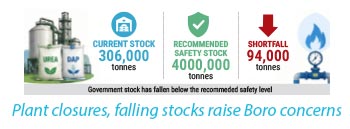
According to the Ministry of Agriculture, Bangladesh's total fertiliser demand stood at 5.785 million tonnes in FY2025-26. Between July and April, around 5.479 million tonnes were distributed. Government stocks have now fallen to just over 306,000 tonnes, well below the recommended safety stock of 400,000 tonnes.
Although fertiliser distribution for May has already begun, concerns are growing over whether sufficient stocks can be rebuilt before the next Boro season.
The fertiliser sector has emerged as one of the worst-hit victims of the gas shortage.
The Bangladesh Chemical Industries Corporation (BCIC)-run Jamuna Fertiliser Factory at Tarakandi in Sarishabari, Jamalpur, has remained shut since February 16 because of inadequate gas supply. Factory officials estimate daily financial losses at around Tk 3.5 crore, while prolonged closure is also raising fears of damage to costly machinery and equipment.
Established in 1991, the factory initially produced around 1,700 tonnes of urea daily. Its output has gradually declined to around 1,200 tonnes because of low gas pressure and mechanical problems. The plant requires gas pressure of around 42-43 PSI for normal operation.
Production was first suspended on January 15, 2024, after gas pressure dropped. Supply resumed on February 23, 2025, allowing operations to restart, but production stopped again three days later following a mechanical failure at the ammonia plant coupled with another fall in gas pressure.
Deputy Chief Engineer (Chemical) Mohammad Fazlul Haque said the factory was ready to resume production immediately once adequate gas supply was restored.
Jamuna Fertiliser supplies urea to more than 20 districts, including 16 in the northern region such as Jamalpur, Sherpur, Mymensingh and Tangail, through around 2,500 dealers. Officials fear that prolonged closure could put additional pressure on fertiliser availability across these areas.
The shutdown has also affected thousands of workers, transport operators and others whose livelihoods depend on the factory, with many transport vehicles involved in fertiliser distribution remaining idle.
The crisis extends well beyond Jamuna.
Chittagong Urea Fertiliser Limited (CUFL) has remained closed since April 4, reducing its production in the current fiscal year to around 65,000 tonnes, far below its historical output.
Karnaphuli Fertilizer Company Limited (KAFCO), with a production capacity of around 2,000 tonnes of urea a day, is also struggling to maintain operations because of inadequate gas supply.
Gas shortages have also affected DAP production. The DAP plant at Anwara continued operating for some time using stored ammonia after gas supply was disrupted. Once those reserves were exhausted, however, the plant was forced to suspend production, removing another 500 tonnes of fertiliser a day from domestic supply.
Ashuganj Fertiliser Factory in Brahmanbaria has also remained shut since early March, with estimated production losses of around Tk 5 crore a day.
Although the Ghorashal-Palash Fertiliser Factory in Narsingdi recently resumed production after more than a month of closure, it lost around 92,000 tonnes of production during the shutdown. Production at the Shahjalal Fertiliser Factory in Sylhet also remains suspended, although authorities say existing stocks are sufficient to meet regional demand.
With domestic production declining, Bangladesh is expected to rely more heavily on fertiliser imports in the coming months. The government has already invited tenders to ensure supplies. Experts, however, caution that greater dependence on imports could expose the country to uncertainties in the international market.
They point to continuing geopolitical tensions in the Middle East, possible disruptions to maritime shipping routes, volatility in global energy and commodity markets and pressure on foreign exchange reserves as factors that could complicate imports if the domestic production shortfall continues.
Against this backdrop, stakeholders are calling on the government to communicate more openly about the causes of the gas crisis, its impact and the measures being taken to address it. They say regular press briefings would help present the actual gas supply situation and reduce public confusion.
They argue that the government should explain whether declining domestic gas production alone is responsible for the crisis or whether other factors, including LNG imports, foreign exchange constraints, gas transmission infrastructure and developments in the international energy market, are also contributing to the situation.
Stakeholders also believe the government should disclose the actual state of domestic gas production, supply, imports, infrastructure and financial liabilities inherited when the current administration assumed office.
The impact of tensions in the Middle East on LNG imports and global energy markets also requires clear explanation, they say, noting that disruptions to shipping routes and higher import costs could further strain Bangladesh's energy and fertiliser supply chains.
Prime Minister's Information, Policy and Strategy Adviser Zahed Ur Rahman has said the gas crisis is expected to ease soon and that electricity generation will increase once gas supplies improve. However, he also warned that any disruption to shipping in the Middle East could create fresh challenges for both the energy and agricultural sectors.
The implications extend far beyond the fertiliser industry.
Boro accounts for a substantial share of Bangladesh's annual rice production, making uninterrupted fertiliser supply critical for maintaining agricultural output and food security. Any prolonged disruption could increase production costs, push up food prices and place additional pressure on consumers.
Experts say the government's immediate priorities should be restoring gas supply to fertiliser plants, resuming domestic production and accelerating imports where necessary. At the same time, they stress the importance of maintaining transparent communication with the public by providing regular updates on the crisis, its causes, existing constraints and the steps being taken to resolve it. As the gas shortage continues, the challenge is no longer simply about keeping factories running. It is about ensuring that fertiliser reaches farmers on time, safeguarding the next Boro harvest and protecting the country's food security.
Loading...
Loading...
Also read



Editor : Iqbal Sobhan Chowdhury
Published by the Editor on behalf of the Observer Ltd. from Globe Printers, 24/A, New Eskaton Road, Ramna, Dhaka.
Editorial, News and Commercial Offices : Aziz Bhaban (2nd floor), 93, Motijheel C/A, Dhaka-1000.
Phone: PABX- 41053001-06; Advertisement: 41053012; 01793317829, 01550707291, E-mail: [email protected], [email protected] Online: email: [email protected] 41053014; 01550707297 Advertisement: 01550707296
Published by the Editor on behalf of the Observer Ltd. from Globe Printers, 24/A, New Eskaton Road, Ramna, Dhaka.
Editorial, News and Commercial Offices : Aziz Bhaban (2nd floor), 93, Motijheel C/A, Dhaka-1000.
Phone: PABX- 41053001-06; Advertisement: 41053012; 01793317829, 01550707291, E-mail: [email protected], [email protected] Online: email: [email protected] 41053014; 01550707297 Advertisement: 01550707296


