



| HEADLINE |

|
Nageshwari's chilli rasgulla hits the streets
Published : Sunday, 8 February, 2026 at 12:00 AM
Our Correspondent


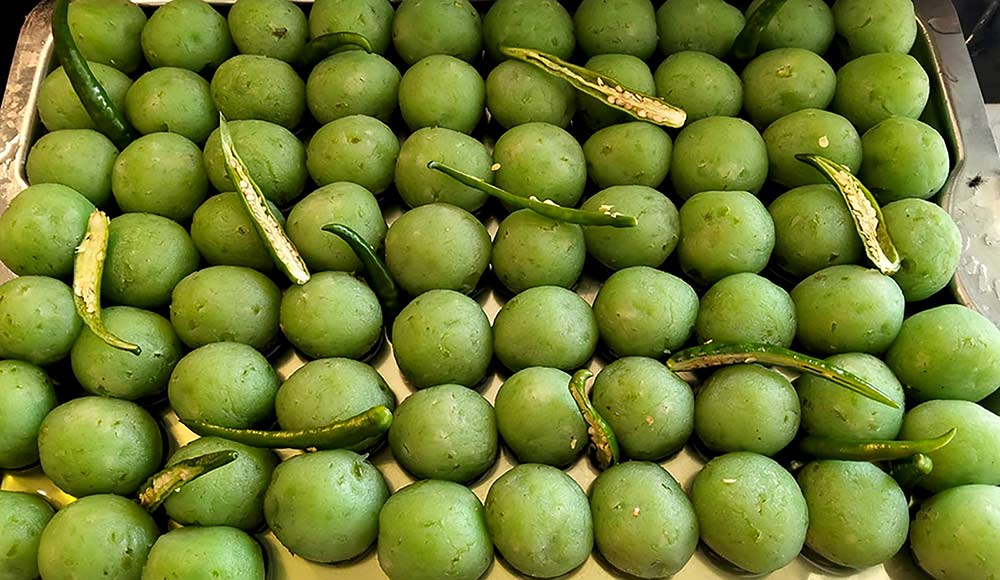 NAGESHWARI, KURIGRAM, Feb 7: Large pots are filled with fresh milk, which is then churned and curdled into chhena (a fresh, acid-set cheese similar to cottage cheese, made by curdling milk with lemon juice or vinegar). The excess water is drained, and the chhena is mixed with a generous amount of green chilli paste to make small mounds. From these mounds, round balls are shaped and gently dropped into a large iron pan filled with lightly boiled sugar syrup. The balls are slowly boiled and stirred until they puff up and expand. Afterward, they are transferred to a thick sugar or jaggery syrup, where they soak briefly before transforming into rasgullas. These are then ready to be served.
Unlike traditional rasgullas, which are usually sweet, these are spicy-sweet. This unique creation is now being made in Kochakata of Nageshwari Upazila in Kurigram. Its popularity is steadily growing, attracting people from far and wide eager to taste the novel dessert.
On the ground, Kochakata market features a small, unbranded sweet shop called Bonoful Sweetmeat, where white, reddish-brown, and green spongy sweets are displayed on racks in neat layers. While some customers enjoy the sweets on-site, others take them home in packets. Most visitors, however, choose the green chilli rasgulla.
Shop owner Riazul Islam said, "Every year during winter, the demand for chili rasgullas rises. We've been making this spicy-sweet version at our shop for the past two years. The demand is very high, and people travel from across the district just to taste it. Like other sweets, these are sold at Tk 240-260 per kilogram. We also make 20 other varieties of traditional sweets here."
Rasgulla, a traditional Bengali sweet made from chhena soaked in sugar or jaggery syrup, has been cherished for generations. Celebrated writer Syed Mujtaba Ali described the sweet's popularity and its cultural significance abroad through his humorous depiction of the character Zhanduda. While the origin of rasgulla is debated between West Bengal and Odisha, both states have earned Geographical Indication (GI) tags. In late 2023, Gopalganj's rasgulla also received a GI tag.
West Bengal's rasgulla is typically white and spongy, while Odisha's variant has a reddish-brown hue, reflecting ancient culinary traditions with distinct flavour.
Loading...
Loading...
Also read



Editor : Iqbal Sobhan Chowdhury
Published by the Editor on behalf of the Observer Ltd. from Globe Printers, 24/A, New Eskaton Road, Ramna, Dhaka.
Editorial, News and Commercial Offices : Aziz Bhaban (2nd floor), 93, Motijheel C/A, Dhaka-1000.
Phone: PABX- 41053001-06; Advertisement: 41053012; 01793317829, 01550707291, E-mail: [email protected], [email protected] Online: email: [email protected] 41053014; 01550707297 Advertisement: 01550707296
Published by the Editor on behalf of the Observer Ltd. from Globe Printers, 24/A, New Eskaton Road, Ramna, Dhaka.
Editorial, News and Commercial Offices : Aziz Bhaban (2nd floor), 93, Motijheel C/A, Dhaka-1000.
Phone: PABX- 41053001-06; Advertisement: 41053012; 01793317829, 01550707291, E-mail: [email protected], [email protected] Online: email: [email protected] 41053014; 01550707297 Advertisement: 01550707296


