



| HEADLINE |

|

Suspicious transactions surge, black money flows ahead of polls
Published : Tuesday, 10 February, 2026 at 12:00 AM
Jibon Islam


 As Bangladesh prepares for the 13th National Parlia-mentary elections on Thursday, the country is witnessing an unprecedented surge of cash circulation, raising alarms over unregulated campaign spending and potential vote-buying.
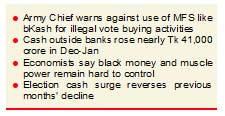
 Army Chief General Waker-Uz-Zaman warns against use of Mobile Financial Services (MFS) like bKash for illegal vote buying activities.
Observers say the source of much of this money remains unclear, and there is no reliable estimate of the total amount now moving through public hands.
The Election Commission (EC) allows candidates to spend up to Tk 10 per voter, with a maximum of Tk 2,500,000. With 1,981 candidates contesting 298 constituencies, this legal cap would total approximately Tk 495.25 crore if fully utilized. However, Bangladesh Bank data indicate that actual cash flow far exceeds this ceiling. Between December and January, cash outside the banking system rose by nearly Tk 41,000 crore, with much of it believed to be withdrawn for campaign purposes, including staff salaries, field-level activities, and other election-related expenses. Allegations of black money usage persist.
In the current election, 1,732 candidates from 51 registered political parties and 249 independents are running for 299 parliamentary seats. The Bangladesh Nationalist Party (BNP) has fielded candidates in 288 constituencies, followed by Jamaat-e-Islami in 224, Islami Andolan Bangladesh in 253, and Jatiya Party (JAPA) in 192 seats. Smaller parties, including the CPB, BSD, and various other alliances, also have candidates in multiple constituencies.
Voter numbers vary widely, impacting permissible spending. Gazipur-2, with 804,333 voters, allows candidates to spend up to Tk 8,043,330, more than triple the standard per-voter limit. Dhaka-19, the second-largest constituency with 747,070 voters, permits Tk 7,470,700 in spending, while Jhalokati-1, with 228,431 voters, is capped at Tk 2,500,000. This adjustment has significantly increased campaign spending potential compared to previous elections, where a blanket Tk 2,500,000 cap applied regardless of voter count.
Economist Professor Abu Ahmed noted that black money in elections is nothing new and difficult to control. "Strict implementation of government directives could help curb the practice," he said, emphasizing the need to control muscle power at polling stations so voters can exercise their rights freely. He added that responsibility lies with law enforcement agencies as well as rival candidates.
Several candidates have complained that black money is pervasive in campaigns. Bangladesh Bank data support these claims: cash outside banks climbed from Tk 269,018 crore in November to Tk 310,000 crore in January, a jump of Tk 40,982 crore in just two months. Bangladesh Bank Executive Director Arif Hossain Khan confirmed that withdrawals spiked ahead of elections as candidates rely heavily on cash for payments. He noted that the Bangladesh Financial Intelligence Unit (BFIU) is closely monitoring suspicious transactions, with banks instructed to report any anomalies promptly.
Economists highlight the stark contrast with previous months. From July to November, cash outside the banking system declined steadily-from Tk 287,294 crore in July to Tk 269,018 crore in November-before the sharp increase in December and January. Dr. Zahid Hossain, former Chief Economist at the World Bank's Dhaka office, said the surge is consistent with Bangladesh's largely cash-driven election spending culture, but stressed that the existing monitoring mechanisms remain critical for transparency.
As the election approaches, the massive influx of liquid money underscores the challenges of regulating campaign finance, maintaining electoral fairness, and curbing illicit influence. Observers warn that without strict oversight, the large cash flow could distort voting outcomes and undermine democratic processes.
Loading...
Loading...
Also read



Editor : Iqbal Sobhan Chowdhury
Published by the Editor on behalf of the Observer Ltd. from Globe Printers, 24/A, New Eskaton Road, Ramna, Dhaka.
Editorial, News and Commercial Offices : Aziz Bhaban (2nd floor), 93, Motijheel C/A, Dhaka-1000.
Phone: PABX- 41053001-06; Advertisement: 41053012; 01793317829, 01550707291, E-mail: [email protected], [email protected] Online: email: [email protected] 41053014; 01550707297 Advertisement: 01550707296
Published by the Editor on behalf of the Observer Ltd. from Globe Printers, 24/A, New Eskaton Road, Ramna, Dhaka.
Editorial, News and Commercial Offices : Aziz Bhaban (2nd floor), 93, Motijheel C/A, Dhaka-1000.
Phone: PABX- 41053001-06; Advertisement: 41053012; 01793317829, 01550707291, E-mail: [email protected], [email protected] Online: email: [email protected] 41053014; 01550707297 Advertisement: 01550707296


