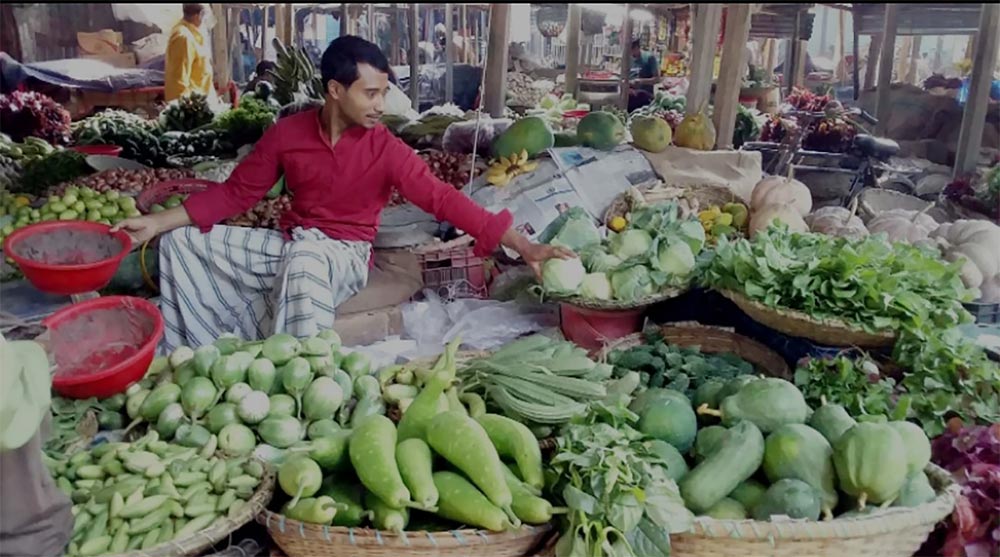
CHATMOHAR, PABNA, Feb 20: The prices of essential commodities have risen sharply in Chatmohar Upazila of Pabna at the very start of Ramadan, putting significant pressure on consumers, particularly middle-income families struggling to manage daily expenses.
A visit to Chatmohar's Old Market and New Market on Friday, the second day of Ramadan, revealed steep price increases in several key items, including chicken, eggplant, green chilli, lemon, ginger, garlic, and dates-staples widely used during Iftar.
Eggplant, a key ingredient for making 'Beguni,' one of the most popular Ramadan snacks, is now selling at Tk 80 to Tk 90 per kg. Traders said a single eggplant is effectively costing around Tk 50 when cut into slices and sold as fried beguni at Tk 5 per piece.
Consumers expressed frustration over the rising costs, saying the price hikes have made essential food items increasingly unaffordable. Regular buyers at Chatmohar Old Market, including Abdur Razzak, Latif, and Azad, alleged that some dishonest traders exploit Ramadan by artificially inflating prices. They also urged the newly formed government to strengthen market monitoring and enforce strict measures against price manipulation.
Wholesale traders, however, attributed the price increases to higher demand during Ramadan. "Many consumers buy in bulk during this period, which creates additional pressure on supply and raises prices," said wholesale trader Makbul Azizul.
Poultry prices have increased notably over the past week. Broiler chicken is now selling at Tk 190 to Tk 200 per kg, while layer chicken prices have risen by Tk 20 to Tk 30, reaching Tk 280 to Tk 320 per kg. Sonali (cock) chicken is selling at Tk 290 per kg, and local varieties are priced between Tk 480 and Tk 500 per kg.
Farid, a poultry trader, said supply shortages at farms have forced retailers to increase prices. "We are buying chickens at higher prices from farms, so we have no option but to sell at higher rates," he said.
Vegetable prices have also increased significantly. Eggplant, which was sold at Tk 30 to Tk 35 per kg just a week ago, now costs Tk 80 to Tk 90 per kg. Green chilli prices have jumped by Tk 30 to Tk 40, reaching Tk 160 to Tk 200 per kg, while lemons are selling at Tk 160 per kg.
Bitter gourd is priced at Tk 140 per kg after a Tk 20 increase. Cucumbers and tomatoes are selling at Tk 80 per kg, while bottle gourd costs Tk 50 to Tk 60 per piece.
Meanwhile, garlic prices have increased from Tk 120-140 to Tk 180-200 per kg, and ginger is selling at Tk 130-140 per kg. Onion prices have also increased slightly. Dates, an essential item for iftar, are now selling at Tk 240 to Tk 250 per kg after rising by Tk 40 to Tk 50. Premium varieties are available at prices as high as Tk 3,000 per kg.
Fish prices have also surged. Shrimp prices have doubled to Tk 1,200 per kg, while shing fish is selling at Tk 800 per kg. Rui and katla fish are priced between Tk 250 and Tk 430 per kg.
Local fish varieties from rivers and Chalan Beel, including air, guza, bain, and magur, are selling at around Tk 1,200 per kg. However, beef and mutton prices remain stable.
Mohammad Ali, a resident of Baluchar, said, "Items that cost Tk 10 before Ramadan now cost nearly double. It has become very difficult for ordinary people to manage daily expenses."
Mokhlesur Rahman Bidyut, President of the Chatmohar Traders' Association, said prices tend to fluctuate during Ramadan but assured that the situation is being monitored.
Contacted for comment, Musa Naser Chowdhury, Upazila Nirbahi Officer of Chatmohar, warned that legal action would be taken against traders found charging excessive prices. "We are actively monitoring the market to keep essential commodity prices stable during Ramadan," he said.





