



| HEADLINE |

|
US, Iran meet directly for peace talks in Islamabad
Delegations exchange texts on issues on first day as talks to continue today
Published : Sunday, 12 April, 2026 at 12:00 AM


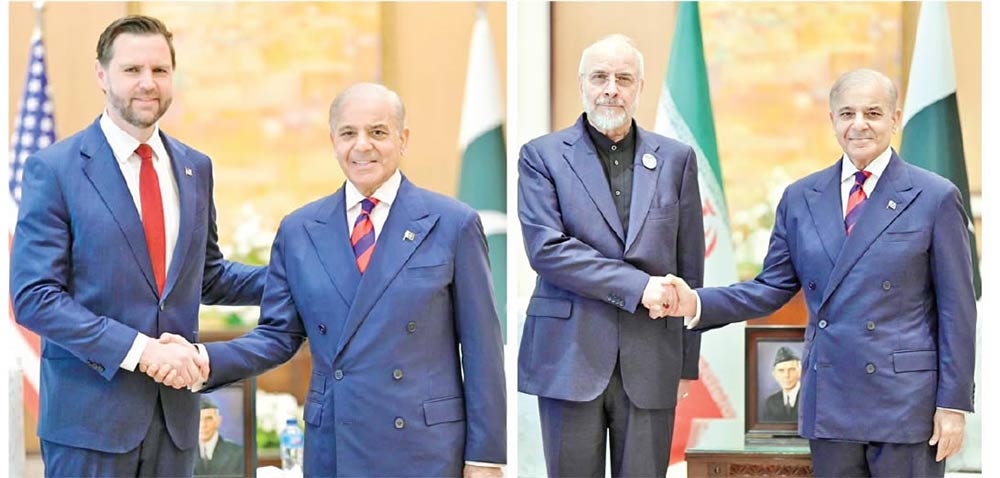 ISLAMABAD, Apr 11: Direct talks begun between the US and Iranian delegations in Islamabad, Pakistan on Saturday.
The US delegation was led by US Vice President JD Vance, who is accompanied by US President Donald Trump's son-in-law Jared Kushner and Middle East envoy Steve Witkoff.
The Iranian delegation was led by Parliament Speaker Mohammad Bagher Ghalibaf and also includes Foreign Minister Abbas Araghchi, along with other leaders.
The Iranian government, in a post on X, said that the talks had entered the "expert-level stage as economic, military, legal, and nuclear committees joined".
"Negotiations continue at the Serena Hotel to finalise technical details," it added.
According to the latest reports, expert teams from both sides exchanged written texts on the issues under discussion after the end of in-person talks.
The talks are taking place during a two-week halt in the US-Israeli war against Iran, which began with US-Israeli attacks on February 28. The conflict, which spread across the Middle East and sent shockwaves through global economies, paused after Pakistan brokered a temporary ceasefire on April 8.
Meanwhile, in a post on X, Iranian President Masoud Pezeshkian said that Iran's delegation remained "fully committed" to safeguarding the country's interests.
He expressed hope that the delegation would "negotiate courageously". He added that regardless of the outcome of the negotiations, the government will "stand by its people".
Meanwhile, US President Donald Trump on Saturday posted on social media that the United States military has started to clear the Strait of Hormuz, and that all of Iran's minelaying ships have been sunk.
"We're now starting the process of clearing out the Strait of Hormuz," Trump wrote in a social media post, adding that "all 28" of Iran's "mine dropper boats are also lying at the bottom of the sea".
Trump has repeatedly said that American forces have destroyed Iran's navy and air force while crippling its ballistic missile and nuclear programmes.
However, Iran doubled down on parts of its earlier proposal, with its delegation telling Iranian state television it had presented some of the plan's ideas as "red lines" in meetings with Sharif. Those included compensation for damage caused by U.S.-Israeli strikes that launched the war on Feb. 28 and releasing Iran's frozen assets.
The war has killed at least 3,000 people in Iran, 1,953 in Lebanon, 23 in Israel and more than a dozen in Gulf Arab states, and caused lasting damage to infrastructure in half a dozen Middle Eastern countries. Iran's chokehold on the vital Strait of Hormuz has largely cut off the Persian Gulf and its oil and gas exports from the global economy, sending energy prices soaring.
Reflecting the high stakes, officials from the region said Chinese, Egyptian, Saudi and Qatari officials were in Islamabad to indirectly facilitate the talks. The officials spoke on condition of anonymity to discuss the sensitive matter.
In Tehran, residents told The Associated Press they were skeptical yet hopeful about the talks after weeks of airstrikes left destruction across their country of some 93 million people. Some said the path to recovery would be long.
"Peace alone is not enough for our country, because we've been hit very hard, there have been huge costs," 62-year-old Amir Razzai Far said.
Meanwhile, Israel pressed ahead with strikes in Lebanon after saying there is no ceasefire there. Iran and Pakistan have disagreed. The Lebanese state-run news agency reported at least three people killed.
�"Agencies
Loading...
Loading...
Also read



Editor : Iqbal Sobhan Chowdhury
Published by the Editor on behalf of the Observer Ltd. from Globe Printers, 24/A, New Eskaton Road, Ramna, Dhaka.
Editorial, News and Commercial Offices : Aziz Bhaban (2nd floor), 93, Motijheel C/A, Dhaka-1000.
Phone: PABX- 41053001-06; Advertisement: 41053012; 01793317829, 01550707291, E-mail: [email protected], [email protected] Online: email: [email protected] 41053014; 01550707297 Advertisement: 01550707296
Published by the Editor on behalf of the Observer Ltd. from Globe Printers, 24/A, New Eskaton Road, Ramna, Dhaka.
Editorial, News and Commercial Offices : Aziz Bhaban (2nd floor), 93, Motijheel C/A, Dhaka-1000.
Phone: PABX- 41053001-06; Advertisement: 41053012; 01793317829, 01550707291, E-mail: [email protected], [email protected] Online: email: [email protected] 41053014; 01550707297 Advertisement: 01550707296


