



| HEADLINE |

|

Fathoming fuel crisis



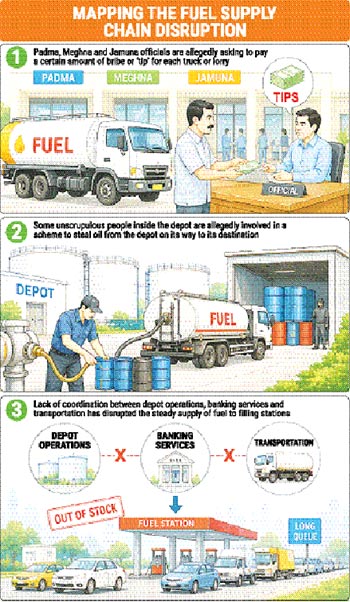 Allegations of corruption, theft and weak coordination have surfaced across Bangladesh's fuel supply chain, raising concerns that the current strain on distribution is less about scarcity and more about systemic inefficiencies and malpractice.
Officials within the Bangladesh Petroleum Corporation (BPC) and its three distribution subsidiaries-Padma Oil Company Limited, Meghna Petroleum Limited and Jamuna Oil Company Limited-have reportedly been asked to pay unofficial "tips" per tanker while lifting fuel, according to multiple sources. Such practices, if proven, point to entrenched irregularities at the operational level.
Long queues at refuelling stations have drawn public attention, but sector insiders say these lines reflect only part of the problem. A significant portion of fuel is consumed outside retail pumps, including in industrial and transport sectors, making the visible shortage only a partial indicator of supply disruption.
Although BPC recently instructed distributors to increase supply to pumps, operators in several areas continued to report inadequate depot deliveries later in the week. This mismatch has been attributed partly to poor coordination between depots, banking channels and transport logistics, which together disrupt timely fuel movement.
More serious allegations point to organised theft. Preliminary findings suggest a syndicate may be siphoning fuel during transit from seagoing vessels and depots, diverting it to illegal storage facilities and local black markets. Areas such as Patenga have been cited as hubs where such activities allegedly occur. Reports also mention modified tanker capacities, pipeline losses and unauthorised stockpiling.
The government, however, has rejected claims of a genuine supply shortage, describing the situation as a "man-made crisis." Speaking in parliament on April 22, Energy Minister Iqbal Hassan Mahmood Tuku said the country holds sufficient reserves of diesel, octane, petrol and jet fuel, with supply levels higher than the previous year. He attributed the queues to black-market manipulation and said law enforcement agencies are conducting drives against illegal stockpiling.
Opposition leaders, including Shafiqur Rahman, warned of mounting public hardship and called for a coordinated national response, including the formation of a joint oversight committee.
Concerns have been particularly acute around Jamuna Oil Company, where longstanding allegations of administrative lapses and irregularities have resurfaced. Analysis of internal documents suggests repeated deviations from allocation orders, lapses in duty and questionable administrative decisions.
One notable incident occurred on March 29 at the Mongla Oil Installation in Bagerhat. A departmental inquiry led to the suspension of a depot head over alleged misconduct, including unauthorised absence. A joint inspection by authorities later found an excess of 12,613 litres of diesel compared to official records-fuel valued at approximately Tk 12.1 lakh.
The discrepancy raised concerns about record-keeping and possible diversion within the system.
Energy analysts warn that continued lack of transparency and accountability in state-run fuel operations could have wider economic consequences. Discrepancies between allocated and actual stock, they say, risk enabling misuse of public resources and destabilising supply management over time.
While the government insists there is no real shortage, the convergence of corruption allegations, logistical bottlenecks and weak oversight suggests a deeper structural problem-one that continues to fuel both uncertainty and public anxiety.

Loading...
Loading...
Also read



Editor : Iqbal Sobhan Chowdhury
Published by the Editor on behalf of the Observer Ltd. from Globe Printers, 24/A, New Eskaton Road, Ramna, Dhaka.
Editorial, News and Commercial Offices : Aziz Bhaban (2nd floor), 93, Motijheel C/A, Dhaka-1000.
Phone: PABX- 41053001-06; Advertisement: 41053012; 01793317829, 01550707291, E-mail: [email protected], [email protected] Online: email: [email protected] 41053014; 01550707297 Advertisement: 01550707296
Published by the Editor on behalf of the Observer Ltd. from Globe Printers, 24/A, New Eskaton Road, Ramna, Dhaka.
Editorial, News and Commercial Offices : Aziz Bhaban (2nd floor), 93, Motijheel C/A, Dhaka-1000.
Phone: PABX- 41053001-06; Advertisement: 41053012; 01793317829, 01550707291, E-mail: [email protected], [email protected] Online: email: [email protected] 41053014; 01550707297 Advertisement: 01550707296


