



| HEADLINE |

|

Militancy no longer exists in Bangladesh: Home Minister
Published : Tuesday, 28 April, 2026 at 6:52 PM
Observer Online Report


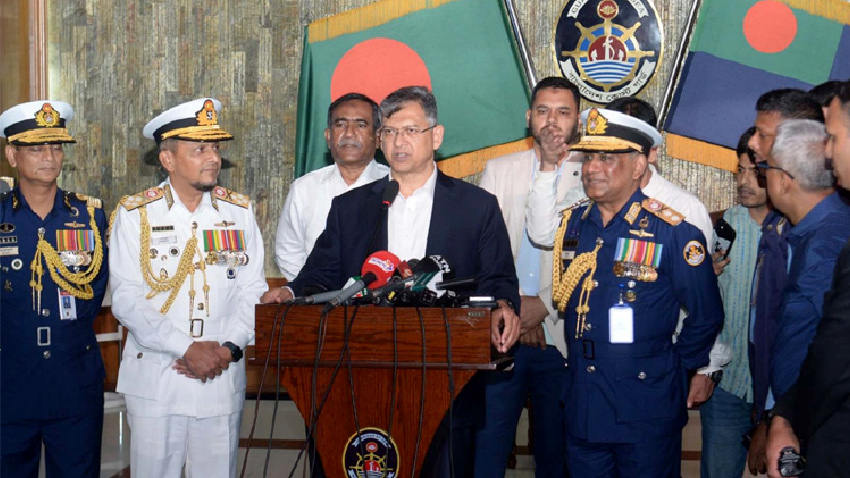
Home Minister Salahuddin Ahmed spoke to journalists after a ceremony marking the 31st founding anniversary of the Bangladesh Coast Guard, held at its headquarters in Agargaon in the capital. Photo: PID
Home Minister Salahuddin Ahmed has stated that militancy is no longer exists in Bangladesh, describing the term as one that was previously used for political purposes during what he called a “fascist era.”
Speaking to reporters on Tuesday after attending a medal ceremony marking the 31st founding anniversary of the Bangladesh Coast Guard at its headquarters in Agargaon, the minister said there is currently no militant activity in the country.
“The term militancy is not recognised by us anymore. There is no such activity in Bangladesh at present,” he stated.
Ahmed acknowledged that extremist or radical groups can be found in many countries, including political forces with fundamentalist leanings, but maintained that these do not amount to organised militancy in Bangladesh today. He alleged that in the past the issue had been amplified to gain political advantage.
Addressing questions about internal monitoring within law enforcement and defence forces, the minister said intelligence units operate in armed forces worldwide to ensure discipline and prevent anti state or criminal conduct. Any wrongdoing by personnel is handled under existing military laws, he added.
On the deployment of the army in civilian areas, Ahmed said a phased withdrawal is underway. While it is not possible to remove all personnel at once, he noted that the presence has already been significantly reduced and will be scaled down further. However, he said forces could be redeployed if required by district magistrates or the government.
Responding to reports about a special alert notice from police headquarters, the minister clarified that no such directive had been issued by the government. He explained that security is routinely tightened around national days and key installations under standard operating procedures, as has always been the practice.
Ahmed also outlined plans to expand and modernise the Bangladesh Coast Guard. He said the government aims to broaden the force’s operations beyond coastal zones into inland waterways and possibly haor regions.
Recalling that the Coast Guard Act was introduced in 1995 under former prime minister Khaleda Zia, the minister said the force has grown since then but remains insufficient for current demands. A policy decision has been taken to gradually double personnel strength from around 5,000 to 10,000.
The expansion will be accompanied by improved logistics, modern equipment, housing and training facilities. The government is prioritising new technology, including surveillance drones, rescue drones and helicopters, along with advanced monitoring systems.
Ahmed said new vessels are being constructed with support from the Japan International Cooperation Agency, while high speed boats are being built at local shipyards. Plans are also in place for a modern dockyard in Munshiganj and for the replacement of ageing vessels.
He emphasised that as criminal networks increasingly use advanced technology, law enforcement agencies must remain equally prepared and modernised to ensure maritime security and maintain order in coastal areas.
During the anniversary event, the minister awarded medals to 14 Coast Guard members in recognition of bravery and distinguished service. Senior Secretary of the Home Ministry Manzur Morshed Chowdhury attended as special guest, while Coast Guard Director General Rear Admiral Md Ziaul Hoque delivered the welcome address. Military and civilian officials from home and abroad were present at the event.
Speaking to reporters on Tuesday after attending a medal ceremony marking the 31st founding anniversary of the Bangladesh Coast Guard at its headquarters in Agargaon, the minister said there is currently no militant activity in the country.
“The term militancy is not recognised by us anymore. There is no such activity in Bangladesh at present,” he stated.
Ahmed acknowledged that extremist or radical groups can be found in many countries, including political forces with fundamentalist leanings, but maintained that these do not amount to organised militancy in Bangladesh today. He alleged that in the past the issue had been amplified to gain political advantage.
Addressing questions about internal monitoring within law enforcement and defence forces, the minister said intelligence units operate in armed forces worldwide to ensure discipline and prevent anti state or criminal conduct. Any wrongdoing by personnel is handled under existing military laws, he added.
On the deployment of the army in civilian areas, Ahmed said a phased withdrawal is underway. While it is not possible to remove all personnel at once, he noted that the presence has already been significantly reduced and will be scaled down further. However, he said forces could be redeployed if required by district magistrates or the government.
Responding to reports about a special alert notice from police headquarters, the minister clarified that no such directive had been issued by the government. He explained that security is routinely tightened around national days and key installations under standard operating procedures, as has always been the practice.
Ahmed also outlined plans to expand and modernise the Bangladesh Coast Guard. He said the government aims to broaden the force’s operations beyond coastal zones into inland waterways and possibly haor regions.
Recalling that the Coast Guard Act was introduced in 1995 under former prime minister Khaleda Zia, the minister said the force has grown since then but remains insufficient for current demands. A policy decision has been taken to gradually double personnel strength from around 5,000 to 10,000.
The expansion will be accompanied by improved logistics, modern equipment, housing and training facilities. The government is prioritising new technology, including surveillance drones, rescue drones and helicopters, along with advanced monitoring systems.
Ahmed said new vessels are being constructed with support from the Japan International Cooperation Agency, while high speed boats are being built at local shipyards. Plans are also in place for a modern dockyard in Munshiganj and for the replacement of ageing vessels.
He emphasised that as criminal networks increasingly use advanced technology, law enforcement agencies must remain equally prepared and modernised to ensure maritime security and maintain order in coastal areas.
During the anniversary event, the minister awarded medals to 14 Coast Guard members in recognition of bravery and distinguished service. Senior Secretary of the Home Ministry Manzur Morshed Chowdhury attended as special guest, while Coast Guard Director General Rear Admiral Md Ziaul Hoque delivered the welcome address. Military and civilian officials from home and abroad were present at the event.
Loading...
Loading...
Also read









Editor : Iqbal Sobhan Chowdhury
Published by the Editor on behalf of the Observer Ltd. from Globe Printers, 24/A, New Eskaton Road, Ramna, Dhaka.
Editorial, News and Commercial Offices : Aziz Bhaban (2nd floor), 93, Motijheel C/A, Dhaka-1000.
Phone: PABX- 41053001-06; Advertisement: 41053012; 01793317829, 01550707291, E-mail: [email protected], [email protected] Online: email: [email protected] 41053014; 01550707297 Advertisement: 01550707296
Published by the Editor on behalf of the Observer Ltd. from Globe Printers, 24/A, New Eskaton Road, Ramna, Dhaka.
Editorial, News and Commercial Offices : Aziz Bhaban (2nd floor), 93, Motijheel C/A, Dhaka-1000.
Phone: PABX- 41053001-06; Advertisement: 41053012; 01793317829, 01550707291, E-mail: [email protected], [email protected] Online: email: [email protected] 41053014; 01550707297 Advertisement: 01550707296


