



| HEADLINE |

|

PM for accountable, people-centric admin
He describes DCs as “one of the main driving forces” while inaugurating 4-day DC Conference
Published : Monday, 4 May, 2026 at 12:00 AM
Special Correspondent


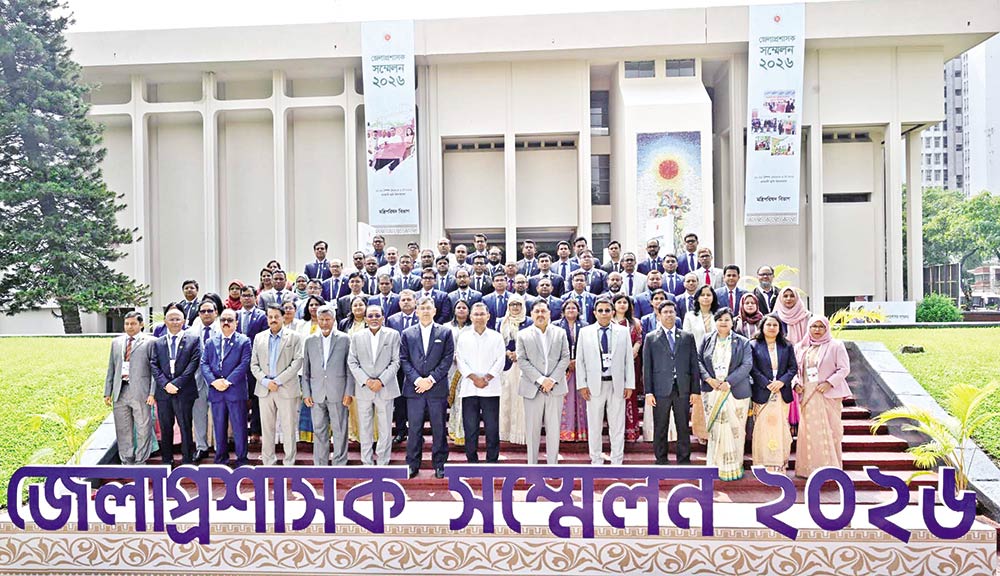 Prime Minister Tarique Rahman on Sunday urged Deputy Commissioners (DCs) to play a proactive role in implementing the government's commitments with accountability, transparency and efficiency.
He made the urge while inaugurating a four-day Deputy Commissioner (DC) Conference 2026 at Osmani Memorial Auditorium.
On the first day of the conference, the ministers, state ministers, advisers to the PM and secretaries of the Prime Minister's Office, the ministries health and family welfare, education, law and parliamentary affairs have briefed the DCs on the relevant issues.
Later, the DCs met President Mohammed Shahabuddin at Bangabhaban and had dinner with the president.
Addressing field-level administrators, the Prime Minister described DCs as "one of the main driving forces" in building a lawful, accountable and people-friendly state system.
He emphasised that good governance depends on efficient management, capable leadership and strict accountability, reiterating a zero-tolerance stance against corruption.
"We will implement each commitment step by step," he said, referring to the government's election manifesto and the July National Charter.
The Prime Minister instructed officials to ensure timely implementation of development projects with transparency and quality; avoid unnecessary bureaucratic delays and adopt practical, citizen-focused decision-making; maintain strict oversight of public expenditure; monitor markets regularly to prevent hoarding and artificial price hikes; and strengthen law and order and take firm action against social crimes, including child marriage, drug abuse and food adulteration.
He also called for visible mobile court drives, improved public service delivery free from harassment, and year-round engagement in sports and cultural activities to positively guide youth.
Highlighting administrative integrity, Rahman warned against seeking preferred postings or promotions through influence, saying such practices weaken neutrality and professionalism. "All positions are equally important. Officials must be ready to serve anywhere in the country," he said.
Referring to the challenges of the Fourth Industrial Revolution, the Prime Minister urged officials to embrace artificial intelligence, automation and digital governance to enhance efficiency and transparency.
He acknowledged that the government assumed office amid economic fragility and institutional weaknesses but said improvements had already been made. He also cited global pressures, including geopolitical conflicts, as ongoing challenges.
Among welfare initiatives, Rahman highlighted programmes such as Family Cards, Farmers' Cards and allowances for religious leaders, aiming to expand the social safety net nationwide. He reiterated plans to excavate 20,000 kilometres of canals over five years to improve water management and irrigation.
The annual conference, running until May 6, includes 34 sessions-30 of them working sessions-with participation from 56 ministries and divisions. DCs have submitted 1,729 proposals, of which 498 have been incorporated into discussion papers.
Key focus areas include land management, law and order, disaster response, employment, social protection, e-governance, health, education and infrastructure development.
Participants also met President Mohammed Shahabuddin at Bangabhaban and are scheduled to hold sessions with the Election Commission and Anti-Corruption Commission.
On the sidelines of the conference, Health Minister Sardar Md Sakhawat Husain said that at least 81% of children in Bangladesh have received the measles vaccine under the ongoing nationwide campaign.
He added that the remaining children would soon be brought under coverage, noting that measles is currently under control and mortality has declined significantly. The campaign aims to vaccinate approximately 1.8 crore children aged six months to under five years.
According to the Directorate General of Health Services, confirmed measles deaths have reached 50, with 244 suspected fatalities reported so far.

Loading...
Loading...
Also read



Editor : Iqbal Sobhan Chowdhury
Published by the Editor on behalf of the Observer Ltd. from Globe Printers, 24/A, New Eskaton Road, Ramna, Dhaka.
Editorial, News and Commercial Offices : Aziz Bhaban (2nd floor), 93, Motijheel C/A, Dhaka-1000.
Phone: PABX- 41053001-06; Advertisement: 41053012; 01793317829, 01550707291, E-mail: [email protected], [email protected] Online: email: [email protected] 41053014; 01550707297 Advertisement: 01550707296
Published by the Editor on behalf of the Observer Ltd. from Globe Printers, 24/A, New Eskaton Road, Ramna, Dhaka.
Editorial, News and Commercial Offices : Aziz Bhaban (2nd floor), 93, Motijheel C/A, Dhaka-1000.
Phone: PABX- 41053001-06; Advertisement: 41053012; 01793317829, 01550707291, E-mail: [email protected], [email protected] Online: email: [email protected] 41053014; 01550707297 Advertisement: 01550707296


