



| HEADLINE |

|

AI cameras push drivers to follow rules


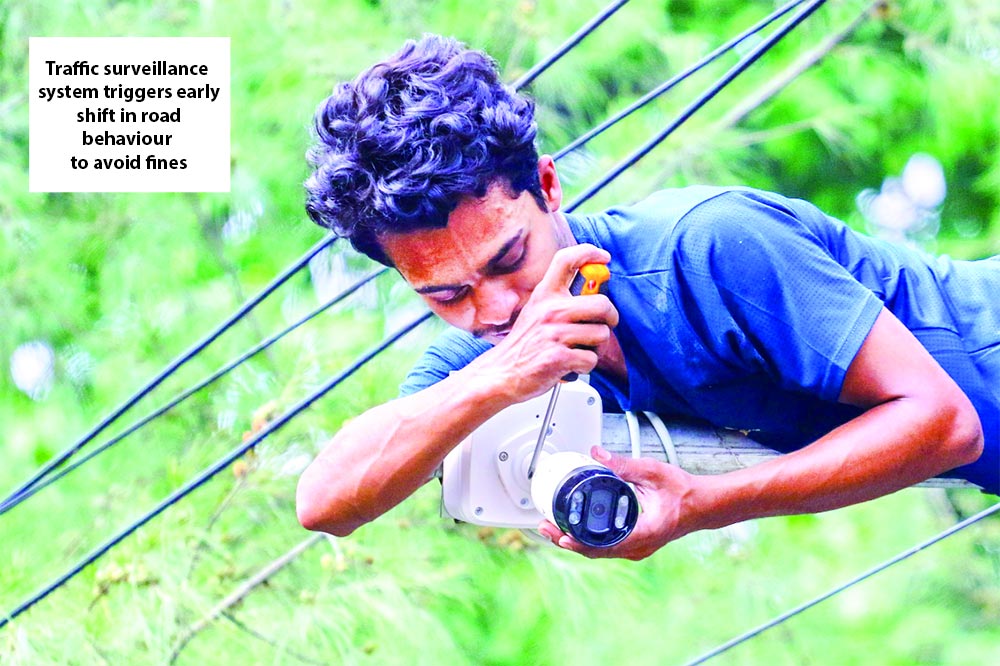 A quiet but visible transformation is unfolding on Dhaka's streets. At intersections once defined by honking, last-second lane cuts and the constant rush to beat the red light, vehicles are now pausing-often patiently-until the signal turns green.
The change is being driven by an artificial intelligence-based traffic surveillance system that automatically detects violations and files cases, marking one of the most significant shifts in road enforcement in recent years.
For many commuters, the difference is already noticeable. Even on empty roads, drivers are stopping at red lights, wary of automated penalties backed by video evidence. What once felt like routine rule-breaking is now being replaced by hesitation, caution and compliance.
Officials say AI-powered cameras have been installed at key intersections including Hotel InterContinental in Shahbagh, Banglamotor, Karwan Bazar, Bijoy Sarani and Jahangir Gate. The Dhaka Metropolitan Police (DMP) plans to expand the system to at least 500 major intersections within six months.
The early impact is already measurable. According to DMP data, more than 300 traffic cases were filed within the first week of operation alone, with officials estimating the number could cross 1,000 once the system is fully expanded across the capital.
Traffic authorities say violation notices are being generated automatically and sent digitally to vehicle owners. Ignoring these notices, they warn, could lead to summons or even arrest warrants under existing laws.
The behavioural shift is most visible at signal points. Drivers who once tried to beat red lights now appear more alert, often slowing down as they approach camera-equipped junctions.
Ride-sharing motorcyclists-frequently criticised for risky manoeuvres-are also showing greater restraint.
"The change is noticeable. I stop at the red light before the crossing line, and I encourage others as well," said CNG driver Sirazul Islam at the Hotel InterContinental intersection. "Some listen, some do not. It's a process."
Ride-sharing motorcyclist Alamgir Hossain said the fear of automated fines is already influencing behaviour. "Earlier, people could ignore signals and escape with apologies. Now they are thinking twice because cases are automatic," he said.
Traffic officials acknowledge that enforcement has long been constrained by manpower shortages and external pressure. "Manual enforcement takes time, and officers sometimes face influence from powerful individuals," said a DMP traffic official, requesting anonymity.
DMP Additional Commissioner Md Anisur Rahman said the AI system is currently active at five intersections. "Our target is to install AI-equipped cameras at at least 500 important signals and crossings within six months," he said, adding that 200-300 violations were recorded within the first four days of operation.
Experts, however, warn that challenges remain. BUET transport specialist Prof Md Hadiuzzaman said Dhaka's large number of unregistered and illegal vehicles, along with uncontrolled auto-rickshaws and weak pedestrian discipline, could limit long-term impact.
Still, for now, Dhaka's roads appear to be experiencing something rare: the early signs of order-not enforced by presence, but by constant digital surveillance watching every move.

Loading...
Loading...
Also read



Editor : Iqbal Sobhan Chowdhury
Published by the Editor on behalf of the Observer Ltd. from Globe Printers, 24/A, New Eskaton Road, Ramna, Dhaka.
Editorial, News and Commercial Offices : Aziz Bhaban (2nd floor), 93, Motijheel C/A, Dhaka-1000.
Phone: PABX- 41053001-06; Advertisement: 41053012; 01793317829, 01550707291, E-mail: [email protected], [email protected] Online: email: [email protected] 41053014; 01550707297 Advertisement: 01550707296
Published by the Editor on behalf of the Observer Ltd. from Globe Printers, 24/A, New Eskaton Road, Ramna, Dhaka.
Editorial, News and Commercial Offices : Aziz Bhaban (2nd floor), 93, Motijheel C/A, Dhaka-1000.
Phone: PABX- 41053001-06; Advertisement: 41053012; 01793317829, 01550707291, E-mail: [email protected], [email protected] Online: email: [email protected] 41053014; 01550707297 Advertisement: 01550707296


