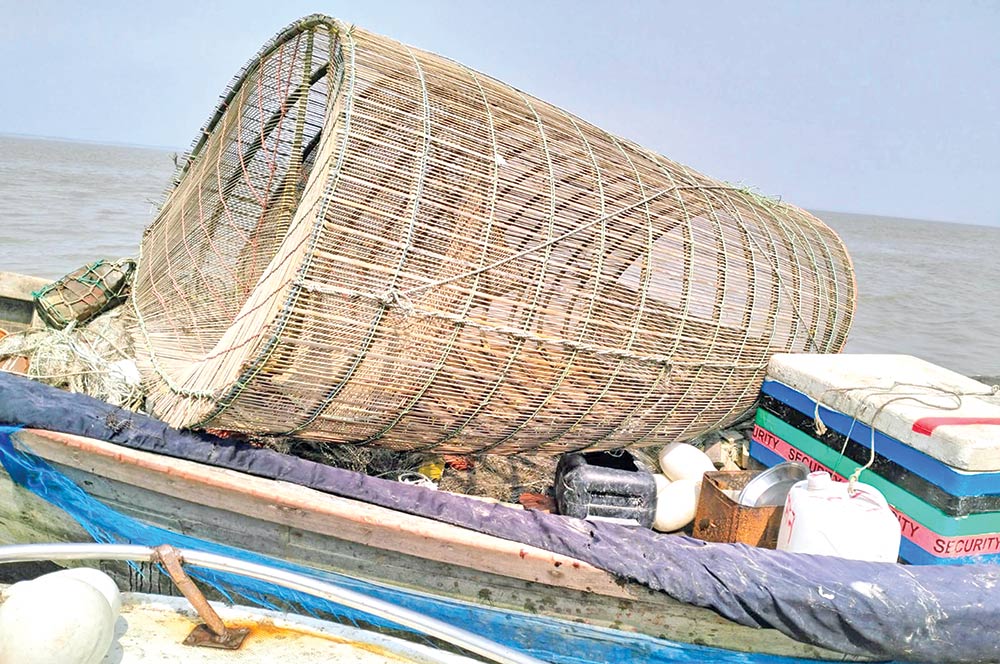
CHAR FASSON, BHOLA, May 18: Illegal use of large bamboo fishing traps, locally known as "chaai," in the Meghna and Tentulia rivers flowing along Char Fasson Upazila is posing a serious threat to millions of pangash fry, raising concerns over the future of fish breeding in the region.
Locals and fisheries experts say the widespread use of these banned nets is destroying juvenile fish stocks, while alleged negligence and lack of monitoring by the Fisheries Department and administration have worsened the situation.
Although occasional drives are conducted and some traps are seized, officials admit that no long-term solution has yet been implemented, allowing organised groups to continue their activities unchecked.
According to sources, a coordinated group has been operating for years in the Meghna-Tentulia river system, using large-scale illegal traps to indiscriminately catch fish fry. These traps are reportedly sold for Tk 45,000 to Tk 50,000 each and are manufactured in Char Fasson and Monpura areas.
Before being placed 40-50 feet underwater, bait made from dried fish, oil cake, bran, sugar, flattened rice and fish oil is used to attract fish. Within hours, the traps capture large quantities of juvenile Pangash, which are later sold in markets as "tangra" fish.
Fishermen said that a single trap can catch around 120 kg of fry per day. Experts, however, note that the fish being sold as tangra are actually Pangash juveniles, while true tangra catfish is a distinct species that rarely exceeds 5-10 cm in size.
Locals alleged that around 50 fishermen in Char Fassion, including areas such as Betua Notun Shulji and Beribhanga, are involved in placing these traps in deep river zones. They said the groups frequently change locations whenever enforcement drives are conducted.
Fisheries officials and fishermen said the traps are often placed in deep waters using coordinated systems, including WhatsApp-based live location sharing, making detection extremely difficult.
As a result, Pangash fry are being openly sold in local markets at Tk 500-700 per kg under the guise of tangra fish.
Experts warn that continued destruction of fry in breeding grounds could severely reduce Pangash production in the country's rivers.
A research team led by Associate Professor Mir Mohammad Ali of Sher-e-Bangla Agricultural University, under the EcoFish Bangladesh project in 2017, identified the Tentulia River basin as an important breeding and habitat zone for Pangash.
He said failure to stop illegal fishing activities in these critical areas could push Pangash production to a critically low level, urging strict enforcement by the Fisheries Department and administration.
Char Fasson Upazila Senior Fisheries Officer Joyanta Kumar Opu said the practice poses a serious threat to fish biodiversity. "We conduct regular drives, but it is difficult to detect as traps are placed in deep river areas at night," he said.
He added that large-scale operations are being planned to curb the practice, warning that stopping the "dangerous chaai system" would significantly boost fish abundance in southern rivers.





