



| HEADLINE |

|

Telco oligopoly risks BD digital security



 Bangladesh's digital security and telecom governance framework has come under renewed scrutiny following policy changes that abolished the Interconnection Exchange (ICX) system, raising concerns among industry stakeholders over market concentration, regulatory oversight and national data management.
Sector insiders argue that the country's telecom ecosystem is increasingly dominated by major foreign-backed mobile operators such as Grameenphone, Robi and Banglalink. They fear the removal of ICX institutions could strengthen the market position of large operators and reduce independent oversight of telecom traffic management.
Officials and stakeholders say the ICX framework was originally introduced under the International Long Distance Telecommunications Services (ILDTS) Policy of 2007 to regulate inter-operator connectivity, curb illegal Voice over Internet Protocol (VoIP) traffic, prevent concealment of call detail records (CDRs), and ensure transparent revenue collection.
According to a senior official of the Bangladesh Telecommunication Regulatory Commission, the Telecommunications Network and Licensing Policy 2025 abolished ICX institutions. Critics allege the decision was influenced by policy preferences within the previous interim administration.
Before the introduction of ICX in 2007, Bangladesh's telecom sector faced widespread problems including illegal VoIP operations, unregulated interconnection practices and revenue leakage. Smaller operators also complained of discriminatory practices by larger telecom companies, which often controlled direct interconnection routes.
Industry stakeholders claim the ICX system created a neutral platform for routing domestic and international calls. Under the framework, international calls arriving through International Gateways (IGWs) were routed to mobile and other Access Network Service (ANS) operators via ICX platforms, allowing regulators to monitor traffic flows and detect illegal call
termination.
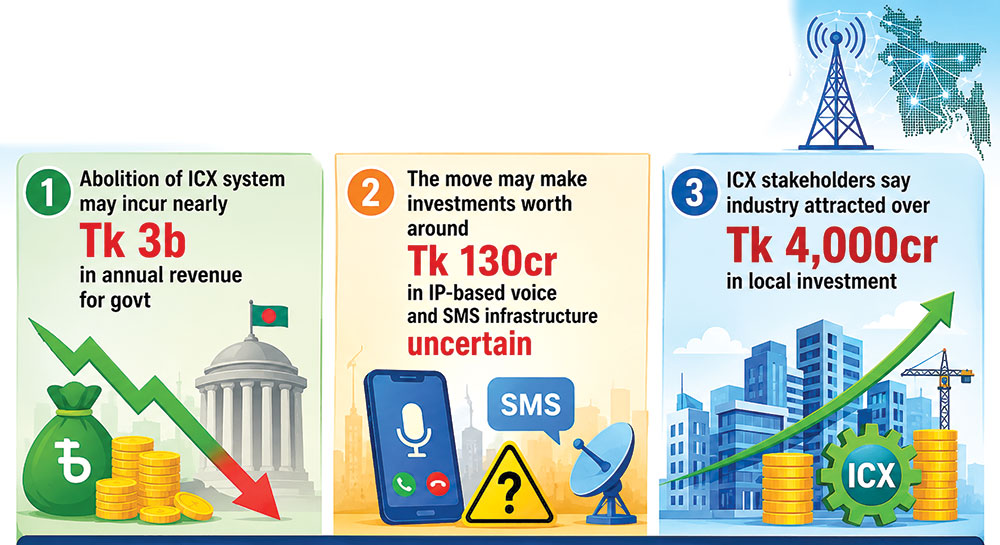
They argue that the system contributed to greater transparency, improved government revenue collection, reduced grey traffic and expanded local investment in the telecom infrastructure sector. Stakeholders also say the industry generated significant domestic employment and attracted more than Tk 4,000 crore in local investment.
According to ICX operators, removing the system may increase dependence on large telecom operators for direct interconnection management. They warn that such a structure could raise the risk of market dominance, weaken competition and complicate monitoring of telecom traffic.
Critics further argue that dismantling centralized interconnection oversight may create challenges for digital sovereignty, as critical communication traffic would rely more heavily on infrastructure managed by foreign-backed operators.
Industry representatives also expressed concern over potential economic impacts. They estimate the government could lose nearly Tk 3 billion in annual revenue, while ongoing investments worth around Tk 130 crore in IP-based voice and SMS infrastructure may face uncertainty.
Stakeholders have urged the government to revisit the Telecommunications Policy 2025 and incorporate a balanced regulatory mechanism that preserves transparency, competition and national oversight in the telecom sector.
They maintain that a comprehensive and data-driven policy approach is necessary to ensure sustainable development, fair competition, consumer protection and national security in Bangladesh's rapidly evolving telecommunications industry.

Loading...
Loading...
Also read



Editor : Iqbal Sobhan Chowdhury
Published by the Editor on behalf of the Observer Ltd. from Globe Printers, 24/A, New Eskaton Road, Ramna, Dhaka.
Editorial, News and Commercial Offices : Aziz Bhaban (2nd floor), 93, Motijheel C/A, Dhaka-1000.
Phone: PABX- 41053001-06; Advertisement: 41053012; 01793317829, 01550707291, E-mail: [email protected], [email protected] Online: email: [email protected] 41053014; 01550707297 Advertisement: 01550707296
Published by the Editor on behalf of the Observer Ltd. from Globe Printers, 24/A, New Eskaton Road, Ramna, Dhaka.
Editorial, News and Commercial Offices : Aziz Bhaban (2nd floor), 93, Motijheel C/A, Dhaka-1000.
Phone: PABX- 41053001-06; Advertisement: 41053012; 01793317829, 01550707291, E-mail: [email protected], [email protected] Online: email: [email protected] 41053014; 01550707297 Advertisement: 01550707296


