



| HEADLINE |

|
‘UNICEF warned interim govt over vaccine crisis’


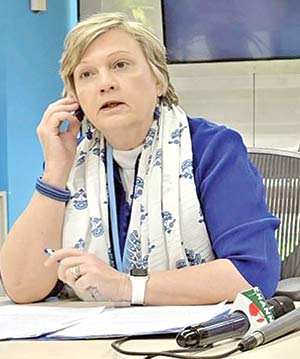 UNICEF Representative to Bangladesh Rana Flowers has said that five to six letters were sent to warn the interim government about a looming vaccine crisis.
Speaking at a press conference held at the JPG Conference Room of UNICEF House in the capital, she made the remarks and said that no epidemic occurs overnight and that such situations develop due to a series of factors, particularly in the case of vaccine-preventable diseases.
Responding to a question, Flowers said that the delay in the vaccine procurement process after the current government assumed office stemmed from a cabinet decision (the interim government) to purchase vaccines through an open tender system.
Noting the decision had been taken last year, she further added "I do not think such a decision had ever been taken before. However, you may verify the matter with the Health Ministry." Replying another question, this UNICEF representative said, "At this moment, I do not have the exact dates in front of me. However, the investigation will confirm the matter. What I know is that we sent five to six letters between 2024 and February 2026, and the last letter reached just before the new government took office. We had hoped that the letter would be waiting on the desk of whoever assumed the responsibility."
She further said, "We repeatedly pushed for emergency meetings with them. At the same time, I can say that I met interim advisers and officials at least 10 times. My employees and I told them that we were concerned. You can see from my face that I am worried you are heading toward a vaccine crisis."
"It was clear that if vaccines could not be brought into the country, problems would arise," Flowers added.
Asked whether Bangladesh had experienced any vaccine shortages over the past two years, Flowers said, "We had forecast a vaccine crisis back in 2024. It could affect different diseases over the following two years. That is why we warned in advance and continuously reminded them that they were heading toward a crisis."
Loading...
Loading...
Also read



Editor : Iqbal Sobhan Chowdhury
Published by the Editor on behalf of the Observer Ltd. from Globe Printers, 24/A, New Eskaton Road, Ramna, Dhaka.
Editorial, News and Commercial Offices : Aziz Bhaban (2nd floor), 93, Motijheel C/A, Dhaka-1000.
Phone: PABX- 41053001-06; Advertisement: 41053012; 01793317829, 01550707291, E-mail: [email protected], [email protected] Online: email: [email protected] 41053014; 01550707297 Advertisement: 01550707296
Published by the Editor on behalf of the Observer Ltd. from Globe Printers, 24/A, New Eskaton Road, Ramna, Dhaka.
Editorial, News and Commercial Offices : Aziz Bhaban (2nd floor), 93, Motijheel C/A, Dhaka-1000.
Phone: PABX- 41053001-06; Advertisement: 41053012; 01793317829, 01550707291, E-mail: [email protected], [email protected] Online: email: [email protected] 41053014; 01550707297 Advertisement: 01550707296


