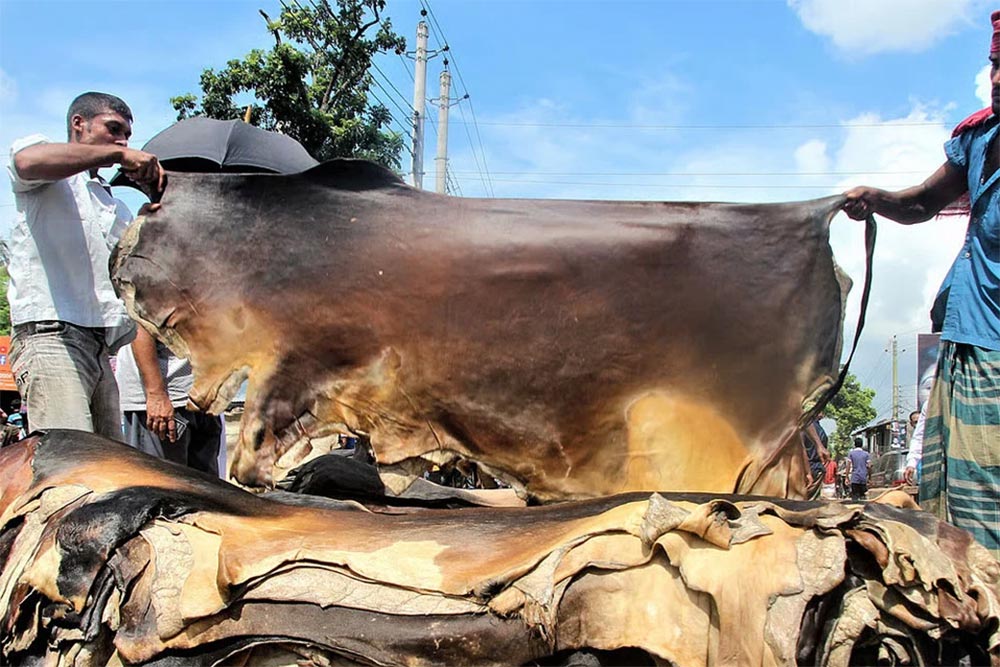
The leather industry is one of the most promising sectors of Bangladesh's economy. With abundant raw materials, cost-effective labor, and strong global demand, the sector has immense potential for growth and foreign exchange earnings. Raw hides are processed through several stages-from wet blue and crust leather to finished leather-before being transformed into products such as shoes, sandals, belts, and various leather goods. The high quality of Bangladeshi leather has created significant opportunities for the country to establish a stronger position in the global leather market.
A major portion of Bangladesh's leather supply comes during Eid-ul-Azha. Every year, nearly 10 million animal hides are collected across the country during the festival. Although the leather industry has not expanded on the scale of the ready-made garments sector, almost all of its earnings contribute directly to the national economy through value addition. Unlike the garment industry, which relies heavily on imported raw materials, leather processing and manufacturing largely utilize domestic resources, apart from some capital machinery and chemicals.
During the fiscal year 2024-25, Bangladesh earned approximately US$1.14 billion from the export of leather and leather products. The sector contributes around 0.60 percent to the national GDP and provides direct and indirect employment to nearly one million people. Furthermore, as leather products are considered durable and environmentally preferable to many synthetic alternatives, global demand for leather goods continues to grow. Improving the environmental standards of the Central Effluent Treatment Plant (CETP) at the Savar Leather Industrial Estate could further enhance international buyers' confidence in Bangladeshi leather products. Various industry estimates suggest that with proper management and policy support, the sector could generate between US$15 billion and US$20 billion annually.
Despite its enormous potential, Bangladesh's leather industry has struggled to achieve sustainable growth. One of the primary reasons is its failure to meet international compliance standards related to environmental protection and workplace safety. According to research conducted by the Bangladesh Small and Cottage Industries Corporation (BSCIC), key challenges include the inadequate capacity of the CETP in Savar, limited awareness among tannery owners regarding compliance requirements, poor solid waste management, and substandard working conditions within tanneries.
As a result, most tanneries in Savar have failed to obtain certification from the Leather Working Group (LWG), the globally recognized authority for leather industry standards. Consequently, processed leather from Bangladesh is often exported to China at lower prices instead of accessing more lucrative European markets.
Bangladesh remains significantly behind its competitors in terms of compliance certification. The country currently has only six LWG-certified tanneries, compared to 139 in India, 103 in China, 68 in Italy, 60 in Brazil, and 24 in Taiwan. The lack of LWG certification has weakened Bangladesh's position in the global leather market. Despite having a sufficient domestic supply of raw hides, export-oriented leather goods manufacturers are forced to import LWG-certified finished leather worth nearly Tk 10 billion annually, reducing their competitiveness and increasing production costs.
Several other factors also hinder the achievement of LWG certification. These include the absence of effective traceability systems to track the origin of raw hides and the destination of processed leather, the disposal of liquid and solid waste through the same pipeline, processing volumes that exceed tannery design capacities, inadequate pre-treatment facilities, improper storage of chemicals, failure to separate chromium-containing waste, limited adoption of modern processing technologies, and poor occupational health and safety standards for workers.
Another major challenge facing the industry is the shortage of capital and recurring labor dissatisfaction. Nearly 40-50 percent of the country's annual leather supply becomes available during Eid-ul-Azha, yet many tannery owners lack sufficient financial resources to purchase and preserve hides. Consequently, animal hides are often sold at extremely low prices, while many others are discarded or buried due to a lack of buyers. Beyond financial constraints, tannery workers frequently face inadequate wages and unsafe working conditions. Exposure to polluted environments often leads to skin diseases, respiratory illnesses, and other long-term health complications.
The limited use of advanced technology in tanneries also contributes to inefficiency and environmental pollution. In addition, the absence of comprehensive government planning and effective policy implementation has further constrained the sector's development. Moreover, every year during Eid-ul-Azha, a significant number of animal hides are damaged or wasted due to poor handling, inadequate preservation techniques, and insufficient public awareness. This results in substantial economic losses and reduces the overall value that the leather sector could generate for the country.
To unlock the full potential of this promising industry, Bangladesh must adopt a comprehensive and long-term development strategy. The government's ongoing initiative to bring the leather sector under a structured long-term policy framework should be implemented effectively. World-class environmental standards must be ensured in tannery operations, while investments should be made in modern technologies and sustainable leather processing methods. Workers should receive proper training to improve their skills, and safe, healthy working environments must be guaranteed.
Special attention should also be given to the preservation and collection of hides during Eid-ul-Azha to prevent unnecessary losses. At the same time, measures must be taken to ensure that the expansion of the leather industry does not come at the expense of environmental sustainability. Above all, coordinated efforts by the government, industry stakeholders, and the public are essential to transform Bangladesh's leather sector into a globally competitive and environmentally responsible industry.
The writer is a student, University of Chittagong





