



| HEADLINE |

|

Model primary schools under UNO supervision
Published : Thursday, 4 June, 2026 at 12:00 AM
NM Abdullah Al Mamun


 In the quiet, agrarian landscape of Gafargaon Upazila, a silent revolution is unfolding within the walls of its government primary schools. Spread across a vast terrain of nearly 400 square kilometers under the jurisdiction of two distinct police stations-Gafargaon and Pagla-this upazila in Mymensingh is currently testing a new template for public education management. In an era of significant administrative transition, the burden of improving primary education has fallen squarely on the shoulders of the Upazila Nirbahi Officer (UNO) and the local administration.
With 238 government primary schools catering to tens of thousands of children, the scale of the challenge is massive. The governance of primary education in Gafargaon has taken an unprecedented turn. In the absence of elected Union Parishad (UP) chairmen, officers from the Upazila Parishad have stepped out of their traditional bureaucratic roles to serve as Union Administrators. Recognizing that real change cannot happen from a desk in the upazila headquarters, the UNO has strategically deployed these administrators to the front lines of education.
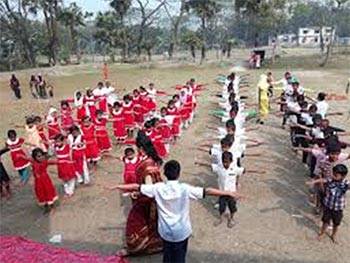 These Upazila officers have been given the explicit mandate of monitoring and conducting regular visits to primary schools within their respective unions. This makeshift administrative layer has successfully filled a critical supervisory vacuum. One of the most visible and widely praised interventions by the Gafargaon upazila administration is the transformation of selected institutions into "Model Primary Schools." Understanding that children learn best when they are happy, the administration has moved beyond a strictly academic focus to address the psychological and physical needs of young learners.
In these model institutions, playgrounds have been revitalized. The administration has installed modern recreational rides, including vibrant slides, swings (cuddles), and see-saws. To encourage physical health and team spirit, proper football goalposts have been erected, and sports kits, including quality footballs, have been distributed.
To bring these rural schools into the 21st century, technology and security have been woven into the infrastructure. High-speed internet facilities have been established to help teachers access modern digital learning tools, while Closed-Circuit (CC) cameras have been installed to monitor school premises, ensuring a secure environment for both students and staff.
The achievements in Gafargaon are particularly remarkable when viewed against the backdrop of severe resource constraints. The Upazila Primary Education Office is currently running on a skeleton crew, facing an acute shortage of field-level staff. Most critically, the post of the regular Upazila Primary Education Officer (UPEO) has remained vacant for several years.
Operating without a permanent, full-time educational head means that the UNO has had to double down on supervisory duties, often stretching the upazila's administrative machinery to its limits. Assistant Upazila Education Officers are forced to manage double their usual workload, juggling paperwork with school inspections across a sprawling geographic area. The local administration's ability to keep the system running smoothly-and even introduce modernizing reforms-is a testament to their resilience and crisis-management capabilities.
The Gafargaon experiment demonstrates that structural deficiencies, such as a lack of specialized personnel, can be mitigated through strong executive will and cross-departmental collaboration. By utilizing upazila officers as union administrators, the local government has created an agile monitoring system that ensures national education goals are met at the village level.
The introduction of model schools, safe connecting roads, sports equipment, and digital safety nets shows a holistic understanding of what a child needs to thrive. As Gafargaon continues to blend its rich regional traditions with progressive administrative strategies, it offers a compelling blueprint for the rest of rural Bangladesh: when you improve the path to school, make the playground joyful, and keep the administration vigilant, the classroom naturally fills with the future leaders of the nation.
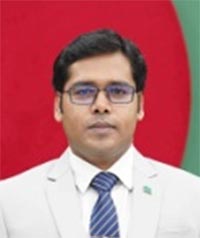
The writer is Upazila Nirbahi Officer

Loading...
Loading...
Also read



Editor : Iqbal Sobhan Chowdhury
Published by the Editor on behalf of the Observer Ltd. from Globe Printers, 24/A, New Eskaton Road, Ramna, Dhaka.
Editorial, News and Commercial Offices : Aziz Bhaban (2nd floor), 93, Motijheel C/A, Dhaka-1000.
Phone: PABX- 41053001-06; Advertisement: 41053012; 01793317829, 01550707291, E-mail: [email protected], [email protected] Online: email: [email protected] 41053014; 01550707297 Advertisement: 01550707296
Published by the Editor on behalf of the Observer Ltd. from Globe Printers, 24/A, New Eskaton Road, Ramna, Dhaka.
Editorial, News and Commercial Offices : Aziz Bhaban (2nd floor), 93, Motijheel C/A, Dhaka-1000.
Phone: PABX- 41053001-06; Advertisement: 41053012; 01793317829, 01550707291, E-mail: [email protected], [email protected] Online: email: [email protected] 41053014; 01550707297 Advertisement: 01550707296


