



| HEADLINE |

|

Bangladesh’s Creative Economy Gambit
Unlocking the wealth of culture and code


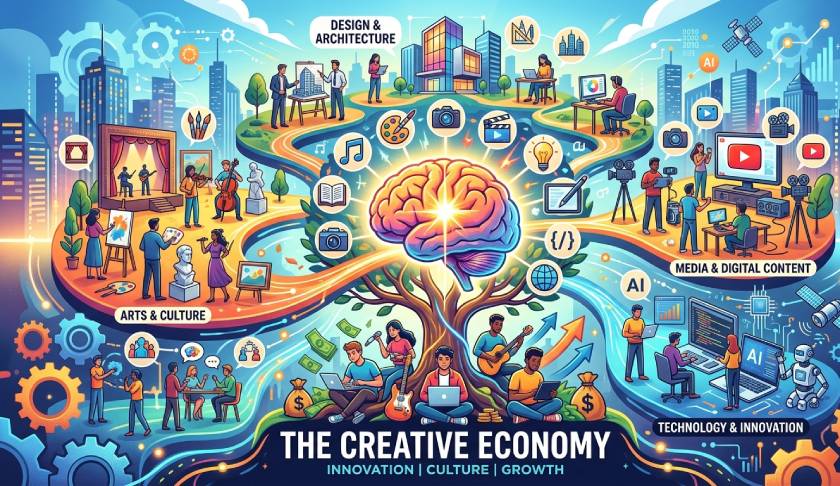
An AI Generated Photo
Creative Economy: Why Does It Matter?
Creative Economy, the much hyped term in the upcoming 2026-27 budget of Bangladesh, is not a new concept but is one that the country has been slow to institutionalise.
At its core, creative economy encompasses the creation, production, and distribution of goods and services that rely primarily on creativity and intellectual capital. It spans film, dance, music, theatre, publishing, advertising, architecture, fine arts, handicrafts, design, software, and video games.
Globally, the sector has grown into a formidable economic force. UNCTAD’s Creative Economy Outlook 2024 reveals that creative services exports surged to $1.4 trillion in 2022, a 29 per cent increase since 2017, while creative goods exports reached $713 billion, up 19 per cent. Across surveyed nations, the creative economy contributes between 0.5 per cent and 7.3 per cent of GDP, employing between 0.5 per cent and 12.5 per cent of the national workforce. Notably, software services alone account for 41 per cent of all creative services exports globally.
Indonesia leads among developing nations with a creative economy contribution of 7.28 per cent of GDP, followed by the Philippines at 7.3 per cent, the United States at 4.2 per cent, and India at 2.5 per cent. Bangladesh does not yet feature in this ranking- a gap that the current government is seeking to close.
Dhaka’s Plan: From Rhetoric to Policy
The Bangladesh government has made creative economy development an explicit policy priority heading into the 2026-27 fiscal year. Finance Minister Amir Khasru Mahmud Chowdhury is set to outline the potential and framework of the creative economy in his budget speech, with an allocation of Tk 3 billion earmarked for the sector.
The government is planning to establish a “Creative District” on approximately 160 acres of land near the capital, and is also considering providing easy loans, raw material support, design development, branding, marketing assistance, and access to international markets for entrepreneurs in this space.
Bangladesh Nationalist Party’s election manifesto had committed to raising the sector’s contribution to GDP to at least 1.5 per cent, creating employment for 500,000 people, forming a “Bangladesh Creative Development Authority,” and launching a national brand called “Created in Bangladesh.”
The Finance Division has identified key potential sectors: folk culture and heritage, performing arts, media and entertainment, publishing, design and creative services, IT and digital creativity, cultural tourism, fashion, and corporate branding.
Folk, Film, and Music: A Culture Waiting for Its Stage
Bangladesh possesses one of the richest folk traditions in South Asia: Baul, Bhatiali, Jari, Sari, and Murshidi music have defined the region’s cultural identity for centuries. Yet these forms generate negligible formal economic output. Cultural Affairs Secretary Kaniz Mawla, speaking at a government roundtable, called for initiatives to revive fading traditional forms such as Jatra and circus, which have been losing audiences and state support for decades.
The film industry tells a similar story of squandered potential. Finance Minister Khosru pointed out that neighbouring countries’ films and music are travelling to other parts of the world, while Bangladesh lacks equivalent soft power.
BRAC Executive Director Asif Saleh identified the film industry, handicrafts, and cultural tourism as the three main focus areas for the development of the creative economy, also calling for subsidies and easy loans for the film sector.
A structured creative economy framework could change this. Dedicated cineplexes at the upazila level, OTT platform development, and formalised music licensing systems would create revenue streams for artists who currently perform without contracts or intellectual property protection.
A proposal at the government’s first stakeholder meeting called for 550 creative centres at the upazila level, each featuring cultural stages, bookstores, cineplexes, and small cafeterias. If implemented, this infrastructure could transform folk and performing arts from a cultural heritage exercise into a self-sustaining industry.
Freelancers at the Crossroads: Strong Numbers, Systemic Gaps
Bangladesh’s digital creative workforce is already substantial. The country has approximately 650,000 active freelancers, putting it second only to India in online labour supply globally, with a 16% share of the world’s online labour market. Together, they earn over $500 million annually in foreign exchange.
The average Bangladeshi freelancer earned $500 to $700 per month in 2025- significantly above the country’s average entry-level corporate salary of around $100 to $115 per month. On the surface, these are impressive figures. However, a closer examination reveals structural weaknesses that prevent the sector from reaching its potential.
Currently, 60 per cent of Bangladeshi freelancers work in creative and multimedia, 16 per cent in software development, and 9 per cent in writing and translation. The heavy concentration in low-barrier creative tasks- primarily logo design and digital marketing- keeps earnings moderate. A study by the National Skill Development Authority (NSDA) published in October 2024 found that most freelancers excel in graphic design but lag significantly behind global competitors in programming, cybersecurity, and other high-value skills.
This gap contributed to Bangladesh dropping to 29th place in CEOWorld Magazine’s ranking of top freelancing countries.
The study’s conclusion is clear: freelancers need to move beyond data entry, graphic design, and digital marketing, and develop skills in artificial intelligence, machine learning, cybersecurity, programming, and 3D modelling to remain competitive in global marketplaces.
A structured creative economy policy could address this. Dedicated innovation centres in public universities, formalised creative training hubs, and a national pool of designers would shift Bangladesh from a supplier of cheap creative labour to a producer of high-value creative services.
A growing number of experienced Bangladeshi freelancers are already building their own agencies and moving away from platform dependency, with freelance earnings growth linked to active professional networking rising at 31 per cent year-on-year according to Payoneer data from 2024, an encouraging structural shift that the right policy environment could accelerate.
The Challenges: Gaps the Government Must Address
Despite the political will, the path to a functioning creative economy in Bangladesh is strewn with practical obstacles.
The Finance Division itself has acknowledged practical weaknesses in intellectual property protection, a lack of reliable statistics, weak policy coordination across ministries, limited funding and restricted loan access for small entrepreneurs, an absence of venture capital and creative funds, shortage of skilled human resources, lack of quality studios and labs, and insufficient Bangladeshi brand recognition in international markets.
There is also a notable data gap. Additional Secretary Hasan Khaled Faisal, presenting a concept paper at the government’s stakeholder meeting, stated there is no national data on the creative sector’s contribution to GDP or employment, a fundamental measurement failure that makes evidence-based policymaking difficult. Any credible implementation roadmap must begin with a national survey.
Political economy is another concern. The Finance Minister has acknowledged that Bangladesh’s economy has long been dominated by a limited group, where excessive regulatory mechanisms increased the cost of doing business, and that many restrictions were imposed on ordinary entrepreneurs while influential groups remained outside their purview. Creative entrepreneurs like musicians, filmmakers, artisans, and developers are precisely the ordinary entrepreneurs who fall outside patronage networks.
Infrastructure gaps are equally pressing. Reliable high-speed internet, which is foundational to the digital creative sector, remains inconsistent outside major urban centres. The internet blackout of July 2024, which followed political unrest, demonstrated how fragile the freelancing ecosystem remains when communications infrastructure is disrupted.
Finally, there is the question of implementation capacity. The government has held two rounds of stakeholder meetings and identified ministries responsible for various creative economy mandates. But without a single empowered authority and binding timelines, initiatives risk dissipating into bureaucratic inertia- a pattern Bangladesh’s development history knows well.
The Creative Dividend Is There: If the Policy Is Followed Through
Bangladesh stands at an intersection that few developing countries reach simultaneously- a young demographic, a globally competitive freelance workforce, a deeply rooted cultural tradition, and, for the first time, a government that has written creative economy development into its budget and manifesto.
The World Bank has expressed willingness to finance this sector, and a special startup fund alongside a 10-year national strategy has been proposed.
The architecture of a policy framework exists. What remains to be seen is whether Bangladesh can convert political intent into measurable outcomes- employment figures, export earnings, and a GDP share that finally places the country on UNCTAD’s creative economy map.
Creative Economy, the much hyped term in the upcoming 2026-27 budget of Bangladesh, is not a new concept but is one that the country has been slow to institutionalise.
At its core, creative economy encompasses the creation, production, and distribution of goods and services that rely primarily on creativity and intellectual capital. It spans film, dance, music, theatre, publishing, advertising, architecture, fine arts, handicrafts, design, software, and video games.
Globally, the sector has grown into a formidable economic force. UNCTAD’s Creative Economy Outlook 2024 reveals that creative services exports surged to $1.4 trillion in 2022, a 29 per cent increase since 2017, while creative goods exports reached $713 billion, up 19 per cent. Across surveyed nations, the creative economy contributes between 0.5 per cent and 7.3 per cent of GDP, employing between 0.5 per cent and 12.5 per cent of the national workforce. Notably, software services alone account for 41 per cent of all creative services exports globally.
Indonesia leads among developing nations with a creative economy contribution of 7.28 per cent of GDP, followed by the Philippines at 7.3 per cent, the United States at 4.2 per cent, and India at 2.5 per cent. Bangladesh does not yet feature in this ranking- a gap that the current government is seeking to close.
Dhaka’s Plan: From Rhetoric to Policy
The Bangladesh government has made creative economy development an explicit policy priority heading into the 2026-27 fiscal year. Finance Minister Amir Khasru Mahmud Chowdhury is set to outline the potential and framework of the creative economy in his budget speech, with an allocation of Tk 3 billion earmarked for the sector.
The government is planning to establish a “Creative District” on approximately 160 acres of land near the capital, and is also considering providing easy loans, raw material support, design development, branding, marketing assistance, and access to international markets for entrepreneurs in this space.
Bangladesh Nationalist Party’s election manifesto had committed to raising the sector’s contribution to GDP to at least 1.5 per cent, creating employment for 500,000 people, forming a “Bangladesh Creative Development Authority,” and launching a national brand called “Created in Bangladesh.”
The Finance Division has identified key potential sectors: folk culture and heritage, performing arts, media and entertainment, publishing, design and creative services, IT and digital creativity, cultural tourism, fashion, and corporate branding.
Folk, Film, and Music: A Culture Waiting for Its Stage
Bangladesh possesses one of the richest folk traditions in South Asia: Baul, Bhatiali, Jari, Sari, and Murshidi music have defined the region’s cultural identity for centuries. Yet these forms generate negligible formal economic output. Cultural Affairs Secretary Kaniz Mawla, speaking at a government roundtable, called for initiatives to revive fading traditional forms such as Jatra and circus, which have been losing audiences and state support for decades.
The film industry tells a similar story of squandered potential. Finance Minister Khosru pointed out that neighbouring countries’ films and music are travelling to other parts of the world, while Bangladesh lacks equivalent soft power.
BRAC Executive Director Asif Saleh identified the film industry, handicrafts, and cultural tourism as the three main focus areas for the development of the creative economy, also calling for subsidies and easy loans for the film sector.
A structured creative economy framework could change this. Dedicated cineplexes at the upazila level, OTT platform development, and formalised music licensing systems would create revenue streams for artists who currently perform without contracts or intellectual property protection.
A proposal at the government’s first stakeholder meeting called for 550 creative centres at the upazila level, each featuring cultural stages, bookstores, cineplexes, and small cafeterias. If implemented, this infrastructure could transform folk and performing arts from a cultural heritage exercise into a self-sustaining industry.
Freelancers at the Crossroads: Strong Numbers, Systemic Gaps
Bangladesh’s digital creative workforce is already substantial. The country has approximately 650,000 active freelancers, putting it second only to India in online labour supply globally, with a 16% share of the world’s online labour market. Together, they earn over $500 million annually in foreign exchange.
The average Bangladeshi freelancer earned $500 to $700 per month in 2025- significantly above the country’s average entry-level corporate salary of around $100 to $115 per month. On the surface, these are impressive figures. However, a closer examination reveals structural weaknesses that prevent the sector from reaching its potential.
Currently, 60 per cent of Bangladeshi freelancers work in creative and multimedia, 16 per cent in software development, and 9 per cent in writing and translation. The heavy concentration in low-barrier creative tasks- primarily logo design and digital marketing- keeps earnings moderate. A study by the National Skill Development Authority (NSDA) published in October 2024 found that most freelancers excel in graphic design but lag significantly behind global competitors in programming, cybersecurity, and other high-value skills.
This gap contributed to Bangladesh dropping to 29th place in CEOWorld Magazine’s ranking of top freelancing countries.
The study’s conclusion is clear: freelancers need to move beyond data entry, graphic design, and digital marketing, and develop skills in artificial intelligence, machine learning, cybersecurity, programming, and 3D modelling to remain competitive in global marketplaces.
A structured creative economy policy could address this. Dedicated innovation centres in public universities, formalised creative training hubs, and a national pool of designers would shift Bangladesh from a supplier of cheap creative labour to a producer of high-value creative services.
A growing number of experienced Bangladeshi freelancers are already building their own agencies and moving away from platform dependency, with freelance earnings growth linked to active professional networking rising at 31 per cent year-on-year according to Payoneer data from 2024, an encouraging structural shift that the right policy environment could accelerate.
The Challenges: Gaps the Government Must Address
Despite the political will, the path to a functioning creative economy in Bangladesh is strewn with practical obstacles.
The Finance Division itself has acknowledged practical weaknesses in intellectual property protection, a lack of reliable statistics, weak policy coordination across ministries, limited funding and restricted loan access for small entrepreneurs, an absence of venture capital and creative funds, shortage of skilled human resources, lack of quality studios and labs, and insufficient Bangladeshi brand recognition in international markets.
There is also a notable data gap. Additional Secretary Hasan Khaled Faisal, presenting a concept paper at the government’s stakeholder meeting, stated there is no national data on the creative sector’s contribution to GDP or employment, a fundamental measurement failure that makes evidence-based policymaking difficult. Any credible implementation roadmap must begin with a national survey.
Political economy is another concern. The Finance Minister has acknowledged that Bangladesh’s economy has long been dominated by a limited group, where excessive regulatory mechanisms increased the cost of doing business, and that many restrictions were imposed on ordinary entrepreneurs while influential groups remained outside their purview. Creative entrepreneurs like musicians, filmmakers, artisans, and developers are precisely the ordinary entrepreneurs who fall outside patronage networks.
Infrastructure gaps are equally pressing. Reliable high-speed internet, which is foundational to the digital creative sector, remains inconsistent outside major urban centres. The internet blackout of July 2024, which followed political unrest, demonstrated how fragile the freelancing ecosystem remains when communications infrastructure is disrupted.
Finally, there is the question of implementation capacity. The government has held two rounds of stakeholder meetings and identified ministries responsible for various creative economy mandates. But without a single empowered authority and binding timelines, initiatives risk dissipating into bureaucratic inertia- a pattern Bangladesh’s development history knows well.
The Creative Dividend Is There: If the Policy Is Followed Through
Bangladesh stands at an intersection that few developing countries reach simultaneously- a young demographic, a globally competitive freelance workforce, a deeply rooted cultural tradition, and, for the first time, a government that has written creative economy development into its budget and manifesto.
The World Bank has expressed willingness to finance this sector, and a special startup fund alongside a 10-year national strategy has been proposed.
The architecture of a policy framework exists. What remains to be seen is whether Bangladesh can convert political intent into measurable outcomes- employment figures, export earnings, and a GDP share that finally places the country on UNCTAD’s creative economy map.

Loading...
Loading...
Also read





Editor : Iqbal Sobhan Chowdhury
Published by the Editor on behalf of the Observer Ltd. from Globe Printers, 24/A, New Eskaton Road, Ramna, Dhaka.
Editorial, News and Commercial Offices : Aziz Bhaban (2nd floor), 93, Motijheel C/A, Dhaka-1000.
Phone: PABX- 41053001-06; Advertisement: 41053012; 01793317829, 01550707291, E-mail: [email protected], [email protected] Online: email: [email protected] 41053014; 01550707297 Advertisement: 01550707296
Published by the Editor on behalf of the Observer Ltd. from Globe Printers, 24/A, New Eskaton Road, Ramna, Dhaka.
Editorial, News and Commercial Offices : Aziz Bhaban (2nd floor), 93, Motijheel C/A, Dhaka-1000.
Phone: PABX- 41053001-06; Advertisement: 41053012; 01793317829, 01550707291, E-mail: [email protected], [email protected] Online: email: [email protected] 41053014; 01550707297 Advertisement: 01550707296


