



| HEADLINE |

|

FIFA World Cup 2026: A look into the sportech revolution
Published : Sunday, 7 June, 2026 at 3:28 PM
Ishtiaque Foysol


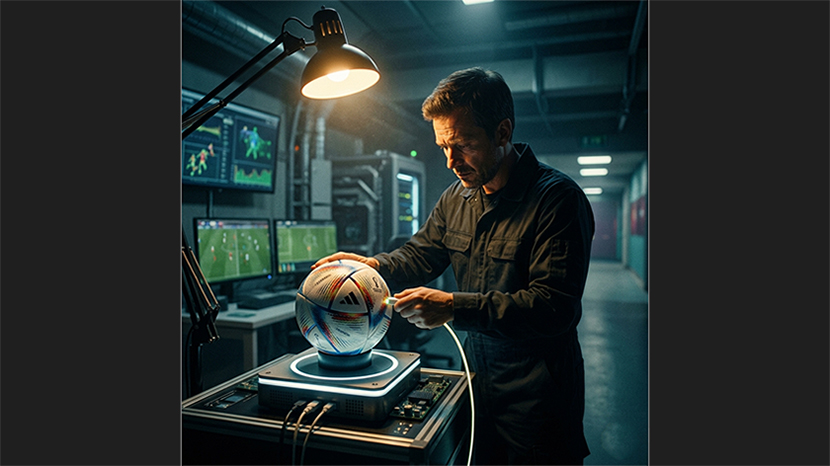
An AI Generated Photo
This year’s FIFA world cup is going to be historic for two reasons, the biggest ever event of the franchise and the bleeding edge sportech technologies the hosting countries using.
Before even a single goal is scored at the 2026 FIFA World Cup, a technician in the bowels of one of 16 host stadiums across the United States, Canada, and Mexico is doing something that would have been unthinkable at any previous tournament: charging the match ball.
That detail, mundane, almost comic, tells the full story of what FIFA has built this summer. The 2026 World Cup is not merely a larger football tournament. With 48 teams, 104 matches, and a three-nation footprint stretching across two continents, it is the most technologically complex live event ever attempted in the history of sports.
Artificial intelligence, generative analytics platforms, 3D player avatars, immersive viewing infrastructure and a sentient match ball have together redefined what a global sports event looks like- on the pitch, in the stands, and on screens worldwide.
The Ball Has a Heartbeat
At the centre of it all is the Adidas Trionda, the official match ball of the 2026 World Cup. Its name nods to the three host nations (from the Spanish onda, meaning wave), but the engineering inside it is what commands attention.
Embedded within a specially constructed layer of one of its four thermally bonded panels is a 500-hertz inertial measurement unit (IMU), a motion sensor chip that captures ball speed, spin, trajectory, and exact moment of contact 500 times every second. The data is transmitted in real time directly to the Video Assistant Referee or VAR system. As one Adidas technician told a journalist, “We gave a heartbeat to the ball.”
The Trionda runs on a six-hour rechargeable battery, which is why every match day begins with a charging ritual that would have seemed absurd at Qatar 2022. But the payoff is significant: every marginal touch, a deflection off a defender’s shoulder, a brush of a player’s sleeve, is now recorded with electronic precision. “The technology is part of football’s governing body’s latest push to use artificial intelligence and tracking technology to make refereeing decisions faster and more accurate,” Australia’s SBS News reported this week.
The ball does not function in isolation. It feeds into a broader officiating ecosystem of 16 optical tracking cameras positioned in each stadium, generating over 150 million data points per match - the foundation upon which all of FIFA’s most consequential technological bets have been placed.
3D Avatars Replace Stick Figures
The most visible transformation in officiating at this tournament is the retirement of the crude, robotic mannequins that previously illustrated VAR offside decisions. In their place: photorealistic, AI-generated 3D digital avatars of every player competing in the tournament.
According to FIFA and Lenovo’s official announcements, every participating player was required to step into a specialised scanning chamber upon arrival in North America. Within approximately one second, the chamber captured precise body dimensions and generated an accurate digital twin of that player. These avatars are then synchronised in real time with the Trionda’s 500Hz sensor and the stadium-wide tracking cameras.
When a VAR review is triggered, the system constructs a life-like 3D reconstruction of the play.
The result is a dramatic reduction in review times. Webnames Blog, citing FIFA data, reported that the new system brings offside review times down from over a minute to approximately 20 seconds. FIFA President Gianni Infantino, speaking at Lenovo Tech World 2026, described the development as “a big advancement in semi-automated offside technology providing great images, faster decisions and a clear understanding by everyone.”
The system also democratises officiating transparency: for the first time, fans watching on broadcast screens and in stadiums will see the same high-fidelity 3D reconstruction that VAR officials consult in the review room.
Football AI Pro: Equalising the Playing Field
Beyond officiating, FIFA has introduced what may be its most consequential long-term innovation: Football AI Pro, a generative AI knowledge assistant made available to all 48 competing teams.
As reported by Euronews, the platform analyses matches to deliver “tactical insights, performance analysis, and strategic recommendations.” It can process over 2,000 football-specific metrics- pressing intensity, defensive transitions, movement patterns, expected goals- and present findings as text summaries, short video clips, or graphical data representations. The system is built on the same 150-million-data-point-per-match tracking infrastructure that powers the VAR avatars
.
The stated purpose is explicit equalisation. Football analytics has historically been the domain of wealthy European clubs and well-resourced national federations. A debutant African or Asian nation could not previously access the same depth of pre-match intelligence as a perennial power like Brazil or Germany.
Football AI Pro, according to FIFA’s Director of Innovation Johannes Holzmüller, is designed to close that gap, giving coaches from every economic background access to the same analytical depth.
The South China Morning Post, citing Bank of America Global Research, quoted analysts writing: “If in the past rich teams had an advantage, in 2026 AI will democratise data and give everyone a similar chance.” The same report noted the system can process “hundreds of millions of FIFA data points.”
The Referee Wears a Camera
A third officiating innovation, and one with significant broadcast implications, is the evolution of Referee View, first trialled at the 2025 FIFA Club World Cup.
At the 2026 tournament, referees will wear body cameras whose footage is stabilised in real time using AI-powered software, eliminating the motion blur caused by a referee sprinting alongside live play.
FIFA’s Infantino described the experience as giving viewers the sensation of being “in the centre of the field together with the players.” For broadcasters and fans accustomed to wide-angle stadium shots, the body-cam feed introduces an entirely new visual grammar for football, one that places the viewer at ground level, inside the match, not observing it from a distance.
BBC, VR, and the Immersive Broadcast Race
Off the pitch, the contest among broadcasters to deliver the most immersive viewing experience has produced some of the most significant changes in sports media in a generation.
The BBC, which shares UK rights to the tournament with ITV, announced in May 2026 that it would deliver World Cup matches in Ultra HD on iPlayer-and more notably, would introduce immersive VR experiences following every England and Scotland match. According to TVBEurope, the BBC said it “also intends to employ interactive technology, new digital-first shows and immersive VR experiences.”
For the first time, BBC Sport will also deliver always-on World Cup coverage across YouTube and TikTok, including live match streaming and instant post-match reaction, as part of a FIFA deal allowing broadcasters to stream the first ten minutes of games on the platform.
FIFA’s own streaming platform, FIFA+, has expanded its augmented reality features for 2026. Fans inside stadiums can now point their smartphones at the pitch to see real-time player statistics, speed, pass accuracy, expected goals, physical intensity, overlaid directly onto the live field of play, as reported by AlleyWatch. Digital ticketing systems, now entirely paperless and linked to fan ID verification, are integrated with transit and access control across all host venues.
For fans unable to travel to North America, a company called Cosm has signed a media-rights deal with Fox Sports and FIFA to deliver “Shared Reality” screenings of World Cup matches at dome venues in Los Angeles and Dallas. Unlike conventional VR, which isolates a viewer inside a headset, Cosm’s technology projects life-sized, immersive footage across a massive curved LED dome with spatial audio, an experience designed to replicate a front-row stadium seat without the travel. Yahoo Sports described the format as resembling “an IMAX movie theater, except the screen covers your entire peripheral vision and a live sporting event is being shown.”
The Infrastructure Behind the Spectacle
Managing a tournament of this scale across three countries, 16 cities and 104 matches required an operational infrastructure that itself represents a step-change in event technology.
Lenovo, FIFA’s official technology partner, has deployed what it calls Digital Twin models of all 16 host stadiums, hyper-accurate virtual maps that allow officials to monitor crowd flow, security deployments, and technical systems in real time. If a bottleneck forms at a stadium gate in Atlanta, it appears immediately on a command centre display before it becomes a physical problem. An AI-powered Intelligent Command Center generates daily operational summaries for FIFA officials and monitors developments across the entire tournament footprint.
Meanwhile, Lenovo’s AI infrastructure manages near-real-time highlights production, multi-angle broadcast delivery, and IPTV distribution to global audiences. The company’s ThinkSystem servers handle massive volumes of live video data streaming in simultaneously from venues in Vancouver, Guadalajara, and New York, processing and distributing it with what the company describes as “near real-time” latency.
The data volumes generated by the tournament are themselves a story. SanDisk has estimated that the 2026 World Cup will produce more than 90 petabytes of data, approximately 45 times the amount generated during Qatar 2022.
Bank of America analysts went further, projecting total data volume, including social media and mobile interactions, at two exabytes. Their research team was quoted as saying: “The 2026 World Cup is the first tournament where the data itself is a primary product.”
A New Benchmark
The technologies deployed at the 2026 FIFA World Cup did not emerge overnight. Semi-automated offside was tested at the 2022 World Cup. Referee cameras were trialled in 2025. Generative AI analytics tools have been developing in club football for several years. What the 2026 tournament represents is the convergence of these systems, integrated, operational, and deployed simultaneously at the highest level of the sport.
Whether Football AI Pro genuinely closes the competitive gap between resource-rich and resource-poor football federations will only become apparent over time. Whether AI-assisted officiating produces greater fairness or new forms of contestable error remains an open question. What is not in question is the scale of the ambition.
The ball is charged. The avatars are scanned. The cameras are live. Football’s largest tournament has also become its most ambitious technological experiment, one whose results will be studied long after the final whistle in Los Angeles on July 19, 2026.
Sources:
Euronews, BBC/TVBEurope, South China Morning Post, Technology Magazine, FIFA official announcements (inside.fifa.com), Lenovo press releases, SBS News Australia, Yahoo Sports, AlleyWatch.
Before even a single goal is scored at the 2026 FIFA World Cup, a technician in the bowels of one of 16 host stadiums across the United States, Canada, and Mexico is doing something that would have been unthinkable at any previous tournament: charging the match ball.
That detail, mundane, almost comic, tells the full story of what FIFA has built this summer. The 2026 World Cup is not merely a larger football tournament. With 48 teams, 104 matches, and a three-nation footprint stretching across two continents, it is the most technologically complex live event ever attempted in the history of sports.
Artificial intelligence, generative analytics platforms, 3D player avatars, immersive viewing infrastructure and a sentient match ball have together redefined what a global sports event looks like- on the pitch, in the stands, and on screens worldwide.
The Ball Has a Heartbeat
At the centre of it all is the Adidas Trionda, the official match ball of the 2026 World Cup. Its name nods to the three host nations (from the Spanish onda, meaning wave), but the engineering inside it is what commands attention.
Embedded within a specially constructed layer of one of its four thermally bonded panels is a 500-hertz inertial measurement unit (IMU), a motion sensor chip that captures ball speed, spin, trajectory, and exact moment of contact 500 times every second. The data is transmitted in real time directly to the Video Assistant Referee or VAR system. As one Adidas technician told a journalist, “We gave a heartbeat to the ball.”
The Trionda runs on a six-hour rechargeable battery, which is why every match day begins with a charging ritual that would have seemed absurd at Qatar 2022. But the payoff is significant: every marginal touch, a deflection off a defender’s shoulder, a brush of a player’s sleeve, is now recorded with electronic precision. “The technology is part of football’s governing body’s latest push to use artificial intelligence and tracking technology to make refereeing decisions faster and more accurate,” Australia’s SBS News reported this week.
The ball does not function in isolation. It feeds into a broader officiating ecosystem of 16 optical tracking cameras positioned in each stadium, generating over 150 million data points per match - the foundation upon which all of FIFA’s most consequential technological bets have been placed.
3D Avatars Replace Stick Figures
The most visible transformation in officiating at this tournament is the retirement of the crude, robotic mannequins that previously illustrated VAR offside decisions. In their place: photorealistic, AI-generated 3D digital avatars of every player competing in the tournament.
According to FIFA and Lenovo’s official announcements, every participating player was required to step into a specialised scanning chamber upon arrival in North America. Within approximately one second, the chamber captured precise body dimensions and generated an accurate digital twin of that player. These avatars are then synchronised in real time with the Trionda’s 500Hz sensor and the stadium-wide tracking cameras.
When a VAR review is triggered, the system constructs a life-like 3D reconstruction of the play.
The result is a dramatic reduction in review times. Webnames Blog, citing FIFA data, reported that the new system brings offside review times down from over a minute to approximately 20 seconds. FIFA President Gianni Infantino, speaking at Lenovo Tech World 2026, described the development as “a big advancement in semi-automated offside technology providing great images, faster decisions and a clear understanding by everyone.”
The system also democratises officiating transparency: for the first time, fans watching on broadcast screens and in stadiums will see the same high-fidelity 3D reconstruction that VAR officials consult in the review room.
Football AI Pro: Equalising the Playing Field
Beyond officiating, FIFA has introduced what may be its most consequential long-term innovation: Football AI Pro, a generative AI knowledge assistant made available to all 48 competing teams.
As reported by Euronews, the platform analyses matches to deliver “tactical insights, performance analysis, and strategic recommendations.” It can process over 2,000 football-specific metrics- pressing intensity, defensive transitions, movement patterns, expected goals- and present findings as text summaries, short video clips, or graphical data representations. The system is built on the same 150-million-data-point-per-match tracking infrastructure that powers the VAR avatars
.
The stated purpose is explicit equalisation. Football analytics has historically been the domain of wealthy European clubs and well-resourced national federations. A debutant African or Asian nation could not previously access the same depth of pre-match intelligence as a perennial power like Brazil or Germany.
Football AI Pro, according to FIFA’s Director of Innovation Johannes Holzmüller, is designed to close that gap, giving coaches from every economic background access to the same analytical depth.
The South China Morning Post, citing Bank of America Global Research, quoted analysts writing: “If in the past rich teams had an advantage, in 2026 AI will democratise data and give everyone a similar chance.” The same report noted the system can process “hundreds of millions of FIFA data points.”
The Referee Wears a Camera
A third officiating innovation, and one with significant broadcast implications, is the evolution of Referee View, first trialled at the 2025 FIFA Club World Cup.
At the 2026 tournament, referees will wear body cameras whose footage is stabilised in real time using AI-powered software, eliminating the motion blur caused by a referee sprinting alongside live play.
FIFA’s Infantino described the experience as giving viewers the sensation of being “in the centre of the field together with the players.” For broadcasters and fans accustomed to wide-angle stadium shots, the body-cam feed introduces an entirely new visual grammar for football, one that places the viewer at ground level, inside the match, not observing it from a distance.
BBC, VR, and the Immersive Broadcast Race
Off the pitch, the contest among broadcasters to deliver the most immersive viewing experience has produced some of the most significant changes in sports media in a generation.
The BBC, which shares UK rights to the tournament with ITV, announced in May 2026 that it would deliver World Cup matches in Ultra HD on iPlayer-and more notably, would introduce immersive VR experiences following every England and Scotland match. According to TVBEurope, the BBC said it “also intends to employ interactive technology, new digital-first shows and immersive VR experiences.”
For the first time, BBC Sport will also deliver always-on World Cup coverage across YouTube and TikTok, including live match streaming and instant post-match reaction, as part of a FIFA deal allowing broadcasters to stream the first ten minutes of games on the platform.
FIFA’s own streaming platform, FIFA+, has expanded its augmented reality features for 2026. Fans inside stadiums can now point their smartphones at the pitch to see real-time player statistics, speed, pass accuracy, expected goals, physical intensity, overlaid directly onto the live field of play, as reported by AlleyWatch. Digital ticketing systems, now entirely paperless and linked to fan ID verification, are integrated with transit and access control across all host venues.
For fans unable to travel to North America, a company called Cosm has signed a media-rights deal with Fox Sports and FIFA to deliver “Shared Reality” screenings of World Cup matches at dome venues in Los Angeles and Dallas. Unlike conventional VR, which isolates a viewer inside a headset, Cosm’s technology projects life-sized, immersive footage across a massive curved LED dome with spatial audio, an experience designed to replicate a front-row stadium seat without the travel. Yahoo Sports described the format as resembling “an IMAX movie theater, except the screen covers your entire peripheral vision and a live sporting event is being shown.”
The Infrastructure Behind the Spectacle
Managing a tournament of this scale across three countries, 16 cities and 104 matches required an operational infrastructure that itself represents a step-change in event technology.
Lenovo, FIFA’s official technology partner, has deployed what it calls Digital Twin models of all 16 host stadiums, hyper-accurate virtual maps that allow officials to monitor crowd flow, security deployments, and technical systems in real time. If a bottleneck forms at a stadium gate in Atlanta, it appears immediately on a command centre display before it becomes a physical problem. An AI-powered Intelligent Command Center generates daily operational summaries for FIFA officials and monitors developments across the entire tournament footprint.
Meanwhile, Lenovo’s AI infrastructure manages near-real-time highlights production, multi-angle broadcast delivery, and IPTV distribution to global audiences. The company’s ThinkSystem servers handle massive volumes of live video data streaming in simultaneously from venues in Vancouver, Guadalajara, and New York, processing and distributing it with what the company describes as “near real-time” latency.
The data volumes generated by the tournament are themselves a story. SanDisk has estimated that the 2026 World Cup will produce more than 90 petabytes of data, approximately 45 times the amount generated during Qatar 2022.
Bank of America analysts went further, projecting total data volume, including social media and mobile interactions, at two exabytes. Their research team was quoted as saying: “The 2026 World Cup is the first tournament where the data itself is a primary product.”
A New Benchmark
The technologies deployed at the 2026 FIFA World Cup did not emerge overnight. Semi-automated offside was tested at the 2022 World Cup. Referee cameras were trialled in 2025. Generative AI analytics tools have been developing in club football for several years. What the 2026 tournament represents is the convergence of these systems, integrated, operational, and deployed simultaneously at the highest level of the sport.
Whether Football AI Pro genuinely closes the competitive gap between resource-rich and resource-poor football federations will only become apparent over time. Whether AI-assisted officiating produces greater fairness or new forms of contestable error remains an open question. What is not in question is the scale of the ambition.
The ball is charged. The avatars are scanned. The cameras are live. Football’s largest tournament has also become its most ambitious technological experiment, one whose results will be studied long after the final whistle in Los Angeles on July 19, 2026.
Sources:
Euronews, BBC/TVBEurope, South China Morning Post, Technology Magazine, FIFA official announcements (inside.fifa.com), Lenovo press releases, SBS News Australia, Yahoo Sports, AlleyWatch.

Loading...
Loading...
Also read








Editor : Iqbal Sobhan Chowdhury
Published by the Editor on behalf of the Observer Ltd. from Globe Printers, 24/A, New Eskaton Road, Ramna, Dhaka.
Editorial, News and Commercial Offices : Aziz Bhaban (2nd floor), 93, Motijheel C/A, Dhaka-1000.
Phone: PABX- 41053001-06; Advertisement: 41053012; 01793317829, 01550707291, E-mail: [email protected], [email protected] Online: email: [email protected] 41053014; 01550707297 Advertisement: 01550707296
Published by the Editor on behalf of the Observer Ltd. from Globe Printers, 24/A, New Eskaton Road, Ramna, Dhaka.
Editorial, News and Commercial Offices : Aziz Bhaban (2nd floor), 93, Motijheel C/A, Dhaka-1000.
Phone: PABX- 41053001-06; Advertisement: 41053012; 01793317829, 01550707291, E-mail: [email protected], [email protected] Online: email: [email protected] 41053014; 01550707297 Advertisement: 01550707296


