



| HEADLINE |

|

The Price of Six Strawberries
Published : Saturday, 20 June, 2026 at 12:00 AM
Lekhak Gupta


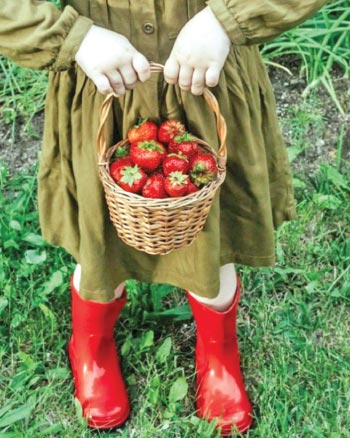 A sense of paternal affection, after all, demands expression. An emotional man cannot suppress feeling, just as a writer cannot suppress words. The weight of the unspoken becomes unbearable over time, and so it must find release�"somewhere, somehow, in ink or breath or quiet confession.
It began, quite simply, with a child’s desire.
For months now, my daughter had been asking for strawberries.
“Strawberries,” she would say with unwavering certainty, as though naming them alone might summon them into existence. She had seen them somewhere�"perhaps in a picture book carefully chosen in her early childhood, those brightly illustrated volumes meant to introduce children to fruits, flowers, fish, and forests. We had once thought it a noble act, to acquaint her with the wider world through color and imagination.
We did not know then that imagination, once awakened, becomes expectation.
And expectation, once formed, does not easily dissolve.
It was summer.
The kind of summer that turns the air thick and heavy, that makes even ordinary fruit feel like a distant memory of a colder land. And yet, in the mind of a child, seasons are irrelevant. Desire does not consult climate.
“Strawberries,” she repeated again and again, with the calm persistence of someone stating a natural law.
At first, I smiled. Then I promised to look. Then I began to search.
What followed was a quiet pilgrimage through the city.
I walked through narrow lanes where fruit vendors sat under fading umbrellas, their stalls overflowing with mangoes, bananas, guavas�"everything except what I sought. I asked in shop after shop, repeating the word like a spell: strawberries.
Some shook their heads before I finished speaking. Others laughed softly, not unkindly, as if I had asked for snow in August.
I expanded my search. I called acquaintances in nearby towns. I made inquiries that felt increasingly absurd with each repetition. It was as though I were chasing a rumor, or attempting to retrieve something that had never belonged to this climate in the first place.
Days passed.
The word itself began to feel foreign in my mouth�"strawberry, strawberry�"as if it belonged to another geography, another life.
At times, I thought of giving up. I told myself a child forgets quickly, that desire is fluid at that age. But each evening she would return with the same question, gently persistent:
“Did you find it?”
And I would answer, “Not yet,” though the “yet” was beginning to feel dishonest.
Finally, through one of my students, a faint possibility emerged. A store in Dhaka�"Unimart�"had them, imported, rare, almost ceremonial in their availability. I called immediately.
“Yes,” came the voice on the other end, casual, almost indifferent. “We have strawberries.”
There was a pause.
Then the price was spoken.
Five thousand nine hundred and ninety-five taka per kilogram.
For a moment, I did not respond. It felt less like a price and more like a judgment.
I looked at the world around me�"the small calculations that make up a household, the invisible arithmetic of responsibility�"and then I thought of my daughter’s face when she said the word “strawberry.”
So I compromised.
One hundred grams.
A small box of six pieces. Enough, I told myself. Enough for joy.
The order was placed.
But even in the act of ordering, reality does not remain simple. There were courier charges. Transport costs. Small additions that accumulate like quiet guilt. The numbers grew legs of their own: 629.48 taka for the fruit, 115 for delivery, 50 for transport, 20 for incidental expenses that no one bothers to define clearly.
All for six strawberries.
I remember waiting for them as one waits for something more significant than fruit. There is a peculiar dignity in anticipation�"it elevates even the most ordinary object into symbolism. These were no longer strawberries. They were expectation, longing, promise, and compromise, all folded into a small plastic box in transit.
When the parcel finally arrived, it was almost unremarkable.
A modest package. No grandeur. No ceremony.
And yet, when I opened it, the six strawberries sat there like small red witnesses to everything I had done to bring them home.
My daughter stood beside me.
Her eyes widened�"not with surprise, but with recognition, as if she had always known they would arrive, as if the world had simply taken its time obeying her wish.
She counted them carefully.
One. Two. Three. Four. Five. Six.
Then she smiled.
It was a small smile, uncomplicated and absolute�"the kind of smile that does not understand economics or geography or scarcity. A smile that belongs entirely to the present moment.
She picked one up as if it were something delicate and rare, which, in that moment, it was.
Behind her, I could hear her mother’s silence. That particular silence that carries its own commentary, its own unspoken arithmetic. It said everything without needing words.
Later, I sat alone for a while.
I thought about what I had actually bought.
Was it fruit?
Was it effort?
Was it the illusion of fulfillment?
Or was it something else entirely�"an act of translation, converting love into something tangible enough to be held in a child’s hand?
Six strawberries.
105 grams.
A few hundred taka of fruit and freight and friction.
And yet none of those numbers felt accurate.
Because what, after all, is the price of a moment when a child believes the world has answered her?
Or the cost of a father deciding that it must?
Loading...
Loading...



Editor : Iqbal Sobhan Chowdhury
Published by the Editor on behalf of the Observer Ltd. from Globe Printers, 24/A, New Eskaton Road, Ramna, Dhaka.
Editorial, News and Commercial Offices : Aziz Bhaban (2nd floor), 93, Motijheel C/A, Dhaka-1000.
Phone: PABX- 41053001-06; Advertisement: 41053012; 01793317829, 01550707291, E-mail: [email protected], [email protected] Online: email: [email protected] 41053014; 01550707297 Advertisement: 01550707296
Published by the Editor on behalf of the Observer Ltd. from Globe Printers, 24/A, New Eskaton Road, Ramna, Dhaka.
Editorial, News and Commercial Offices : Aziz Bhaban (2nd floor), 93, Motijheel C/A, Dhaka-1000.
Phone: PABX- 41053001-06; Advertisement: 41053012; 01793317829, 01550707291, E-mail: [email protected], [email protected] Online: email: [email protected] 41053014; 01550707297 Advertisement: 01550707296


