



| HEADLINE |

|
World Refugee Day Today
No respite in rise of refugee numbers globally
Published : Saturday, 20 June, 2026 at 12:00 AM
Staff Correspondent


 World Refugee Day is being observed today, June 20, across the globe, including Bangladesh, highlighting the rights, protection and humanitarian needs of forcibly displaced populations.
The day was first observed globally on June 20, 2001, marking the 50th anniversary of the 1951 Convention Relating to the Status of Refugees. The United Nations General Assembly, through Resolution 5576 adopted on December 4, 2000, formally designated June 20 as World Refugee Day. The day was previously observed in some regions as African Refugee Day.
This year’s theme, “Until Everyone Is Safe”, is being promoted alongside the United Nations High Commissioner for Refugees (UNHCR)’s campaign message “The right to seek safety was made for you and me. Until everyone is safe, we show up.” The observance is taking place ahead of the 75th anniversary of the 1951 Geneva Convention in 2026.
Refugee Week 2026 is also being marked with the co-theme “Courage”, which, according to organisers, reflects the lived experiences of displaced people. It highlights the resilience of individuals forced to rebuild their lives amid conflict, persecution and uncertainty, as well as the role of host communities providing shelter.
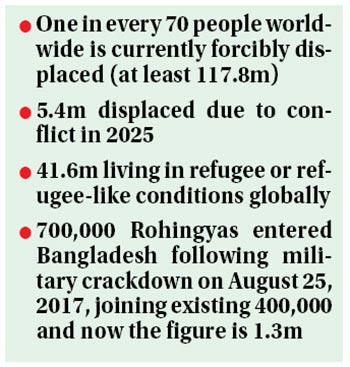
According to the UNHCR, one in every 70 people worldwide is currently forcibly displaced, amounting to at least 117.8 million individuals.
The agency further reported that in 2025 alone, 5.4 million people were displaced due to conflict and persecution, bringing the total number of people living in refugee or refugee-like conditions to 41.6 million globally, including approximately six million Palestinian refugees.
UNHCR data also indicates that around 415,200 refugees and internally displaced persons in Myanmar have returned to their places of origin. However, the report does not specify whether those returning include Rohingya refugees or other displaced groups.
World Refugee Day is observed with two core objectives- to highlight the rights and urgent needs of refugees and displaced populations, and to strengthen global awareness of the responsibilities of states and societies in ensuring protection, dignity and assistance for those who have lost their homes.
Bangladesh continues to host a significant Rohingya refugee population. More than 700,000 Rohingyas entered the country following the military crackdown in Myanmar on August 25, 2017, joining an already existing population of approximately 400,000. The total Rohingya population in Bangladesh is now estimated at around 1.3 million.
Despite multiple diplomatic and bilateral initiatives, no Rohingya repatriation has yet taken place. The displaced community continues to express uncertainty over their future return to Myanmar, demanding citizenship guarantees, security assurances and freedom of movement.
Analysts say the repatriation process has been delayed due to a combination of political, diplomatic and geopolitical factors, including Myanmar’s reluctance and competing strategic interests among regional actors. Some ASEAN countries, along with China and India, are perceived to prioritise broader political and economic considerations in relation to Myanmar.
Diplomatic sources also note that divisions within the United Nations Security Council, particularly the use of veto power by permanent members, have constrained international enforcement mechanisms. Despite sustained international pressure, repatriation efforts have repeatedly stalled, even after several proposed timelines.
Loading...
Loading...
Also read



Editor : Iqbal Sobhan Chowdhury
Published by the Editor on behalf of the Observer Ltd. from Globe Printers, 24/A, New Eskaton Road, Ramna, Dhaka.
Editorial, News and Commercial Offices : Aziz Bhaban (2nd floor), 93, Motijheel C/A, Dhaka-1000.
Phone: PABX- 41053001-06; Advertisement: 41053012; 01793317829, 01550707291, E-mail: [email protected], [email protected] Online: email: [email protected] 41053014; 01550707297 Advertisement: 01550707296
Published by the Editor on behalf of the Observer Ltd. from Globe Printers, 24/A, New Eskaton Road, Ramna, Dhaka.
Editorial, News and Commercial Offices : Aziz Bhaban (2nd floor), 93, Motijheel C/A, Dhaka-1000.
Phone: PABX- 41053001-06; Advertisement: 41053012; 01793317829, 01550707291, E-mail: [email protected], [email protected] Online: email: [email protected] 41053014; 01550707297 Advertisement: 01550707296


