



| HEADLINE |

|

School-hour congestion exposes planning failures



 Every school day, roads around some of Dhaka’s busiest educational institutions descend into gridlock as hundreds of private vehicles converge to drop off and collect students, exposing a transport crisis that experts say stems from years of poor planning, weak enforcement and the failure to establish an effective school bus system.
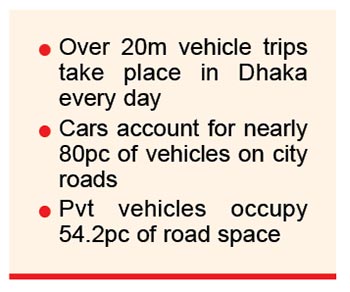
According to the Detailed Area Plan and the Revised Strategic Transport Plan, around 20 million vehicle trips take place in Dhaka every day. Nearly 80 per cent of vehicles are private cars, occupying 54.2 per cent of road space. Experts estimate that about one-fifth of the city’s congestion is linked to school travel.
Professor Hadiuzzaman of Bangladesh University of Engineering and Technology (BUET) said, “17 to 18 per cent of the total trips in Dhaka are related to travel to school or educational institutions.”
The impact is most visible around major schools during opening and closing hours. Field observations show that private vehicles frequently occupy multiple lanes while waiting for students, causing severe traffic disruptions. Traffic police enforcement remains limited, while school authorities rarely take proactive measures.
The situation is particularly acute around Wills Little Flower School in Kakrail, where a four-lane road is often overwhelmed by private cars, with congestion spreading to nearby roads. Similar scenes unfold around Motijheel Ideal School and College. Parents begin arriving long before classes end, occupying two to three lanes, while at closing time vehicles line the entire road, creating congestion that extends to Motijheel and Kamalapur.
The problem is compounded by socio-economic disparities and weak enforcement. English-medium schools often attract expensive private vehicles linked to influential families, and there are allegations that many of these vehicles are not subjected to regular checks. In many cases, cars remain parked on public roads after dropping students off, effectively turning public infrastructure into private parking spaces.
Advocate Md Gias Uddin proposed stricter measures to curb the problem.
"A private car takes up 12 feet of space while carrying only one or two passengers. Therefore, an odd-even number plate system should be introduced, and it should be mandatory to carry full passenger capacity. Additionally, registration of more than one car within a single family should be cancelled. The problem will be solved to a great extent," he said.
Authorities have attempted to address the issue for more than a decade, but implementation has remained weak.
In November 2009, the Ministry of Education reached an agreement with school authorities to introduce institutional bus services. The initiative, however, never moved forward. In January 2010, BRTC launched a pilot project with 14 buses on the Pallabi-Azimpur route. Then chairman Major (retd) MM Iqbal had said that another 100 buses would be added if the programme succeeded.
Today, only three school buses remain operational in Dhaka, while six other services were discontinued in 2018.
Subsequent efforts, including a 2015 government directive and a Dhaka North City Corporation pilot project in 2022 targeting English-medium schools, also failed to gain momentum. An eight-member committee formed by the Secondary and Higher Education Division on September 12, 2022, to rationalise student transport has yet to produce visible results.
The newly elected government has also expressed concern over the issue. Prime Minister Tarique Rahman has directed the education ministry to find solutions, prompting trials of hybrid education models combining online and physical classes to reduce vehicle movements and fuel consumption.
While such measures may provide temporary relief, concerns remain over excessive internet dependency among students, similar to what was observed during the coronavirus pandemic.
Meanwhile, experts point to Chattogram as an example of a workable alternative. The district administration there operates ten double-decker buses for government school students, equipped with GPS tracking, IP cameras and AI-based monitoring. Guardians receive automated notifications when students board and leave buses, while smart cards, cashless payments and a centralised database improve efficiency. Despite its success, the model has not been replicated effectively in Dhaka.
Commuter Rokibul Islam Shanto said dedicated school transport services could significantly reduce congestion.
"Pick and drop arrangements should be made with good quality coaster buses. Private cars should be restricted from going to school, and school bus services should be introduced by the government. Like American school buses, a Section 144 type policy with security measures could be enforced wherever such buses operate. This would significantly reduce congestion," he said.
Experts argue that the roots of the problem lie in flawed urban planning. Professor Dr Shamsul Haque of BUET criticised RAJUK for approving educational institutions along major roads.
"Schools and colleges in the capital were approved and built along main roads despite knowing they would create congestion. There was no proper planning," he said.
He added, "Globally, educational institutions are located within residential areas so students can walk to school, but our planners ignored this principle, creating a lasting problem."
Experts say that without stricter enforcement of transport regulations, wider introduction of school bus services, restrictions on private cars around educational institutions and better urban planning, school-time congestion will continue to worsen, placing additional pressure on Dhaka's already overburdened road network.

Loading...
Loading...
Also read



Editor : Iqbal Sobhan Chowdhury
Published by the Editor on behalf of the Observer Ltd. from Globe Printers, 24/A, New Eskaton Road, Ramna, Dhaka.
Editorial, News and Commercial Offices : Aziz Bhaban (2nd floor), 93, Motijheel C/A, Dhaka-1000.
Phone: PABX- 41053001-06; Advertisement: 41053012; 01793317829, 01550707291, E-mail: [email protected], [email protected] Online: email: [email protected] 41053014; 01550707297 Advertisement: 01550707296
Published by the Editor on behalf of the Observer Ltd. from Globe Printers, 24/A, New Eskaton Road, Ramna, Dhaka.
Editorial, News and Commercial Offices : Aziz Bhaban (2nd floor), 93, Motijheel C/A, Dhaka-1000.
Phone: PABX- 41053001-06; Advertisement: 41053012; 01793317829, 01550707291, E-mail: [email protected], [email protected] Online: email: [email protected] 41053014; 01550707297 Advertisement: 01550707296


