



| HEADLINE |

|

Govt to revamp public finance to cut debt pressure: Amir Khosru
Published : Sunday, 21 June, 2026 at 2:49 PM
Observer Online Report


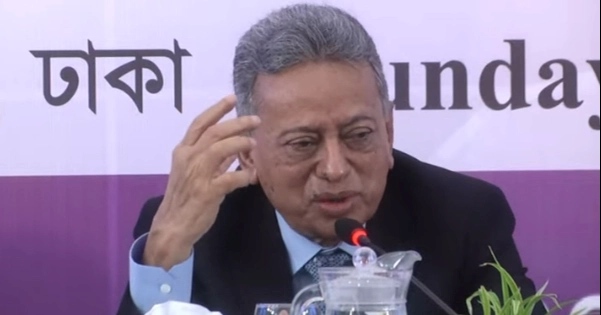
Finance Minister Amir Khosru Mahmud Chowdhury said on Sunday that the government will restructure its public finance architecture to finance the proposed FY2026-27 budget while reducing pressure on the country’s debt burden.
“We cannot keep looking towards the World Bank, International Monetary Fund (IMF) and Asian Development Bank (ADB). We need to restructure our own public financing,” he said while speaking at the “CPD Budget Dialogue 2026” organised by the Centre for Policy Dialogue (CPD) at a hotel in the capital.
The minister said the government is working to develop alternative financing channels and will introduce market-based financing mechanisms for budget funding.
He noted that the gap between multilateral financing rates and market interest rates is narrowing, making borrowing costs considerably higher and leaving little option but to rely on market-based instruments.
Announcing a phased withdrawal from local bank borrowing, Amir Khosru said local banks are charging 12 to 14 per cent interest, a burden that even the private sector struggles to bear.
“It is simply not feasible for the government to sustain such borrowing costs,” he said.
On broader economic challenges, he highlighted that the Middle East labour market, worth $4 billion, is facing headwinds, and that the government inherited hundreds of crores of taka in outstanding bills across every sector upon taking office.
The minister also noted the government got only one and a half months to prepare a budget that normally takes six months.
He said the government inherited 1,300 projects from the previous administration, many conceived to serve personal interests, and that a number of schemes have since been cancelled or repurposed. Projects that were 80 per cent complete were being finished despite uncertain returns.
To ensure accountability, Amir Khosru announced that an ADP dashboard will go live in the first week of July, allowing real-time tracking of project progress and implementation status.
On trade facilitation, he said Bangladesh will gradually move away from the letter of credit (LC) system towards direct payment mechanisms for import-export, in line with global practice, allowing credible businesses to trade internationally without opening LCs.
About education, the minister said the allocation will be raised to 5 per cent of the ADP by the end of the government's current term, up from the current 2 per cent.
He stressed that vocational training will receive the strongest emphasis this year, citing China's model, where 60 per cent of students pursue vocational education after secondary school. “Bangladesh's certificates hold little value in the job market because skills are absent. Vocational training is how we bridge that gap.”
On health, Khosru said the government is working towards establishing universal healthcare, with preventive healthcare as the first priority.
Addressing questions over the Family Card programme, he said 72,000 people have already received cards under a pilot project, which he described as the largest social protection initiative in Bangladesh's history.
The minister said the selection process has been deliberately kept free of political interference, with a new formula developed to ensure fairness at both local and central levels.
He acknowledged a roughly 1-1.5 per cent error rate and said the government is actively working to identify and resolve the causes.
Amir Khosru reaffirmed the government’s commitment to carrying out all necessary economic reforms during its tenure.

Loading...
Loading...
Also read






Editor : Iqbal Sobhan Chowdhury
Published by the Editor on behalf of the Observer Ltd. from Globe Printers, 24/A, New Eskaton Road, Ramna, Dhaka.
Editorial, News and Commercial Offices : Aziz Bhaban (2nd floor), 93, Motijheel C/A, Dhaka-1000.
Phone: PABX- 41053001-06; Advertisement: 41053012; 01793317829, 01550707291, E-mail: [email protected], [email protected] Online: email: [email protected] 41053014; 01550707297 Advertisement: 01550707296
Published by the Editor on behalf of the Observer Ltd. from Globe Printers, 24/A, New Eskaton Road, Ramna, Dhaka.
Editorial, News and Commercial Offices : Aziz Bhaban (2nd floor), 93, Motijheel C/A, Dhaka-1000.
Phone: PABX- 41053001-06; Advertisement: 41053012; 01793317829, 01550707291, E-mail: [email protected], [email protected] Online: email: [email protected] 41053014; 01550707297 Advertisement: 01550707296


